
Listen to the full episode on Spotify, Apple, Google, Amazon, or wherever you get your podcasts.
Hey! Hey! Hey! Welcome everyone! Thanks for joining us! I am so glad you are here listening!
Last week, we talked about Sunzi’s Five Strategic Success Factors, the fourth of which was general leadership. Today, we are going to focus on these five essential leadership attributes and a couple of simple actions to help us develop them.
So let’s go!
The Five Essential Attributes for General Leadership
In last week’s episode, we talked about how the Way, or Dao, is the Way of leadership. It is the vision a leader has at the crossroads of choice to take action. Sunzi lists five essential attributes for generals. They are: wisdom, trust, empathy, courage, and disciplined determination. These are equally applicable as general leadership attributes outside of a military context.
Wisdom
The first essential general leadership attribute that Sunzi lists is wisdom. Dan Millman said: “Wisdom is the use of knowledge.” Interestingly, there is a similarly close connection in Chinese between wisdom and knowledge. The etymology of the Chinese character for knowledge comes out of the archery tradition. It depicts an arrow next to a mouth. In ancient China, archery was used both for hunting and warfare. It was an essential skill to protect and provide and is a difficult art to master, requiring a lot of practice and instruction.
I can imagine the novice archer shooting volley after volley at the target with some success but not satisfied with their results and then the master archer coming over and whispering something in the novice’s ear with their arrow nocked ready to release and then suddenly in a flash of understanding it clicks and the archer can now hit the bullseye more consistently. See, knowledge, applied knowledge is power.
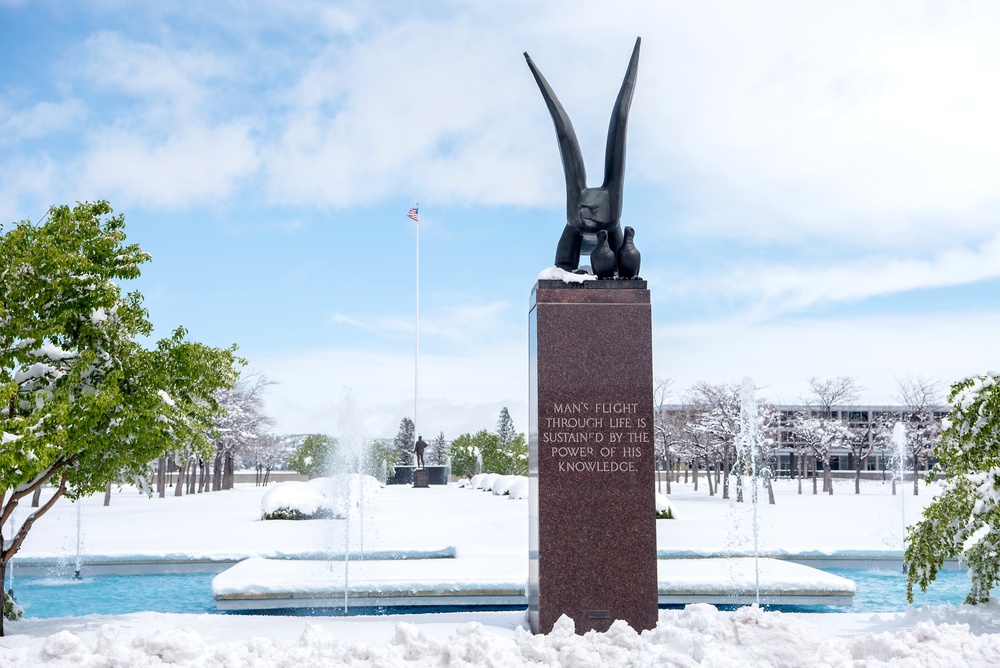
I’ve mentioned in previous episodes that I’ve taught at the U.S. Air Force Academy for 15 years now. The heart of the Cadet Area is the Terrazzo, which was designed by landscape architect Dan Kiley. The name comes from the walkway’s terrazzo tiles that are set among a checkerboard of geometric marble strips forming a square around the grassy knoll known as “Spirit Hill,” with a historic plane standing as a sentinel in each corner. On the east side of the Terrazzo lies the Air Gardens, boasting two reflecting pools and fountains. On the south side of the Air Gardens is the famous Eagle and Fledgling Statue. I passed by it just this morning. The inscription by Lt. Col. Austin “Dusty” Miller, USAF (1914-2006) reads: “Man’s flight through life is sustained by the power of his knowledge.” Each of us, man or woman, is sustained by the power of our knowledge – and more specifically by the knowledge we master and learn to apply in our flight through life.
Interestingly, the Chinese character for wisdom contains the character for knowledge within it and adds to it noteworthy speech and a set of calipers for measuring. If knowledge is the arrow of the mouth, or the ability to utilize what we know to protect and provide, wisdom, is both the ability to articulate what we know and share necessary information with others in a timely, learning-focused manner and the ability to internalize and act on the information being shared by others – what others know – and apply in our own lives. Wisdom is the ability to apply knowledge to gauge where we are in relation to our target, our goal, or our desired outcome.
The general doesn’t have to be the smartest person in the room and neither do we. In fact, if we are, we may want to find a better room. No, just need to be able to share what we know in accessible ways and apply what others know. In other words, while it is true that all of us no more than we apply – increasing wisdom is closing that gap.
All this talk of wisdom, knowledge, and arrows has got me thinking of the Avenger Hawkeye. I have always related to him because he has no superpowers and yet, he has an arrow for every occasion and can make the shot. As we increase our wisdom, we load our quiver with knowledge we can apply in any situation.
So how do we increase our wisdom? We can start by reflecting on these questions to determine where we are and where we can improve. How well do I articulate what I know so that others clearly understand? How well do I apply and help others apply knowledge? How well do I let others share what they know? How well do I apply others’ knowledge as a tool to help myself and others?
Wisdom has two skills then. The ability to share what we know and make it accessible, applicable, and actionable for others. The better we do that, the more we empower others. The second skill is the ability to leverage the landscape, the intellectual landscape in this case, to apply what other people know, the knowledge that they have to our own lives, so that we can stand on the shoulders of giants and don’t have to reinvent the wheel.
Here are two simple actions to try this week to increase our wisdom. First, when sharing what we know, focus on what people are hearing instead of on what we are saying or teaching. What are people picking up? Are they getting the right message? Do they understand what I am offering? Second, on the flip side, create an environment that encourages people to share what they know. Get curious about people’s passions and expertise. Ask lots of questions. Then find ways to apply their knowledge and insights. As we do, we will find that our quivers will be fully loaded with the arrows of applied knowledge.
Trust
The second essential attribute of general leadership listed by Sunzi is trust or trustworthiness. It’s etymology in Chinese is simple and straightforward. Trust 信 is composed of a standing person 亻 next to speech 言 or literally, to stand 立 (inverted) by the words of our mouths 口. Trust, then is the integrity to have our actions reliably match our words in transparency and honesty.
Some people say that trust is earned. Others hold that trust is given. I’m going to be honest here and admit that I have not always been the most trusting or trustworthy person. This one is one of the hardest ones for me. See, I grew up as a people pleaser, so I would say a lot of things in the moment to appease people that I did not follow through on. I made promises, I didn’t keep. I offered things, I couldn’t give. This hurt my integrity. As I dug deeper into this issue, I discovered that at the heart of it all was a lack of self-trust.
I thought that I did not trust myself because I had made and broken so many personal promises over the years. As I peeled back the layers and got to the pith of the problem, I discovered that
As German poet, playwright, novelist, scientist, and statesman Johann Wolfgang von Goethe (1749-1832) has stated: “As soon as you trust yourself, you will know how to live.” Because I didn’t trust myself, I didn’t know how to live and I had a hard time trusting others. I couldn’t give something to others that I wasn’t giving to myself. So, in the words of Nepalese poet Santosh Kalwar: “Trust yourself, you will start to trust others.”
What can we do to increase our trustworthiness and be more trusting? We can begin by reflecting on where we are, then work to improve, and reveal and resolve issues that come up that affect our trustworthiness and our ability or willingness to trust others. How well do my actions reflect my words? Do I do what I say I will? Is my word my bond? Do I stand by what I say? Do I say what I mean? Some say trust is earned, others say that it a gift. How can I both earn and give the gift of trust to others?
Lewis Cass (1782-1866) said: “People may doubt what you say, but they will believe what you do.” So stand by what we say. Our word is our bond. People believe behavior. Be honest with ourselves and others. Give others the gift of trust and the opportunity to stand by what they say. Most importantly, begin with leveling up our self-trust. As Ralph Waldo Emerson (1803-1882) wrote: “Self-trust is the essence of heroism.” So “Trust thyself, for every heart vibrates to that iron string.” Forgive ourselves for our past mistakes. Give ourselves a second chance, a clean slate, a fresh start – because each of us is worthy of our own trust. Each of us deserves to stand by ourselves – to be our own greatest advocate, not just our greatest critic.
Empathy
The third essential characteristic for general leadership mentioned by Sunzi is what I call empathy. It is also more regularly translated as benevolence, humaneness, or co-humanity. The character for empathy 仁 is composed of a standing person 亻 next to the number two 二. Empathy, then, is the ability to relate to the experiences and emotions of those around us through our shared humanity. It is the cornerstone of interpersonal emotional intelligence.
Brene Brown has stated: “Empathy doesn’t require that we have the exact same experiences as the person sharing their story with us…Empathy is connecting with the emotion that someone is experiencing, not the event or the circumstance.” When I see someone struggling do I get in touch with the times in my own life that I have struggled with similar feelings and thoughts? Do I look upon others as people with passions and pain, dreams and doubts? Returning to Brene Brown: “Empathy has no script. There is no right way or wrong way to do it. It’s simply listening, holding space, withholding judgment, emotionally connecting, and communicating that incredibly healing message of ‘you’re not alone.’” Leaders who do that connect with and gain the fierce loyalty and devotion of those they serve.
How do we develop empathy? Start by looking at others as whole beings with strengths and weaknesses, struggles and successes. When others are struggling, we can choose to get in touch with our own humanity to connect with them through the power of empathy. As Oprah Winfrey aptly put it: “Leadership is about empathy. It is about having the ability to relate to and connect with people for the purpose of inspiring and empowering their lives.”
Courage
The fourth of Sunzi’s five essential attributes for general leadership is courage or bravery. Courage is the ability to act boldly and bravely in pursuit of what we want and inspire others to join us in the fight. In Chinese, courage 勇 is the strength 力 to get to work, to find or make a way, plough a field, haul buckets, or build a pipeline for ourselves and others. Courage reverberates and resonates like the clarion call of a bell 甬.
For much of my life, I was a coward – paralyzed by my internal fears and doubts. Fears and doubts, that as I mentioned in Episode 0, pretended to useful and helpful – protecting me – but they weren’t. They did not serve me at all. See, as rapper, actor, and motivational speaker Wil Smith has said: “Fear is not real. The only place that fear can exist is in our thoughts of the future. It is a product of our imagination, causing us to fear things that do not at present and may not ever exist. That is near insanity.” That was my inner life.
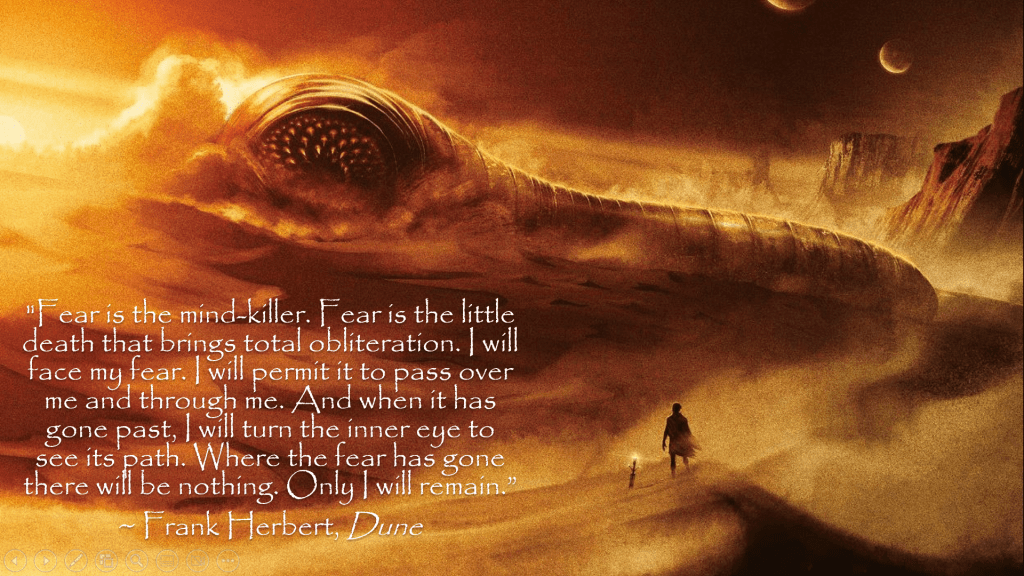
What do I use my might and strength for? Does it serve only myself or does it extend to others? This returns us to our soul yearning, our “Big Deal,” our “Grand Endeavor.” What am I willing to fight for, to work for? Without courage, fear takes over in our lives. My favorite quote on fear comes from Frank Herbert’s (1920-1986) epic novel Dune: “Fear is the mind-killer. Fear is the little-death that brings total obliteration. I will face my fear. I will permit it to pass over me and through me. And when it has gone past I will turn the inner eye to see its path. Where the fear has gone there will be nothing. Only I will remain.”
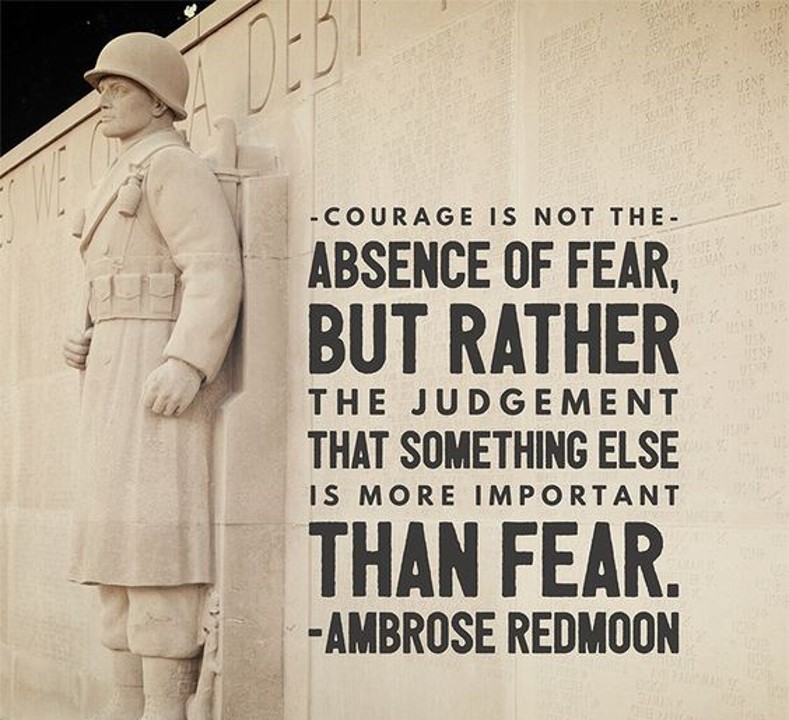
How do we develop courage? We can use our strengths to bravely find or make a way forward for ourselves and others. Let our courage to face our fears and get out there and work inspire others to action. Do something we have been afraid to do. As we face our fears with courage, we give others permission to do likewise. See, in the words of Ambrose Redmoon (1933-1996): “Courage is not the absence of fear, but rather the judgment that something else is more important than fear.” So, what is more important to us than our fears? What is it that emboldens and empowers us to face our fears?
Disciplined Determination
The last of Sunzi’s five essential characteristics for general leadership is what I call disciplined determination. Abraham Lincoln (1809-1865) said: “Discipline is choosing between what you want now and what you want most.” The Chinese word here means strict, severe, serious, and disciplined. It also means respect. The character is comprised of two mouths above dangerous cliffs overhanging the character for boldness or daring. determination, perseverance, grit. It is the ability to persevere and the grit to not give up in the face of criticisms and setbacks.
When things get serious, severe, & hard, when we are facing overhanging cliffs of challenge 厂 and people are mocking and doubting 吅, saying we aren’t going to make it, discipline is the daring determination 敢, the grit to claw and climb and work our way up with any tools 攵 we have for as long as it takes to reach the top.

The greatest example of this to me comes from American rock climber Chris Sharma. He’s arguably the greatest rock climber the world has ever known. One of the most outrageous and amazing rock climbs ever filmed was when he climbed up the underside of this freestanding limestone arch known as Es Pontas, off the coast of Mallorca. Es Pontas, known as “The Bridge,” is considered to be one of the hardest climbs in the world. If you fall, you plummet straight into the water forty feet below. Climbing ropeless above the Mediterranean Sea, Sharma spent months attempting to make this climb, but he kept getting stuck at this 7-foot dyno. He splashed down at least fifty times, dropping into the ocean below. He had to swim back to shore, dry himself off, swap out his gear, and try again. Finally, after falling fifty times, he stuck it! But that wasn’t the end. Climbing further up, he fell many more times than that, at the even harder lip of the arch. After over a hundred falls plummeting into the ocean, he finally made the first ascent in September of 2006. That is grit. That is disciplined determination!
I love Angela Duckworth’s concept of grit, which she defines as the power of passion and perseverance. She challenges us with this great series of questions: “How often do people start down a path and then give up on it entirely? How many treadmills, exercise bikes, and weight sets are at this very moment gathering dust in basements across the country? How many kids go out for a sport and then quit even before the season is over? How many of us vow to knit sweaters for all of our friends but only manage half a sleeve before putting down the needles? Ditto for home vegetable gardens, compost bins, and diets. How many of us start something new, full of excitement and good intentions, and then give up—permanently—when we encounter the first real obstacle, the first long plateau in progress? Many of us, it seems, quit what we start far too early and far too often. Even more than the effort a gritty person puts in on a single day, what matters is that they wake up the next day, and the next, ready to get on that treadmill and keep going.”
In what areas of my life can I practice more daring determination instead of shrinking before the voices of my (inner) critics? This brings us back to last week’s idea of attacking those antagonistic voices inside ourselves and adopting an atmosphere of awesome accomplishment and achievement where we expect to do whatever it takes to win and will adjust our approach to ensure that instead of allowing an atmosphere of anxiety and apathy determine the results that are available to us. Each of us can choose an area of our lives to practice more disciplined determination in. As we do so, it will get easier.
Stop for a moment and think what our lives would look like if we leveled up our leadership in these five areas. What problems would we be able to solve and solutions would we be able to provide with our quivers full of the wisdom of more applied knowledge? What would our relationships look like with greater trust and empathy for each other? If we stood by our words and engaged with those around us from the place of our own humanity? What seeds could we sow, what risks could we take in our lives and how could we better inspire others out there with the clarion call of greater courage to stare down the illusion of our fears and push through them to the other side? What mountains could we climb if we had greater disciplined determination to ignore and not be dissuaded by the absurd objections of naysayers and doubters that would see us crushed against the cliffs of criticism?
Questions or comments? Feel free to shoot me an email at: artofwarforlife@gmail.com.
Episode soundtrack by Sentius

 Warrior: The Art of War for Life - A Podcast on Winning
11 Comments