
Introduction
Hey! Hey! Hey! Welcome everyone! Thanks for joining us! I am so glad you are here listening! I want to take a moment to personally invite you connect with me. If you are listening to this episode, I want to hear from you! It’s been a month since we launched and I would love to get some feedback on what you like about the podcast, what is working and what isn’t, what you want to hear more about, and what I can do better to help you start winning your daily battles. I’d also love to hear what challenges you are looking to overcome, what you are looking to create, and what your “Big Deals” are. So please shoot me an email at artofwarforlife@gmail.com or send me a DM on Instagram @artofwarforlife, and join the Art of War for Life Facebook page. When you do, I will send you a free copy of the Sunzi Battle Planner I developed, which is a great resource to walk you through getting clear on your “Big Deal,” getting in touch with your why, working through Sunzi’s Five Strategic Success Factors, and how to level up our leadership with Sunzi’s Five Essential Attributes of great leaders.
Last week, we talked about Sunzi’s Five Essential Attributes for General Leadership and how to level them up! As I mentioned a few weeks ago, next week, we are going to talk about Sunzi’s Six Traps of (Self)-Deception. Today, we are going to discuss Sunzi’s “Four Keys to tip the scales of life and shift the balance of power in our favor.”
So let’s go!
Sunzi’s 4 Keys to Tip the Scales of Life and Shift the Balance of Power in Our Favor
Have you ever had an inspiring win? Or the feeling of just totally crushing it in life? Have you ever felt so on top of your game that you were filled with absolute confidence and just knew that everything was going to work out great?! Like you were so “on” or in the zone that you just couldn’t miss? That’s an amazing feeling! On the flip side, have you ever just felt “off,” like things were just misaligned – that you just couldn’t get into a groove? That no matter how hard or what you tried, that something was missing? Or worse, that the deck was stacked against you, that you were destined to just take the “L” and that the odds are never in your favor? I have been there so many times! Wouldn’t it be life-changing if we could tip the scales and shift the balance of power in all areas our lives so that could have more of the former feelings and less of the latter?
In Chapter 1, verse 5 of Sunzi’s Art of War, we read:
“The benefits of strategic planning come from listening, then turning what you hear into tactical advantages that can assist you out in the field. Tactical advantages are utilizing potential benefits to control the balance of power.”
From this passage, I’ve derived four key actions for dominating our daily battles, which form the acronym LISTEN, which stands for Listen (& Learn), Strategize, Transform into Tactics, and Engage.

If you haven’t realized it by now, I love acronyms because they are easy to remember and help to focus my thinking. That, and in the military, we love our acronyms, so it is kind of ingrained in me now.
So how do we gain those benefits of strategic planning?
Key #1: LISTEN 聼
2,500 hundred years ago, Sunzi identified the art of listening as the first key action for unlocking the benefits of strategic planning. In Chinese, the character to listen or hear 聼 (Simplified: 听), which is pronounced ting1 in Mandarin, is literally regarded as the virtue of the ears. The oldest form of the character found in the Oracle Bones, which date back over 3,000 years, depicts an ear beside one or two mouths – or the ability to hear what others are saying.
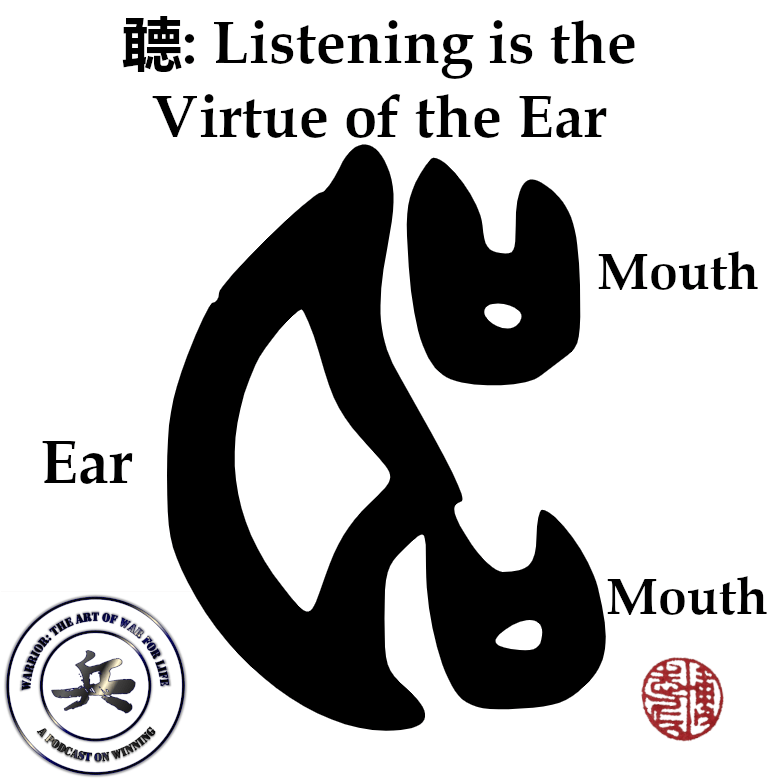
Someone once said: “Listening is a great way of receiving gifts of wisdom, intelligence, and inspiration, [if] we but only hear.” Last week we discussed what our lives would look like with a little more wisdom, one of the five essential leadership attributes that Sunzi lists. The art of listening is essential to leveling up our wisdom and yet far too often we let ourselves get distracted and our own inner voice of wisdom gets covered up in the cacophony of culture.
In today’s “digital age” we are constantly bombarded with information. At the end of 2020, the digital world was composed of 44 zettabytes, which is 44 trillion gigabytes of information – and that astounding number is growing exponentially! It is estimated that by 2025, there will be over 200 zettabytes of information in the cloud! We now carry more information in our pockets than entire ancient civilizations had at their disposal – but are we any better for it?
According to the Harvard Business Review, “the surging volume of available information—and its interruption of people’s work – can adversely affect not only personal well-being but also decision making, innovation, and productivity.”[1]
If knowledge is the arrow, as we discussed last week, with so much information at our disposal, who should we listen to?
Our Hearts
In order to re-center our lives from the constant pull of information overload and recover our inner voice of wisdom so that we can hit the targets in our lives with the arrows of applied knowledge, we need to first listen to our hearts and get back in touch with ourselves. As Carly Fiorina, the first female CEO of a Fortune 20 company, now turned politician, has said: “You have to master not only the art of listening to your head, you must also master listening to your heart and listening to your gut.”
What do our hearts tell us? This brings us back to our soul yearnings and to our “Big Deal.” What is it that we really want? What is the most important thing to us in our lives right now? And, as we discussed last week, why. Because our Why is our Way forward!
Letting go of all the negative names, all the limiting labels, all the belittling beliefs, all of the parasitic practices, and embracing the infinite possibilities available to us in this moment, what is it that we want to believe about ourselves, about each other, and about the world? What do we want to believe is possible? Start there.
Inner Circle
Next, listen to our people. Once, we have spent some time really getting in touch with ourselves, then we go to our inner circle, our support network, our trusted cohort – those who have our backs, love us unconditionally, and want to see us succeed and thrive in our lives and listen to what they have to say, and we share with them what we have learned in listening to our hearts.
American Psychiatrist Karl A. Menninger (1893-1990) said: “Listening is a magnetic and strange thing, a creative force. The friends who listen to us are the ones we move toward. When we are listened to, it creates us, makes us unfold, and expand.”
If we are stuck in the process, it is a great idea is to go these people first and ask them, “Hey what makes me unique? What would you say my strengths are? What are my talents?” Because sometimes, we are so boxed in that we can’t even see those things in ourselves, and we are blinded to the talents and abilities that we are already using and just don’t realize.
Outer Circle
Then, we go listen to those in our outer circle, to those we know, and sphere of influence and we ask them. What is your biggest challenge right now? What help do you need? What would you like to see happen? What would help?
Lastly, we listen to what is going on in the world around us. What are the trends and patterns. What do people need right now? What are they looking for? Who has achieved the outcomes and results I want in my life? What plans, strategies, and tactics did they use to get there? This is all about getting curious and collecting information. The better we listen, the more our strategic plans will benefit.
No matter how long it has been since we have listened to our hearts, we can begin, once again, to do so now and as we do, we will recover the voice of our inner wisdom.
Key #2: Strategize 計
The second key action that will tip the scales of life and shift the balance of power is to strategize. Interestingly, the Chinese character for strategic plans or planning 計 (Simplified: 计), pronounced ji4, is comprised of speech 言 and the number ten 十, which is a symbolic number implying completeness and perfection. This indicates the importance of hearing what a lot of people have to say. Once we have done that, it’s time to strategize – to develop some strategic plans.
When I was a little kid, I had a lot of plans for my life. I wanted to be an explorer, an archaeologist like Indiana Jones. I wanted to recover things that were lost in the sands of time, uncover things that were buried beneath the surface, and discover things that could change the world. I also wanted to be a Ninja. Go figure.
Somewhere along the way amidst the heartbreaks, setbacks, and disappointments, I stopped believing in myself, in my potential and in the infinite possibilities that lay ahead. As I did, I began to shelve those dreams and plans for my life, and to settle for less and less. It wasn’t so much a singular act, but rather a slow death of a thousand cuts. Like a favorite childhood book I once read multiple times each day that I took off the shelf and looked at less and less as I got older, my dreams and plans were largely pushed aside and crowded out by “reality” and relegated to the margins of memory, only to be recalled occasionally, to be reminisced of fondly, to be longed and pined for desperately, but rarely to actually be reached for, and acted upon.
There is an old adage, “If you fail to plan, you plan to fail.” For a long time, I didn’t have much of a strategic plan and I didn’t realize that I was setting myself up for failure by not having one.
I thought I had a plan but it was more like 12% of a plan, which according to the Guardians of the Galaxy is NOT a plan, and barely a concept.
Business strategist Ellie Pidot provides us with a great definition of strategy: “Strategy is a fancy word for coming up with a long-term plan and putting it into action.” That is the heart of strategic planning.
I don’t remember who said it but: “First we observe and then we serve.” We take all that information we recovered through listening to our hearts and gained by listening to our inner and outer circles, to those who have achieved what we want to create in our lives, to what is happening in the world, and then uncover the plans and identify strategic opportunities to set ourselves up for success in pursuing our “Big Deal,” serve others, solve problems, and provide solutions. We are purposeful beings on this planet with great gifts to give the world. How do we do that? By getting tactical!
Key #3. 勢: Get Tactical
The third key action for tipping the scales and shifting the balance of power in our favor on the battlefield of life is to get tactical. Once we have synthesized a general strategic plan of how to accomplish our “Big Deal” from everything we have learned through listening, it is time to get tactical, to transform those strategic observations and opportunities into tactical advantages that can help us out there in the real world.

There is a funny story I heard. “Two men formed a partnership. They built a small shed beside a busy road. They obtained a truck and drove it to a farmer’s field, where they purchased a truckload of melons for a dollar a melon. Then they drove the loaded truck to their shed by the road, where they sold their melons for a dollar a melon. They drove back to the farmer’s field and bought another truckload of melons for a dollar a melon. Transporting them to the roadside, they again sold them for a dollar a melon. As they drove back toward the farmer’s field to get another load, one partner said to the other, “We’re not making much money on this business, are we?” “No, we’re not,” his partner replied. “Do you think we need a bigger truck?”
While their strategy of selling melons along a busy roadside was sound, their tactics were ineffective. They did NOT need a bigger truck. A lot of times, the answer to our problems is NOT just to work harder, work longer hours, or do more of the same, but to find a transformational tactic that can tip the scales and shift the balance of power in our favor, thereby increasing our chances for success.
The Chinese word for tactical advantages 勢 (Simplified: 势) is pronounced shi4 in Mandarin. It can also mean power, potential, force, tendency. The character has a rich two-fold etymology, both stemming from agriculture. The character for shi4, or tactical advantages, is built upon the character 力 li4, meaning might or strength, at its base. It is a depiction of a plough beneath a person kneeling and holding a seedling or a crop start (埶).
The invention of the plough radically revolutionized agriculture in China, as it did throughout the world. The plough allowed ancient farmers who had previously been limited to digging and sowing seeds by hand, to harness a strength far greater than their own – that of horses, oxen, or other domesticated livestock. This in turn, gave farmers the potential to plant more fields in less time, which led to greater harvests, supporting larger populations. This was a total game-changer for humanity! One that changed the trajectory of civilization. Any farmer who had a plough was at a dramatic advantage over those who prepared fields through manual labor. Communities, cultures, and civilizations who developed the plough earlier than others likewise possessed a decided advantage over those that didn’t.

The top half of the character 埶 is a depiction of a person kneeling down, holding a seedling or crop start for planting, with all of the potential it contains within it to grow and provide an abundant harvest for years to come. See, a single plant carries within it more than enough seeds to repopulate. A stalk of rice grown from single grain of rice will produce about fifty additional grains of rice. A single sunflower can produce between 80 to 200 seeds, an average oak tree can produce about 10,000 acorns a season, and a single orchid plant will produce an estimated 4 million seeds a year! That is potential!
Just as the plough revolutionized agriculture, there are tactical advantages that allow us to harness a strength greater than our own, to increase our potential and efficiency, waiting to be discovered in every area of our lives. I call these advantages transformational tactics because these are game-changers. They open up new possibilities and opportunities. In economics, these would be a whole new market, a disruptive technology, or a groundbreaking approach that gives us access to things that were previously inaccessible. These bring new fields or endeavor into cultivation for us and allow us to serve and support more people in a greater capacity. These are broadening perspective changes and paradigm shifts that allow us to see what was previously invisible. Far from “miracle cures”, these are tactical tools we use to help tip the scales and the balance of power in our favor, so that we can work smarter and not just harder, which leads us to the last key action.
Key #4. 外: Engage – Get Out There
The fourth key action that Sunzi identifies is to engage, or literally to get out there! There is a recurring theme in Star Trek called the “Ready Room” scenario, where the Captain and the command officers get together and discuss the problem or difficulty they are facing. After listening to all of the information and perspectives available, they then decide on the best strategy for resolving the issue and the most effective tactics for making it happen, then it is time to move, to act. It was Captain Jean-Luc Picard, who popularized the command “Engage” whenever they set out to their far-off destinations with a strategic plan and tactical advantages in place.
The Chinese word here (外 wai4) refers to just that; to “getting out there” and implementing in the field. This is where all the listening and learning and all the general strategizing become boots on the ground, butt-kicking tactics that tip the balance of power in our favor and enable us take control out on the battlefields of life. Or, more peacefully, to sow the seeds and reap the harvest of the abundant life we are looking to create.
Conclusion
Whenever, we listen, listen to our hearts, and get in touch with what is really important to us, and to our why, listen to those who unconditionally love and support us, and who truly have our best interests in mind, we increase our wisdom, or our ability to achieve our goals and hit the bullseyes we are aiming for in our lives. As we take all that we have learned in that process and look for openings and opportunities to apply it, we will develop and synthesize strategic plans and transform them into tactics that tip the scale and shift the balance of power in our lives, opening up new possibilities and potential for growth and abundance. We don’t need a bigger truck! We only need to recover our inner voice of wisdom, uncover the plans and purpose of our lives that we have let get buried under the dirt and detritus of disappointment and distraction, and discover the transformational tactics that will change everything for us, that will tip the scales and shift the balance of power so that we can start winning in life again and more abundantly! So listen to our hearts this week! Then get out there and share! It’s time to engage!

 Warrior: The Art of War for Life - A Podcast on Winning
4 Comments