

Summary
Do you ever feel conflicted? Embattled? Like you are being pulled in too many directions? Do you ever go back and forth on decisions in your life? Like you are at war with yourself? Like even the victories take a toll? In Episode 17 of “Warrior: The Art of War for Life ~ A Podcast on Winning” I talk about three principles for achieving the most excellent personal victory in our lives. They are:
1. Preservation: Save All We Can & Avoid Collateral Damage
2. Permission: Give Ourselves a Break! Break Down, Breakthrough, & Break Out
3. Persistence: Wear Down & Wear Out Our Resistance – Not Ourselves
With inspiring quotes from Albert Schweitzer, John Sawhill, Billy Cox, Steven Furtick, Joyce Meyer, Germany Kent, and Anjali Chaturvedi, and thought-provoking discussions on achieving the ultimate personal victory in life — a mind freed of limiting labels, debilitating doubts, and belittling beliefs, healthy compartmentalization, how to stop doubting our empowering beliefs and believing our dubious doubts, and calling “BS” on our limiting “Belief Systems,” this episode is sure to inspire!
See if you can hear the little boisterous bird chirping in the background! :p
If you are a visual learner like me, check out the blog version of this podcast at http://www.artofwarforlife.com, which includes the Chinese characters I discuss along with additional images. Also, don’t forget to join the Art of War for Life Facebook page and follow us on Instagram @artofwarforlife. For any questions, comments, or to work with me, shoot me an email at: artofwarforlife@gmail.com.
Soundtrack by Sentius
Transcription
Episode 17: Three Principles for Achieving the Ultimate (Personal) Victory in Life!
Podcast Intro (Previously Recorded)
Welcome to Warrior: The Art of War for Life – A Podcast for Those Who Want to Win! Leadership Lessons, Motivational Mindsets, Empowering Principles, Success Strategies, and Transformational Tactics from Sunzi, the Master of Victory
I am your guide on the side, David Boyd, award-winning educator, transformational speaker, and Certified Life Coach.
It’s time to start winning at life!
Episode Introduction
Hey! Hey! Hey! Welcome everyone! Thanks for joining us! I am so glad you are here listening! Last week, we discussed Sunzi’s: “Three Tactics for Maintaining Motivation & Growing in Abundance and Strength.” Last week, I had the distinct pleasure of interviewing longtime friend, All-American volleyball player, competitive weightlifter, Brazilian Jujitsu champion, USAFA strength and conditioning coach, and U.S. Army Reserve Military Police Captain Kim Pinske.” She has such an amazing story everyone, so if you missed it please check it out! If you are a visual learner like me, check out the blog version of this podcast at www.artofwarforlife.com, which includes the Chinese characters I discuss along with additional images. Don’t forget to join the Art of War for Life Facebook page and follow us on Instagram @artofwarforlife. For any questions, comments, or to work with me, shoot me an email at: artofwarforlife@gmail.com. I am so excited for Today’s topic, which is “Three Principles for Achieving the Ultimate (Personal) Victory in Life!” So let’s go!
Disclaimer
“And as always: The views expressed in this podcast are my own and do not necessarily reflect the official policy or position of the United States Air Force Academy, the Air Force, the Department of Defense, or the U.S. Government. Thank you. Thank you very much!”
Three Principles for Achieving the Ultimate (Personal) Victory
In Chapter 3.1 of Sunzi’s Art of War, we read:
Sunzi said: In general, the model for deploying the military is: Preserving an [enemy] state is superior to, destroying an [enemy] nation, which is not the foremost priority or ideal; preserving enemy battalions is superior to destroying them, which is secondary – not the foremost priority or ideal; preserving enemy platoons is superior to destroying them, which is secondary – not the foremost priority or ideal; preserving enemy squadrons is superior to destroying them, which is secondary – not the foremost priority or ideal. Therefore, achieving a hundred victories in a hundred battles is not the utmost excellence; exhausting and swaying the enemy army to surrender without us fighting with sling and dagger-axe is the utmost excellence.
孫子曰: 凡用兵之法, 全國為上, 破國次之; 全旅為上, 破旅次之; 全卒為上, 破卒次之; 全伍為上, 破伍次之。是故百戰百勝, 非善之善者也; 不戰而屈人之兵, 善之善者也。
In the opening passage of Chapter 3, Sunzi presents the principle of preservation as the highest ideal for military action. One of the most important pieces of historical context to this is remembering that Sunzi’s Art of War was written in a time of intense civil war. The unifying order of the Zhou Dynasty (1046-256 BCE) had broken down into the chaos of the Warring States Period (ca. 453-221 BCE), where numerous states were vying for total control. These were nation-states that in more peaceful times had interacted, traded, and intermarried with one another. It is helpful to think about the U.S. Civil War (1861-1865), where family was divided against family, some on one side and some on the other. Most of these people didn’t care about power or politics, they just wanted to live their lives in peace and provide for their families. They aren’t that different from us today.
In war, everyone is someone’s child, sibling, parent, or spouse. I think Sunzi would agree with Nobel Peace Prize recipient Albert Schweitzer’s (1875-1965) sentiment that: “Preservation of life is the only true joy.” That is why the Principle of Preservation states: Preservation is superior (全為上), destruction is secondary to it and is not ideal (破次之), and the most excellent victory (善之勝) is won without having to resort to weapons and combat. That is not to say that there is never a time to fight or go to war. Rather, the Principle of Preservation is to avoid and minimize collateral damage at all costs and to wear down and wear out the enemy – not ourselves – by being extremely precise and targeted in our offenses. Simply put: save all you can, break only what you must, and wear down the enemy not ourselves.
In applying the Principle of Preservation personally to our daily battles, I want to talk about three principles for achieving the most excellent victory in our lives today. They are:
1. Preservation: Save All We Can & Avoid Collateral Damage
2. Permission: Give Ourselves a Break! Break Down, Breakthrough, & Break Out
3. Persistence: Wear Down & Wear Out Our Resistance – Not Ourselves
1. Preservation: Save All We Can & Avoid Collateral Damage
The first principle for achieving the ultimate victory in our lives is the Principle of Preservation. The Principle of Preservation is embodied in the Chinese character quan2 全, which means complete, intact, whole, or perfect. Its etymology is derived from the top-down mouth decreeing or mandating 亼, that we talked about in Episode 15, over the character for jade 玉. Some ancient variants added one hand 又 or two hands 廾, along with the character to work 工 (gong1), with a blade 刀 (dao1), or an altar 示 (shi4). In ancient China, jade was highly regarded for its beauty and healing properties. It was used in a variety of religious and ritual contexts and symbolized personal worth and purity. Exquisite jades have been found dating back over four thousand years! According to the Shuowen jiezi 说文解字, one of the earliest etymological dictionaries from the Han Dynasty, 全 means “pure jade.” Jade is extremely hard and difficult to work with, especially in ancient times with only simple hand tools. In working jade, extreme caution had to be used not to crack or break the piece because the value and utility of the jade resided in what remained, what was saved, or what was preserved, not the little pieces that were carved out or chipped away. In the words of environmentalist John Sawhill (1936-2000): “In the end, our society will be defined not only by what we create, but by what we refuse to destroy.” So it is with us. We don’t have to totally destroy ourselves to become our best.
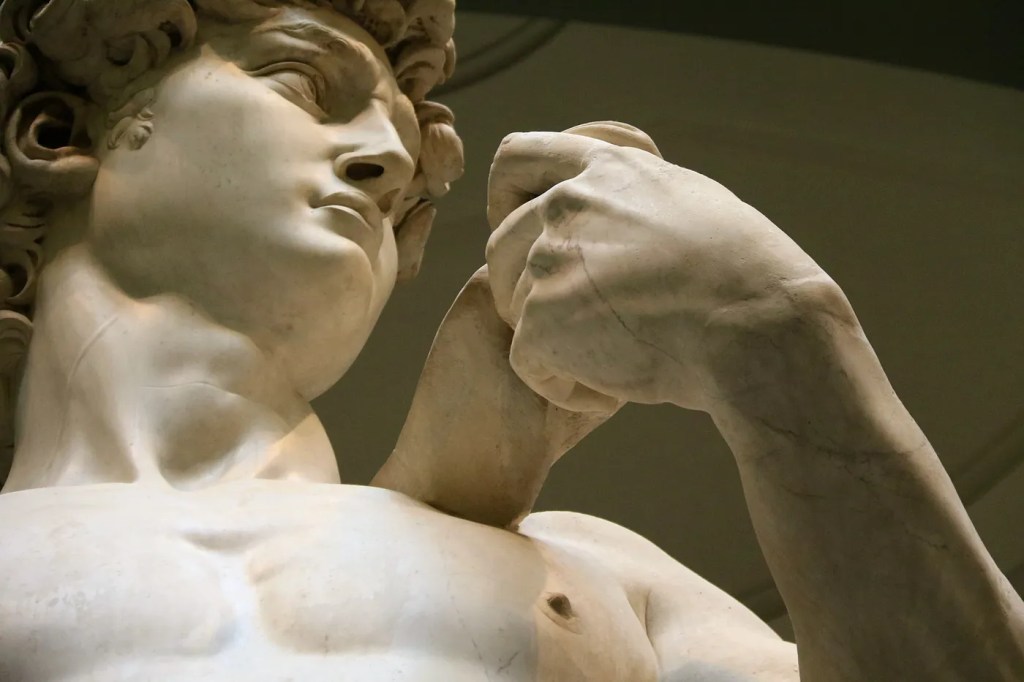
This reminds me of a story that I heard as a kid. “There was a sculptor. He found this stone, a special stone. He dragged it home and he worked on it for months until he finally finished it. When he was ready he showed it to his friends. They said he had created a great masterpiece, but the sculptor said he hadn’t created anything. The statue was always there, he just chipped away the rough edges.” This story seems related to a quote attributed to the great Italian artist Michelangelo (1475-1574): “The sculpture is already complete within the marble block, before I start my work. It is already there; I just have to chisel away the superfluous material.”
As we fight our daily battles it is all too easy to fall into the trap of fixating on what is wrong with us or what we lack. I grew up believing I was fundamentally flawed, broken, and defective. I was wrong. What if we aren’t actually? What if there is actually more right with us than there is wrong? What if we already have everything we need inside of us? What if we already carry the seeds of success within? What if we aren’t inherently the problem? What if it is nothing more than the environment of belief that we have inherited, accepted, or unknowingly embraced that has stifled our progress and buried us deep down inside ourselves?
In our obsession with becoming and amassing “more” it is a useful corrective to contemplate that we are already a wondrous work of art inside, a masterful mosaic in the making – we only need to carefully chip away a few rough edges or protruding pieces, a few pain points, that are getting in the way of being who we already truly are inside. As we work on ourselves, as we go to war with the limiting labels, the debilitating doubts, the festering fears, and the belittling beliefs, let’s take a holistic view of ourselves and not overly fixate on our problems and shortcomings. In a world of all-or-nothing and black-or-white thinking, let’s remember that there is more right with us than there is wrong with us. Shortcomings aside, each of us is amazing, awesome, and absolutely essential in this world! Each of us is a powerful being with great gifts to give and a profound purpose on this planet. So, when the gap between who we think we are, who we want to be, and who we wish we were seems like an uncrossable chasm, when the distance between where we are right now and where we want to be seems like an ever receding mirage, take a holistic view that balances out and considers ourselves a whole person. Don’t throw the baby out with the bathwater. Don’t blow things out of proportion. Self-improvement goals are stars to steer by not clubs to beat ourselves with every time we fall short.
Growing up I had a friend who loved riding motorcycles and softball. One day, while riding his bike, he was clipped by a semitruck. The accident almost killed him, and he lost one leg from the knee down. It was a terrible tragedy. He could have let it devastate him and ruin his life. He could have closed himself off to the world, shut everyone out of his life, and just given up. He could have turned to alcohol, drugs, or other self-destructive behaviors to numb his feelings, avoid his pain, and buffer his life – but he didn’t. He decided that he was NOT his missing leg. Rather than focus on what he had lost, he was an example of gratitude that the doctors had managed to save so much of his leg and save his life. He looked forward not backward and focused on what he still had. I never heard him complain (except when he would humorously remind me of his occasional wish to scratch a ghost itch in his now missing toes when I was complaining about something :P). He was a great softball pitcher and could still mash the ball at the plate! More importantly, he was a great example to me. He didn’t let a challenge or setback in one area of his life ruin the rest of it. We don’t have to either.
This takes us back to something my friend and mentor Brigadier General Paul Pirog talked about in Episode 12 in our Warrior Mindset Unplugged Interview when he talked about avoiding collateral damage at all costs. Have you ever taken your stress from one area of your life out on another area? I know I have. We don’t have to let stress in one area of our lives destroy all the other areas of our lives! We don’t have to let a bad situation at work affect our relationships at home, or let financial setbacks damage our physical and mental health and wellbeing. How do we do that? We practice healthy compartmentalization.

Compartmentalization often gets a bad rap and when it turns to neglect needed changes or even denial of damage and problems it is. However, there is a healthy application of compartmentalization. The ancient Chinese discovered the concept of compartmentalization from bamboo, where each segment is independently sealed and airtight from the next. Compartmentalization, then, is the ability to seal off one area or section so that it doesn’t affect other areas. I always like to think of this in terms of naval vessels. We have independently sealed compartments on ships to protect them in the case of damage. Some repairs simply can’t be made at sea. If a ship takes damage to its hull, the affected area can be sealed off, protecting the rest of the ship and preventing it from sinking. This allows the vessel to stay afloat and carry out its mission until it can return to safe harbor and get up on dry dock, where the sealed compartment can then be opened up and the necessary repairs made. Compartmentalization is a useful and I would argue necessary coping, survival, and self-preservation tactic. If your finances get torpedoed and we find ourselves sinking into debt, we don’t have to let it drown our relationships too. When a relationship goes south, we don’t have to let the pain of rejection, betrayal, or loneliness ruin our job performance. Doing so only makes bad situations worse!
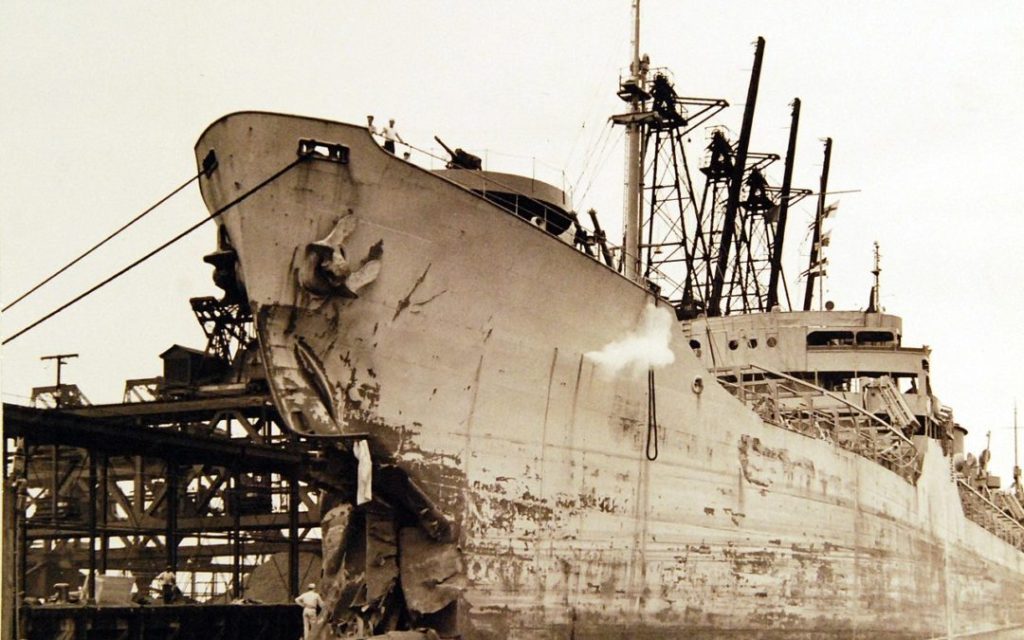
Similarly, there have been times of deep despair and trial that tested me to my very limits; times when I didn’t know how I could go on, move forward, or recover from the bombs that blew up in my life. In those troubling times, I compartmentalized, I focused on the mission, whether it was mentoring cadets, serving in church or community, or just enjoying my family. I gave myself a mission to focus on. Next steps to take to keep me moving forward and save whatever I could and get it from being affected and not drown in despair. I refused to let a present failure flood my future and drag me down to the depths. A few years ago, our beautiful St. Bernard Timber contracted cancer. He was only five years old. At the time, we were living in Idaho and I was working in Colorado. I came home immediately to take care of him and ultimately he had to be put down. He was my dream dog. The best dog ever! It was one of the most painful things I have ever done to through that and stay with him to the end and when it was over, I went back home. I knew I didn’t want to let the pain of his passing affect the brief time I had at home with my family, so I focused on them, what I could do to help them and how we could enjoy the time we had together. I grieved later.
No matter how bad things get in one area of our lives, we can look to the good we still have in other areas. When we feel powerless in one area of our lives, we can choose to focus on where we can still serve and make a difference in other areas. When I feel really stressed in one area of my life, it is helpful for me to get outside myself and my troubles, go serve someone else, or engage with another area of my life and create some separation and perspective. This usually helps me go back to the problem areas with renewed hope and clarity about what to do next and how to begin making repairs. It’s not easy but it works. While we don’t want to fall into the trap of disassociating and leave those skeletons in the closet for decades, compartmentalization is one way to keep us afloat and protect and preserve other areas of our lives from damage in another until we can get to a safe space to open up and heal.
There is so much that is good, beautiful, and inspiring in the world, in our communities, and within ourselves! The Principle of Preservation gives us permission to be really intentional about what we want in our lives, out of our lives, and for our lives. So let’s not let the pain of our past or even our present hold the potential and promise of our future prisoner, let’s not let our hurt hold our hopes hostage, let’s not let our worries worm their way through the great work we can do, let’s not let the swirling tides of trial and tribulation sweep us downstream and dash our dreams on the rocks of reality, let’s not let the cliffs of challenge bring us to our knees before our climb through life has even begun. Instead, let us plot our course, navigate our rapids, climb our mountains and reach the summit! We don’t have to save our best for last – we can save our best for now!
2. Permission: Give Ourselves a Break! Break Down, Breakthrough, & Break Out
Sunzi’s second principle for achieving the ultimate victory in our lives is permission to give ourselves a break! Once we have saved all that we can – all that is good, worthy, and inspiring in our core, it’s time to break some stuff! To give ourselves permission to engage in some precision breakthroughs, break down some internal barriers, and break out of past patterns that no longer serve us.
The Chinese character is po4 破, which means to break, ruin, or destroy. The character is comprised of a stone on the left 石 (shi2) and an animal skin or hide on the right 皮 (pi3, which is the phonetic). The ancient character form of animal skin or hide 𡰻 was comprised of a carcass 尸beside a sideways stone knife above a reaching hand 𠬛. I remember field dressing my first deer with my Grandma Boyd and my cousins before I was a teenager. If not done properly, the entrails and fluids can spoil the meat. In hunting, a slain animal must be skinned before the delicious meat can be accessed, processed, and prepared – we have to literally breakthrough the skin to get to the meat beneath – some cuts had to be made.
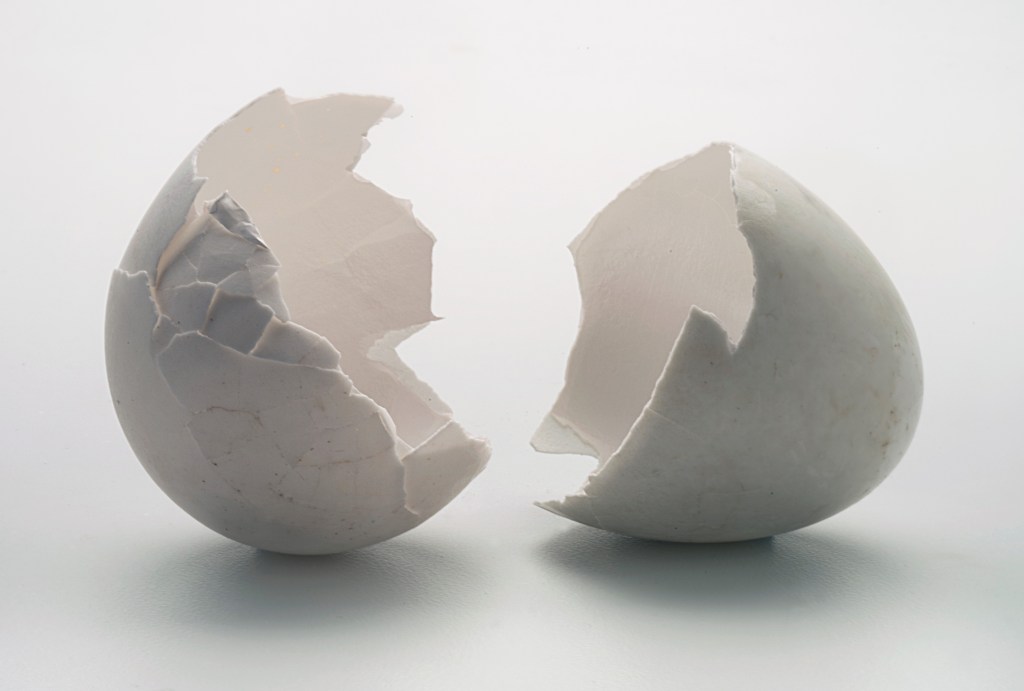
For a more vegetarian example, we have a small flock of free-range chickens on our property that give us delicious eggs every day. I am often reminded of the riddle employed by J.R.R. Tolkien’s Bilbo Baggins in his battle of wits with Golem: “A box without hinges, key, or lid, yet golden treasure inside is hid.” I think of that every time I collect eggs. My mother was a gourmet chef and she reminded me that in order to make an omelet, we have to break a few eggs.
In our own lives, what breakthroughs do we need to have to take our lives to the next level? What limiting labels, debilitating doubts, and belittling beliefs do we need to breakdown to rise to our fullest potential? What self-sabotaging or self-destructive patterns do we need to break out of to be truly free to pursue our passions and purpose, our dreams and our Big Deals? What mold do we need to give ourselves permission to break to create something new in our lives, for our lives, and out of our lives?
As musician Billy Cox who played with the late great Jimi Hendrix () put it: “Remember … life’s greatest difficulties always happen right before life’s greatest breakthroughs.” Often our breakthrough is right on the other side of whatever we are resisting the most in our lives. So, where have we been resisting change and why? Resistance Whatever we are going through right now is preparing us for our next breakthrough. As Tony Robbins has said: “All personal breakthroughs begin with a change in beliefs.” So what beliefs about ourselves, each other, and the world do we need to make? What beliefs will empower and inspire us to take the next step toward what we really want in our lives, for our lives, and out of our lives?
Success comes when our persistence breaks through our resistance, because as Steven Furtick has taught: “Resistance is always fiercest on the borderline of breakthrough.” Sometimes it takes an overwhelming breakdown to have an undeniable breakthrough. The more we feel like giving up, the closer we are to a breakthrough. Joyce Meyer has said that: “When you are tempted to give up, your breakthrough is probably just around the corner.” Germany Kent: “You’re on the verge of your breakthrough. Your next level is near and your dreams are about to take flight. Believe it.” All we need to do is to face our fears and decide that what we want is more important than those fears and give ourselves permission to achieve and receive all the outstanding opportunities and amazing abundance that are waiting for us up ahead.”

3. Wear Down & Wear Out Our Resistance – Not Ourselves
Do you ever feel conflicted? Embattled? Like you are being pulled in too many directions? Do you go back and forth on things in your life? Like you are at war with yourself? Like even the victories take a toll? I know I do. This brings me back to the Anjali Chaturvedi quote: “In the end, it’s you fighting against you, for yourself.” Surprisingly Sunzi states that the ultimate victory is not to win every battle or defeat every foe. Rather, he argues that the ultimate victory is to wear down our enemies without us ever having to resort to warfare. The imagery returns to the concept of chasing our own tails that we discussed in Episode 10, “Five Full Send Commitment Tactics for When We Hit the Wall!”
In Episode 13, “Three Secret Strategies for Overcoming Our (Inner) Enemies,” I discussed the etymology of “enemy” as anything that enforces limitations and constraints upon us, anything that would reduce or diminish our opportunities or stature, or anything that inhibits or constrains our personal prosperity and individual abundance; anything that coerces, manipulates, or threatens our inalienable human rights and sovereignty by force, or anything that forces us to give up, give in, or settle for less than in our lives. In applying this to our own lives, what are the enemy states of mind that undermine what we really want?
The goal, then, is to work to end our own internal conflicts, the battles within, and wear down our own personal resistance to realizing our “Big Deals,” persistently chasing our dreams, and passionately pursuing our profound purpose on this planet. To do that, we need to get our beliefs working for us rather than against us. As I mentioned in Episode 2: “Look in the MIRROR: You Are in Charge!” when we start out in pursuit of what we want in our lives, for our lives, and out of our lives, we start off with a vision but often lack the beliefs to support that vision at first. This why “Raising the BAR” on beliefs is so important, as I discussed in Episode 9, because we can only receive what we persistently believe we can achieve.

How do we know if our beliefs are enabling and empowering us to achieve and receive what we want in our lives? It’s actually quite simple. There is a question we can ask ourselves. Do I want something more in my life, out of my life, and for my life than I have right now? Let me say it again: Do I want something more in my life, out of my life, and for my life than I have right now? How did you answer that question? How did you feel about that question? Was there a “yes, but” in there? I would say that a “yes, but” is almost always an indicator that there is a disconnect or a conflict between what we want and what we believe about ourselves, each other, and the world. Once we realize we have a “yes, but” we can dig into it, call it into question, ask a lot of “whys” – because remember “Our Why is Our Way Forward” as I discussed in Episode 3. As we begin to question our beliefs instead of our potential and identify our “yes, buts,” we can understand where those limiting lies and belittling beliefs are coming from, and see how they are holding us back and keeping us down, and we can choose to reframe them or replace them with more empowering belief that will support us in becoming who we want to be and how we want to show up in our lives and in the world. By doing so, we chip away the rough edges or superfluous material that is preventing the masterpiece we already are from emerging.
This connects back to the idea of becoming the General on Our Own Future that I discussed in Episode 15: “Six Butt-Kicking Battlefield Beatitudes for Becoming Master of Our Own Destiny.” The ultimate victory is to get our battalion of beliefs formed up and working for us rather than against us; to wear down our resistance to achieving our most excellent victory instead of wearing ourselves out with debilitating doubts, festering fears, and belittling beliefs.
Far too often we doubt our empowering beliefs and believe our debilitating doubts. To achieve the ultimate victory in our lives, we need to do the opposite! Doubt our doubts instead of ourselves, face our fears instead of fearing our future, and bash those belittling beliefs instead of beating ourselves up! We don’t want to let our own internal resistance run us ragged. How do we do that? We persistently call attention to our resistance, we call it into for questioning, and call it out for what it is – nothing more than B.S. – not the “BS” you might be thinking (although that works too) but a “Belief System” that is not serving us! In other words, we overcome our internal resistance with our intentional persistence.
See, our “BS” or our beliefs are nothing more than thoughts, perceptions, ideas, or (mis-)judments that we unknowingly or unconsciously inherited, accepted, or embraced as true and so we have repeated them subconsciously over and over again until they became a habit, a pattern of belief, or a conviction. Then we let those beliefs run amok and run rampant in our hearts and minds, creating chaos and pain. Every thought we think, every belief we embrace or allow to linger forms a neural pathway in our brain. The more that thought pattern is fired, the more that belief is triggered, the stronger that neural pathway becomes. In my case, I have thought patterns that have become entrenched neuro pathways in my brain that have been firing for decades ever since I was a child. It’s like a trail. The first time we hike that path through the weeds, its small and not well established, but if we walk that path multiple times each day, it eventually becomes a well-worn trail, compacted and hard as rock!

I once led a group of Air Force cadets on a horseback ride along the Tea Horse Road in southwest China and I was stunned by what I encountered along the route. The Tea Horse Road runs all the way to India and merchants have been taking horses along it for thousands of years! Over time the compression of the horse’s hoofs along the exact same route have made deep depressions in the soil, which eventually became holes, some of them a foot or more deep! I struggled to get and keep my horse out of those potholes because it was so conditioned to follow the established trail but I was persistent. The horse didn’t know any better. It was just operating on auto-pilot and trying to be as efficient as possible but it was extremely bored with its life. With some persistent effort, we finally broke free of the established trail and the shift was like night and day. It was amazing. All of a sudden, a glimmer came to this horse’s eyes and it came back to life! Rather than eyes down on the trail, disinterested and glazed over, it started looking around at the unfamiliar scenery, smelling the new scents on the air and, at one point, I even steered it over to eat a fresh dandelion! Slowly my mount’s resistance diminished. When it was time to head back, we took a different trail and galloped all the way back to the stables and I could tell, my rented horse was enjoying himself for the first time in a long while. There is a lesson here for us as well.
Just like that horse, if we’re not careful we can get stuck in the rut of routine thinking and if those established pathways are limiting labels, belittling beliefs, or debilitating doubts they can suck the life out of us! The good news is that any moment we can change our thought patterns and provide an alternative to these established beliefs and the ruts of results we keep recreating in our lives. Our brain has a miraculously high degree of neuroplasticity, which means that it doesn’t matter how long we’ve been stuck in those ruts, repeating the same worn out thought patterns, and experiencing life through the lens of the same uninspiring beliefs! With some persistence our own inner resistance will change course and then everything will begin to change.
Returning to the visual Sunzi employed, we want to wear down our resistance through our persistence, until exhausted, like a dog that has been ceaselessly chasing its tail until it finally lays down. So it is with our resistance. When we doubt our doubts instead of ourselves, when we face our fears instead of fearing our future, when we poke holes in our problems instead of our potential, and when we bash those belittling beliefs instead of beating ourselves up, our own inner resistance will ultimately give up and get on board with our new vision. What is that vision for ourselves? What is that most excellent victory? At the end of our lives, what will we look back on and speak of with hallowed voices and say we were most glad that we did or overcame? What will we be most grateful that we gave to those we will one day leave behind and those who will follow after us?
Conclusion
Today we’ve discussed “Three Strategies for Achieving the Ultimate Victory in Our Lives.” They are:
1. Preservation: Save All We Can & Avoid Collateral Damage
2. Permission: Give Ourselves a Break! Break Down, Breakthrough, & Break Out
3. Persistence: Wear Down & Wear Out Our Resistance – Not Ourselves
In the fierceness of our own battles, in the silent chambers of our own souls, and in the myopic fog of war, it is easy to be overly critical of ourselves, to focus too much on our deficiencies, and to lose sight of our own innate worth. If people could only see how precious they truly are, how powerful and capable they are, what great gifts they have to give the world, and all the people who are just waiting for them to show up in their lives with their unique blend and special sauce, suicide would no longer be an issue. Each of us is like a jade sculpture, we already have everything within us to be amazing and awesome! In chipping away the rough edges and chiseling off the superfluous material, we need to take great care to not lose ourselves or throw the baby out with the bathwater. There is more right with us than there is wrong and deep down inside, buried beneath all the compacted layers of limiting labels, the dust and detritus of debilitating doubts, and the berm of belittling beliefs there remains a golden treasure, a glimmering gem, a priceless and precious person with a profound purpose on this planet!
So give ourselves a break! Give ourselves permission to break down those walls that confine us, to break out of the prison that contains us, and to break free of the chains that bind us down, hold us back, and coerce us to give up, give in, and to settle for less than in our lives! Each of us is worth that break! So start wearing down our resistance to all the excuses and reasons why we believe we can’t, all the “Yes-Buts” that keep us paralyzed out of fear of changing. Pick a new path and persistently choose to doubt our doubts and believe empowering beliefs about our potential and promise. Look forward to a future full of possibilities, not backward to a past of broken dreams and the ruts of regrets! Our personal persistence will overcome our internal resistance, so keep at it. Keep believing better things about ourselves, each other, and the world! Keep calling attention to our debilitating doubts, keep calling into question our limiting labels, and keeping calling out the BS of our belittling belief systems! And some day, we will look back on the offering we have made and see that we have won the ultimate victory in our lives – a free and empowered mind and heart.
How do we know if our beliefs are enabling and empowering us to achieve and receive what we want in our lives? It’s actually quite simple. There is a question we can ask ourselves. Do I want something more in my life, out of my life, and for my life than I have right now? Let me say it again: Do I want something more in my life, out of my life, and for my life than I have right now? How did you answer that question? How did you feel about that question? Was there a “yes, but” in there? I would say that a “yes, but” is almost always an indicator that there is a disconnect or a conflict between what we want and what we believe about ourselves, each other, and the world. Once we realize we have a “yes, but” we can dig into it, call it into question, ask a lot of “whys” – because remember “Our Why is Our Way Forward” as I discussed in Episode 3. As we begin to question our beliefs instead of our potential and identify our “yes, buts,” we can understand where those limiting lies and belittling beliefs are coming from, and see how they are holding us back and keeping us down, and we can choose to reframe them or replace them with more empowering belief that will support us in becoming who we want to be and how we want to show up in our lives and in the world. By doing so, we chip away the rough edges or superfluous material that is preventing the masterpiece we already are from emerging.
Outro
Thanks so much for listening everybody! If you found this podcast impactful, please like and subscribe, and join us for new episodes every “Warrior Wednesday.“ For more information, tools, and resources to help you in your daily battles, for questions or to work with me, shoot me an email at: artofwarforlife@gmail.com. Most importantly, always remember: “The power to win resides within! There is ALWAYS a Way!”
Support this podcast: https://podcasters.spotify.com/pod/show/david-boyd3/support

 Warrior: The Art of War for Life - A Podcast on Winning
8 Comments