
Episode Summary
In Episode 23 of “Warrior: The Art of War for Life ~ A Podcast on Winning,” I go unscripted to reflect on the “Five Essential Leadership Attributes” first introduced in Episode 3 and discussed in great detail in Episode 4. They are: wisdom, trust, empathy, courage, and disciplined determination, or grit. In the months, since I first introduced them, I have developed some quick and accessible tools and exercises to help us “level” them up in our lives in about two minutes!
First, knowledge is the arrow, and applied knowledge is wisdom or the ability to hit the bullseye in our lives. In this episode, you’ll learn a pair of two-minute wisdom skills for articulating clearly what we know and making it accessible to others to use while learning how to engage others with curiosity and apply what they know to our own circumstances and situations.
Second, the foundation of all trust — whether it is trustworthiness or entrusting others is self-trust. In the two-minute trust reflection, I give us time to really dig into how to increase our own trust and when and where it breaks down in our lives. With that understanding, and some grace and space, we can overcome our inner obstacles to trust, mend our broken bonds within, and learn to invest in ourselves and others again.
Third, empathy is the key to Emotional Intelligence, interpersonal skills, and thus effective leadership. Here I introduce a two-minute set of “SHARE” skills for engaging those around us with empathy. SHARE stands for: Share, Hear, Ask, Relate, and Express. As we do this, we create powerful bonds of connection with others and will find joy celebrating their successes and supporting each other in our difficulties.
Fourth, courage is the clarion call to face our fears and doubts. It resonates and reverberates like a bell. In exercising greater courage, I introduce a two-minute “Face your FEAR” drill to help us: Face it, Express it, Acknowledge it, and Reframe it so that we can recognize the MESS (Mental, Emotional, Spiritual, and Social) impact of that fear and the beliefs, feelings, thoughts, and behaviors that emerge from it and get in touch with what is more important to us than that fear and our why — because our why is our way forward.
Fifth, disciplined determination or grit is the commitment to ourselves to keep climbing the cliffs of challenge — to scrape and claw our way up the overhangs of life — in spite of the internal and external naysayers screaming we aren’t going to make it. To get in touch with our inner grit, I introduce a two-minute GRIT reflection: Get clear on Growth and Goals, Resolve to Resiliently act, Initiate & Ignore the urge to quit, and Tenaciously try and try again.
Soundtrack by Sentius
Episode Transcript
Welcome to Warrior, the art of War for Life, a podcast for those who want to win! Leadership lessons, motivational mindsets, empowering principles, success strategies and transformational tactics from the Sunzi, the Master of Victory.
I’m your guide on the side David Boyd, award-winning educator, transformational speaker, and certified life coach. It’s time to start winning at life.
Hey, hey, hey! Thanks for joining us. I’m so glad you guys are here listening. Last week we talked about 6 tactics to take back our lives and start picking our battles, and I promised that I was going to do another one of these warrior unscripted. It’s just me, and my thoughts, which can be kind of dangerous, but I hope it’s insightful.
Last week I mentioned that I had given this presentation on Sunzi’s five essential leadership attributes to the Enlisted Leadership Foundation and that I wanted to come back and reflect on that and share a little bit more.
I first introduced Sunzi’s “Five Essential Leadership Attributes” as part of Sunzi’s “Five Strategic Success Factors” way back in Episode 3.
These five attributes got their own treatment in Episode 4, and since then I’ve had some time to reflect and really hone in on how do I develop these? How can I work on these? How can I help people level up their lives, level up their leadership?
And and so I’ve developed some some tools, some exercises, some reflections, and two-minute exercises because everybody’s busy. I wanted these to be really accessible and something that could be just pulled out at any moment. Everybody’s got 2 minutes that they could devote to a practice, that they could invest in improving themselves and empowering themselves. Everybody’s got 2 minutes that they can invest in somebody else around them, whether it’s standing in line at the grocery store, waiting to check out or stuck in traffic or at a red light. I wanted these exercises and reflections to be really available and really accessible and really impactful.
So diving back into Sunzi’s five essential leadership attributes, the first thing that I wanted to convey is that leadership is the vision to take a stand and most importantly, it’s about self leadership. I’ve not been a very good self leader for most of my life — a leader of one. I was much more of a go with the flow sort of guy and part of that was because of my people pleasing and part of that was because I didn’t have a clear vision of what I actually wanted.
And so getting really curious about that led me to discover that I had a belief from my childhood that either I couldn’t get what I wanted or that my wants and needs were secondary to everyone else is around me — so what’s the point? And that fueled a lot of feelings of futility, the “futility farce” we talked about in Episode 6: “Sunzi’s Six Traps of (Self)-Deception and How to Avoid Them,” as one of those traps of self-deception and self sabotage, and it also just contributed to this sense of disempowerment and also a sense of undeservedness that if my needs are so unimportant in comparison to other people it must mean that I’m not as important.
And so that “Incapable Lie” that I wasn’t capable or wasn’t good enough to achieve what I wanted, combined with that limiting belief and the undeservedness and the futility that even if I wanted or even if I knew what I wanted, I couldn’t get it. I couldn’t have it because some other circumstance or somebody else’s needs were going to trump my own. This is kind of the dark side of a life of service. Service has been really important to me in my life. I have dedicated a lot of time to service service in the community, service to my country, and service in church.
I was raised with this idea that “when you’re in the service of your fellow beings, you’re only in the service of God.” That’s a great ennobling ideal. I am so grateful for the service that I’ve done for the opportunity that I’ve had to serve.
The dark side of that for me was this belief that I had to always be serving other people and couldn’t take care of myself, that my own ability to take care of myself was always secondary to the needs of the many — going bakk to Star Trek and to something Mr. Spock had taught “the needs of the many outweigh the needs of the few or the one,” which is a logical supposition.
And at the same time, if I’m not taking care of myself, I can’t take care of others. I can’t share water with others when my own cup is empty. So that’s something that I’ve really become aware of in the last decade.
So I kind of diatribed a little bit there. This was not something I was originally going to talk about. Not sure how I how I got onto that, but hey, we went with it. There it goes!
So leadership is the vision to take a stand and Sunzi identifies these five essential leadership attributes. Oh, I remember how we got on that. We got on that because we were talking about self leadership, leadership of one and I didn’t have great leadership because of a lot of these ideas, a lot of the beliefs that I had. I had good followership, but not great leadership and it’s still something that I struggle with in my life. I can be so passive and casual and so go with the flow that I need to make sure that what I am doing is actually something that I am fine with and I still want to do and that I’m not just people pleasing or trying not to rock the boat.
If I do have something that I want or need, I need to make sure that I’m giving myself space and permission to pursue that. Otherwise, it breeds resentment and resentment is something that I’ve struggled with throughout my life because of that sense of being pulled in opposite directions that I talked about in Episode 21: “Overcoming the Anger of Frustration, Impatience, and Rash Action,” where we want we really want one thing — and for me it was that I really wanted some things but I believed that I couldn’t get them or I believed that there were all these other things that trumped what I wanted, that were more important, and that I was actually the bottom of the totem pole.
And so that bred resentment because I really wanted to do this, but I felt like I had to do that. So leadership is the vision to take a stand, to passionately pursue what we want in our lives out of our lives and for our lives.
Sunzi talks about these five attributes: wisdom, trust, empathy, courage and discipline.
So let’s dive into a few of these, and since I’ve covered all this in Episode 4, I’m not going to go back through the etymologies a whole lot. I want to really focus on application. So let’s go.
Oh, and as a reminder, the views expressed in this podcast are my own and do not necessarily reflect the official policy or position of the United States Air Force Academy, the Air Force, the Department of Defense or the US government. Thank you. Thank you very much.
1. Wisdom
Alright, so starting off with wisdom. In Chinese, wisdom and knowledge are closely related to each other. Knowledge is the arrow of the mouth and wisdom is the ability to articulate that knowledge and to apply what others know into our own lives and our own situations.
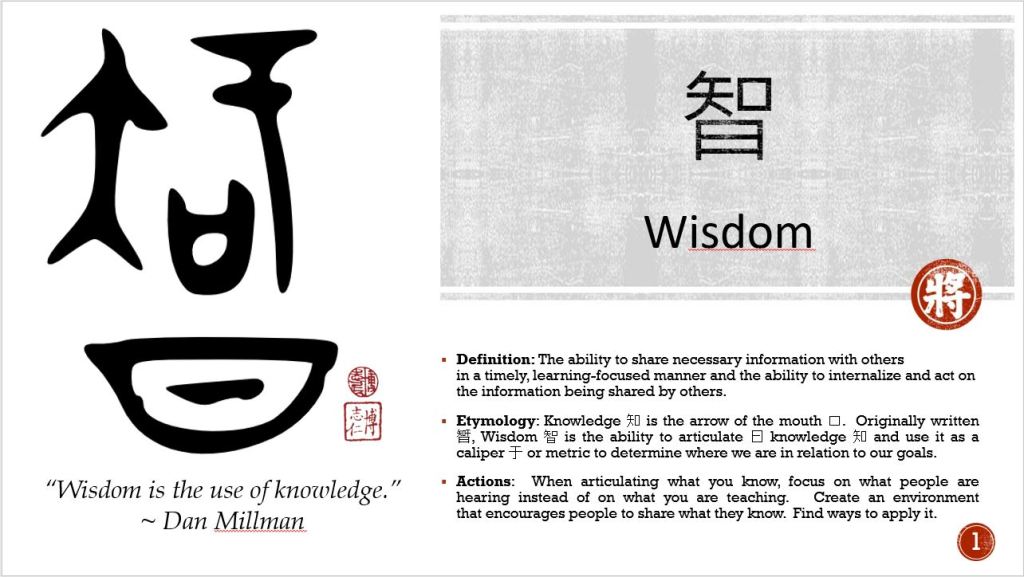
We live in a data saturated world. We have more information at our fingertips than anyone has ever had in the history of humanity. For all those arrows in our quiver, there’s not a lot of people taking their shot wisdom, if knowledge is the arrow, wisdom is the ability to hit the bullseye to hit our objectives, get what we want to use those to get what we want, and it’s an iterative process.
Maybe we’re off a little bit in our first couple of shots. Right? Just like when you go and you shoot around of archery and they’re going to be kind of all over the place, right? Or shooting anything. Same thing with shooting guns. Going to be all over the place. And what’s going to happen is we’re going to make some minor adjustments. We tend to be pulling right or we tend to be a little bit high and we can make some adjustments. Then we’re going to have a better cluster as we make those adjustments. That’s the goal: to hit that bullseye repeatedly every single time in our lives.

You know, so imagine what happens when we just amass knowledge or information and we don’t do anything with it. It would just be like collecting arrows and putting them in our quiver and carrying them around because they look good. It might be fun at parties but to really use knowledge, right? As Dan, Millman said: “Wisdom is the application of knowledge.”
That’s really the whole point of an arrow. The traditional practice of archery had two goals: to hunt to secure food for yourself, your family, your village, and to protect, to defend that same family village from enemies from predators, from danger, from anything that would do us harm, and to do it at a safe distance, and this is the great benefit of ranged weapons.
You don’t have to defend your family or yourself going toe to toe with that danger, whatever that threat is. You can deal with that threat at a relatively safe distance and if you need to, you can take multiple shots.
Same thing is true in our life. Once we start applying what we know, we may have to take a couple of shots. We take a shot, we adjust, we take another shot, we adjust until finally we achieve our our mark, we get our objective. So here are two two-minute wisdom skills that we can practice:
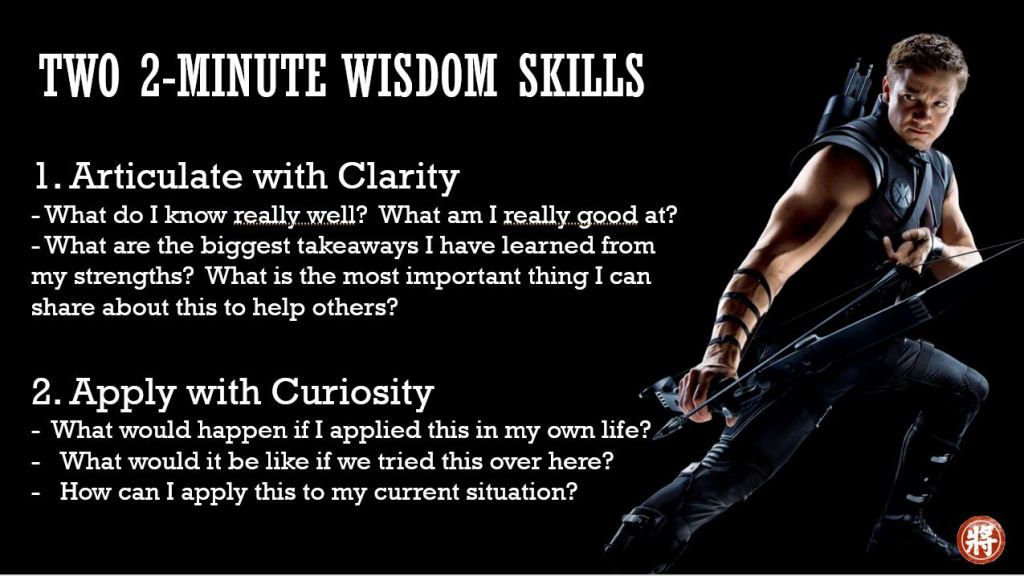
The first one is to articulate with clarity so that others can learn. This is the learning focused skill of leadership. The ability to share what you know. So that others can pick it up as an arrow, put it in their quiver, and use it to sight and shoot at their objectives and hit. The bullseye in their lives. I’ve been in rooms with some super smart people in my life and been completely lost by what they were saying not because I’m an idiot, but because there was a disconnect between what they’re saying and the accessibility of what they knew.
So back to the two-minute wisdom skill #1. Articulate with clarity. So, I want you to think about something you know really well or something that you are really passionate about. You all have amazing skills out there! You all have something that you’re so good at; something that you’ve got some life hacks, you’ve got some experience, you’ve got some knowledge or you are passionate about it and enthusiastic. So I want you to think about that.
What is something you know really well? What are you really good at? And I also want you to think about something really difficult or challenging or a hard time that you’ve had. It could be anyone of these three: Something you’re really good at, something you’re really knowledgeable, passionate about, or something you know really well, or some challenge or difficulty that you have been through — that really pushed you to your limits.
Get in touch with that. What are the biggest takeaways I’ve learned from this? From my strengths, from my expertise, from my experience, from my trials and challenges?
What did I learn and what is the most important thing I can share about this to help others, to empower others who might be going through similar situations, or who might be trying to do the same thing that I’m really good at, or who are just starting off down the path that I was on 10 or 20 years ago?
That’s where the application of knowledge comes in. That’s where we can give them an arrow that can really help them in their lives. And again, I always go back to the Avenger Hawkeye, he’s got that quiver full of all these different arrowheads that can just pop on in an instant, and he can do whatever he needs to do with it and take the shot.
A totally customized specialty arrow for each one of our lives. For every situation that we find ourselves in, that’s what knowledge is. OK, write it out. Write it down. Brainstorm a little bit.
Wisdom, skill, #2: Apply with Curiosity
Knowing that everyone else around us has got a unique set of specialty custom arrows that they can do things with, we want to get really curious about hey, how can I use that arrow? How could that arrow help me in my life? How can this knowledge be applied to my situation?
See far too often in life, we’re so busy discounting what everyone else is going through and what everyone else knows that we prevent ourselves from gaining more tools and insights like we think, oh, that doesn’t apply to me. This person is talking about that and not that’s not something I’m interested in or struggling with. It’s completely irrelevant.
Instead of thinking how is the principle that they are teaching that they applied into their situation relevant to my own? There’s always an application and it may not even be the same application that someone else used but when we engage and we start to look for the application, how to apply that and we engage with curiosity, we will find innovation. We will find insights that become personal and powerful and applicable in our own lives.
So instead of thinking this doesn’t apply, I know this already, or this doesn’t matter, it’s not relevant to me. Instead, really get curious and start questioning when people are talking. When people are sharing some things that they know and an important part of this process is actually going in with curiosity and and asking people what are you really good at? What is your specialty? What is your passion? What sorts of experiences and expertise have you had and then as they’re sharing — because people like to talk about themselves and they love to talk about what they’re passionate and good at, then the challenge is to be constantly thinking what would happen if I applied this principle in my own life, what would it be like if we tried this over here in a different area of life, of business, of relationships, and how can I apply this to my current situation, to my current challenge, to my current objectives, to the pursuit of my “Big Deal”?
If you can get those two two-minute wisdom skills down, just think about the things that you would learn from those around you! Think about the people around you that you would be able to help!
With those two two-minute wisdom skills, think of all the knowledge that would be shared in accessible ways; that would empower people, and all the ways that our lives and other others lives would be empowered and enriched!
2. Trust:
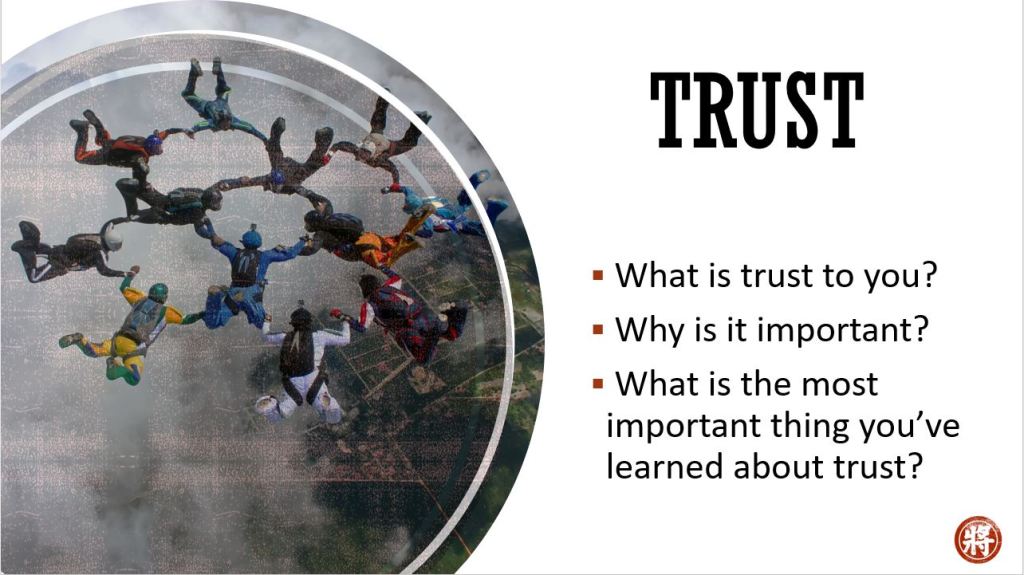
I mentioned when I first introduced this topic, that trust is actually the hardest one for me personally and I’ve reflected a lot on this. It’s because I learned not to trust myself and without that self trust, it was really difficult for me to trust others, and therefore it was also just really hard for me to feel comfortable in positions of trust because I felt like sooner or later I’m going to mess this up. Because deep down inside, I felt like I was not trustworthy and so I really had to dig into this on my own and trust is really about our relationship with ourselves.
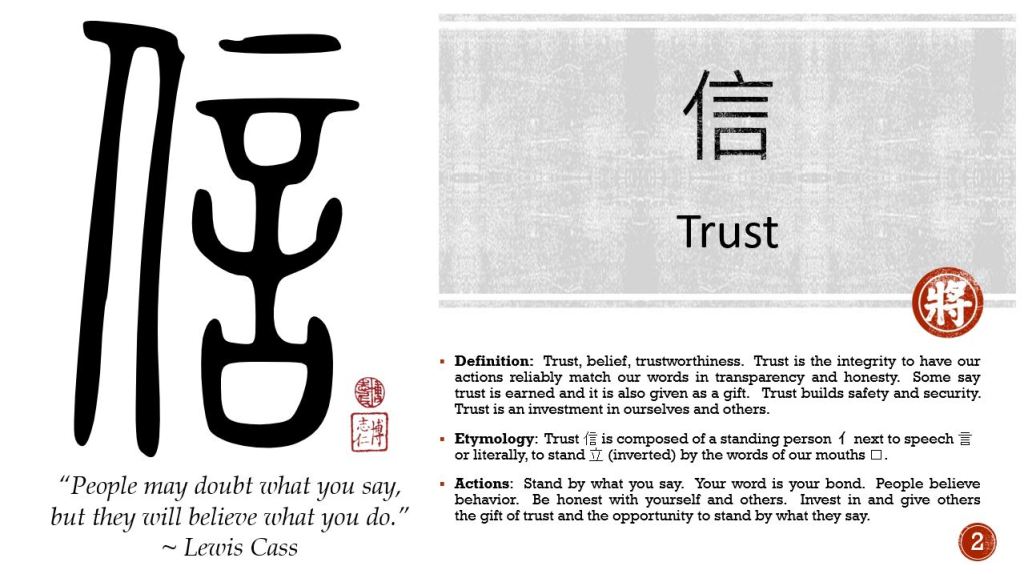
Do we stand by what we say? Do we say what we mean? Do we mean what we say? And do we stand by it? And so I really had to reflect on what was getting in the way of my self trust because the foundation of anyone else being able to trust us and of us being able to trust anyone else is self-trust.
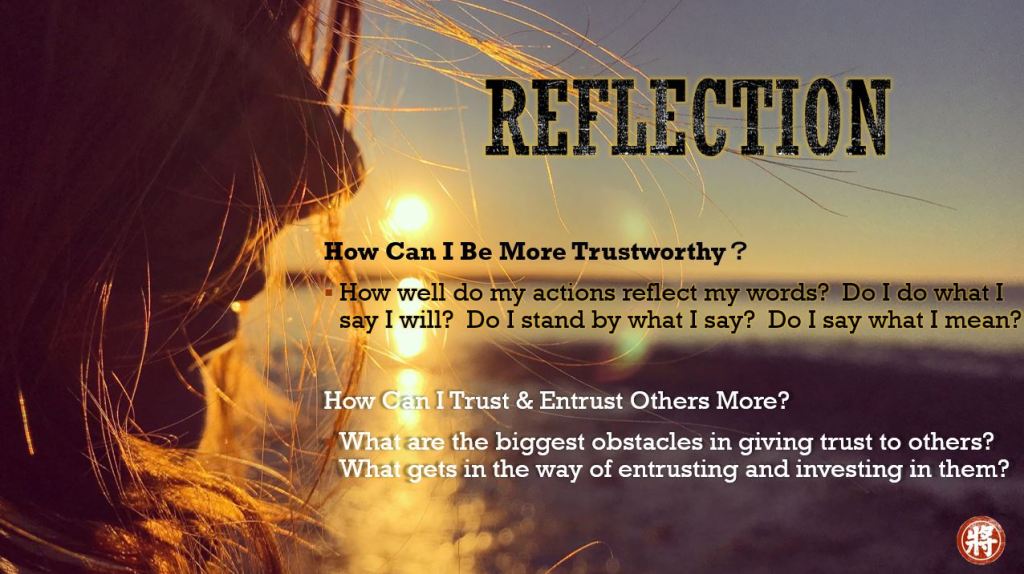
So the trust reflection exercise that I came up with has parts. Simply put:
First: A reflection on how can I be more trustworthy? How well do my actions reflect my words and do I do what I say I will do? Do I stand by what I say? Do I say what I mean? Do I mean what I say and in particular, under what circumstances does that break down? Are there situations and circumstances where I don’t trust myself? Where did that come from? What are the reasons that I don’t trust myself in a given situation or circumstance and really dig into that get really curious. This is not about judgment. It’s not about blame or shame, it’s about curiosity. It’s about understanding ourselves and it’s about healing a broken bond within. It’s about rebuilding our own self trust. It’s about investing in ourselves and in our integrity, and in some cases. It may be about self forgiveness, or it might be about forgiving others and might be about letting some stuff go. Hurts, wounds that we’ve carried around for however long that it’s time to let go of that. It’s time to mend. Otherwise we carry all that baggage and it becomes part of our mess, and in Episode 2: “Look in the MIRROR! You are in Charge!” I talked about the MESS, the mental, emotional, spiritual and social set of beliefs and conditioning that we bring into every single interaction, whether we realize it or not, it’s time to manage our mess, and that is the heart of trust — self-trust and trusting others.
The second part of this reflection is: How can I trust and entrust others more? And what are the biggest obstacles in giving that trust? What gets in the way? Inherently, we all want to trust others and yet sometimes we’ve been burned and so it’s time to reflect on and reevaluate that and really dig in and say: Is it helpful for me to not trust others because I was burned by this person in the past? Is it helpful to other people for me to project this onto them? As a leader, we really need to dig into this because a lack of trust breeds controlling and micromanaging and there’s nothing worse in a leadership position than someone who micromanages who is controlling and who doesn’t trust their people to get their jobs done.
We need to give our people space to thrive, not corner them into this little area where they are constantly feeling like they are being looked over their shoulders. That sucks! So really dig in and get curious about what gets in the way of entrusting others. Because when we entrust others, we invest in others.
So that’s the trust reflection that I came up with and just really get curious. Really dig into this. Ask lots of whys. see what you discover.
3. Empathy
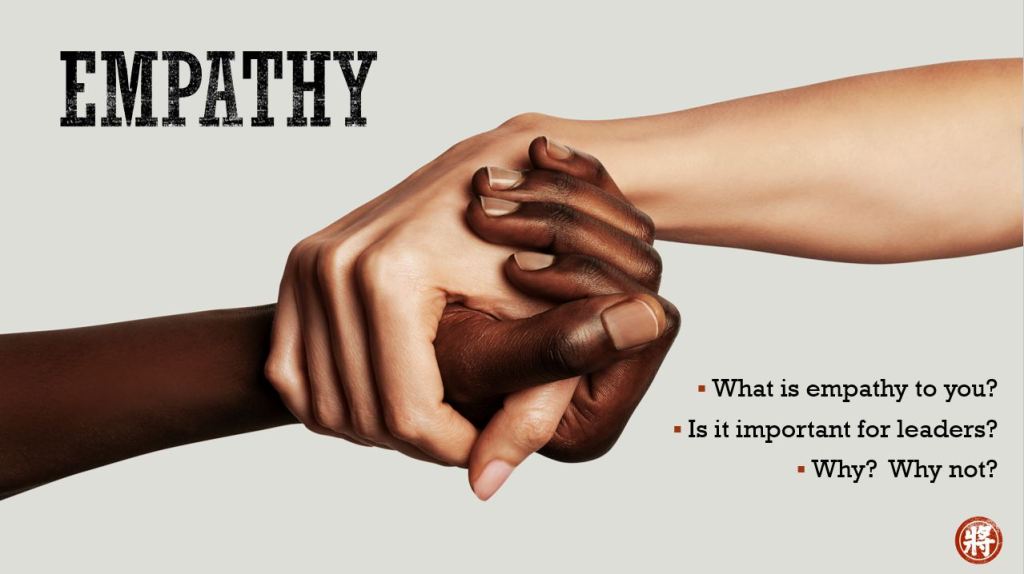
In the Chinese tradition, this is usually translated as benevolence or humaneness, or co-humanity. What we’re really talking about here is empathy. We’re talking about the ways that we interact with another human being with all those people around us. That is the very etymology of the word.
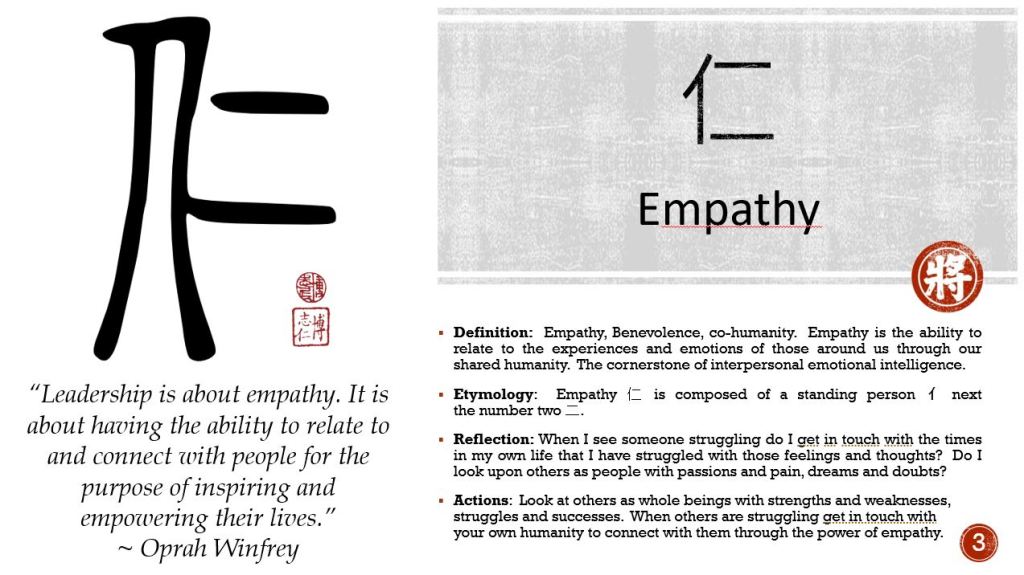
This is interpersonal skills. This is the foundation of emotional intelligence and this is one of the most important attributes for leaders. It doesn’t matter whether you are a powerful CEO or whether you are a three-star general. Empathy is key for relating to our people and even to ourselves. We need to have self empathy.
Sometimes we have such high expectations of ourselves, especially when it comes to emotions, especially when it comes to when we are a little off of our game and we think we just have to suck it up buttercup! We have to figure it out and we have to just get things done. We also need to realize, like my friend Kim Pinske said in her “Episode 16” Warrior Mindset Unplugged interview, that some days our 100% is not going to be the same as other days. Some days just rolling out of bed could be halfway to 100% and anything we can get done on top of that is just gravy.
Some days we’re going to have to invest and spend more time and energy managing our MESS and justice processing and really focusing on the things that matter most and we may not have the time or the energy or the bandwidth for anything else other than picking our battles, as I discussed in Episode 22: “Take Back Your Life! Six Tactics to Pick Your Battles and Start Winning!” Somedays we may only have enough to just show up and take care of school, take care of work, or just show up in our most important relationships a certain way and avoid “collateral damage” like I discussed in Episode 17: “Three Principles for Achieving the Ultimate (Personal) Victory in Life.” That might mean sacrificing some productivity, or it might mean today I have to get the mission done and so I need to set these personal troubles aside because, one I don’t have the time to deal with it and two, this right here in front of me is mission critical. We need to get through that and then take the space to deal with the family issues or deal with the personal issues.
There is this constant balance that has to take place, and so juggling all those priorities, when we feel pulled and stretched in so many different directions and giving ourselves grace in space, compassion and empathy is absolutely critical. As a leader it is really important to be able to give that to those around us, and we can only give that to those around us if we’re giving it to ourselves.
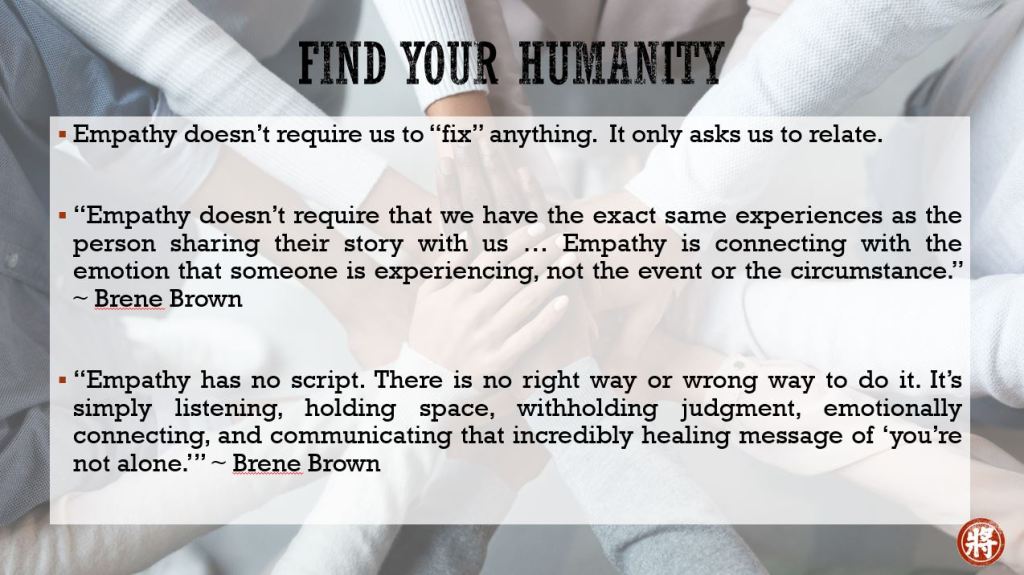
So I came up with a 2 minute empathy SHARE that is comprised of five skills. They create the acronym SHARE. SHARE stands for:
- Share.
- Hear.
- Ask.
- Relate.
- Express.
Let me dig into those a little more. A 2-minute empathy share from a leader could look like this invite someone to share a recent challenge that they’re having and listen. Hear, not just the details of what they’re sharing, but the underlying feelings and the beliefs that those feelings reveal, the thoughts can work backwards and then ask lots of follow up questions. If you don’t get it right away, just ask more questions and see what keeps coming up in their responses. See if we can connect the dots between how they’re feeling and what’s really going on underneath the surface, this is one of those iceberg exercises.

We usually only see the tip of the iceberg with people. We don’t always see what’s beneath the surface or below the water line. As a matter of fact we rarely see the whole picture.
Think about you know about what’s going on with us. How many times do we just wake up in the morning and put on the uniform or get dressed for work or school, and we button ourselves up and we put our best face on and we go out the door and we’re just trying to hold it all together. Guess what? Nobody else is any different! Everyone has days like that! So ask lots of follow up questions. Because the reality is what we’re doing is we’re giving them space to talk through some things and process things that they may not have even realized we’re going on in their lives.
We’re giving them permission and a place to work through their thoughts and their feelings, which maybe they haven’t even given themselves yet because they’ve been so focused on the mission or they’ve been so focused on the task at hand or they’ve just literally been in survival mode trying to get through the day!
And let’s face it: Most people don’t want to engage with painful topics, and they certainly don’t want to engage with painful topics in an unsafe environment where they are worried that they’re going to be invalidated or they’re going to be shut down or they’re going to be called ridiculous!
So asking questions, giving lots of space, and then relating.
Think back on either a similar experience that you’ve had or completely different experience that brought up similar feelings within us and share bits and pieces of that with them so that they know that we are relatable and we get it because when we relate those things, it breaks down this false notion that we are all alone, that we are the exception to the rule, that nobody gets us.
And then #5: Express validating care. This is where we can express admiration, affirmation and encouragement, and we could just love on our folks and we can love on ourselves. This exercise can be done as a self coaching exercise as well.
We tend to think about empathy and employing empathy only in “negative” situations or circumstances, trials and challenges. We can also use empathy as a celebration for the successes! So we don’t just have to ask about a recent challenge we can also ask about a recent success. We can ask someone to share anything in their lives that is important to them and we can hear, we can ask questions, we can relate, and we can express empathy.
So think of empathy not as a spare tire on a vehicle, but as a steering wheel. We don’t just go to empathy when things breakdown. We want to go to empathy and we want empathy to guide our steps, to guide our actions, to guide our interactions with everyone around us and celebrate the good and support each other through the hard times.

So some of the most important things to think about with this two-minute empathy share are to listen attentively without any sort of agenda of response. Imagine yourself in someone else’s shoes being attentive. Listen, be genuinely curious about what they’re going through or what they’ve been through. Validate their feelings, discover similarities. Build bridges between us and them, and most importantly, this is a chance!
Empathy is a chance to share who you are with someone else! When you have an empathetic moment, when you have empathy with someone else, when you share that moment and there’s empathy between you all, you build trust. You build bridges, leaders who have mastered empathy earned the fierce loyalty and devotion of those they work with.
This one is really critical for ourselves as leaders and just as human beings! At the end of the day, it’s just about getting in touch with your humanity! As humans we are “MESSy” and we need to remind ourselves and let everyone else know that it’s OK to be messy and that we can work through our messes together.
4. Courage
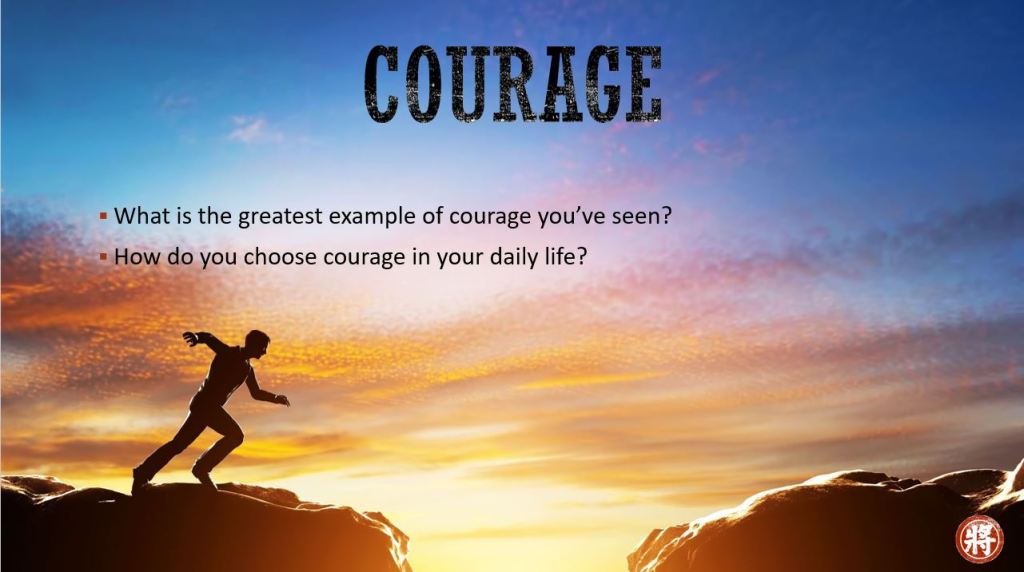
Courage is definitely one of my favorite attributes out of five because the etymology of courage in Chinese is so visually compelling, it depicts a bell above strength, and it conveys this sense that courage is a Clarion call. Courage reverberates like a bell when you hear that bell, when you hear that bell from wherever you are, and you know it’s a long ways away and it’s just carried. It stirs something inside of us.
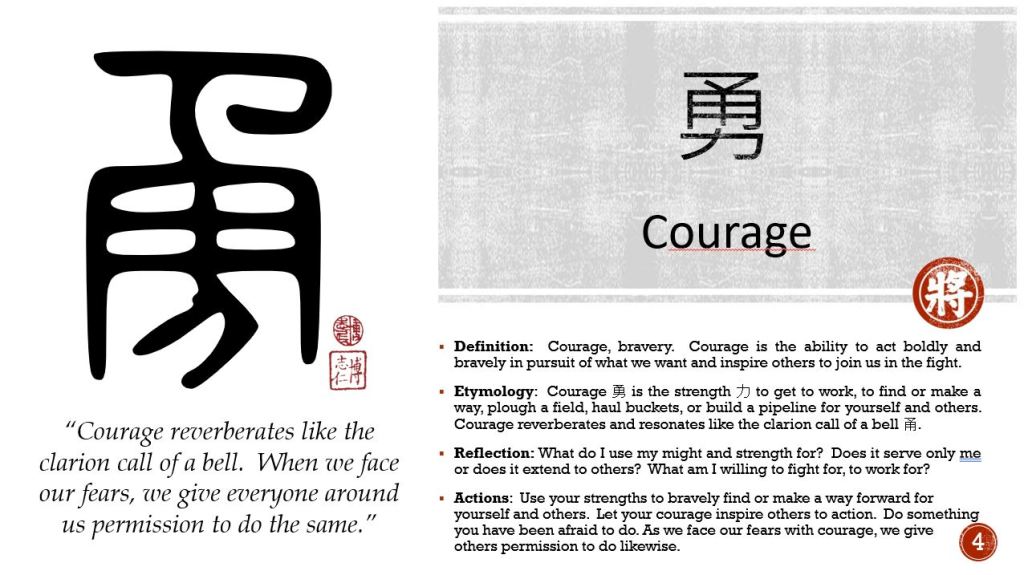
Courage is the exact same way, when we hear about courageous deeds we can and we live in a great age for courage. We live in an age where we can hear of the courage that people are displaying in so many areas of their lives all around the world. The internet can bring us these inspiring stories of courage and it resonates with us. It reverberates into our souls. Someone else’s courage inspires us to be more courageous. It gives us permission to face our problems, to face our fears, to face our doubts with more strength and more might to believe if they can do it, so can I if they can overcome that I can overcome this and so someone else’s example of courage gives us permission to flex a little bit more, try a little harder, dig in a little deeper. To get back up. Give it another shot to discover.
Going back to that Ambrose Red Moon quote, the thing that is more important than our fears and our doubts. That’s what we use. Courage is not the absence of fear. It’s not the absence of doubt, but rather the judgment that something else is more important than that fear and that doubt someone else’s example of courage and even our own examples of prior instances of courage in our lives, can get us in touch with what is more important in this moment in facing this fear, this challenge, this doubt, this problem, this obstacle.
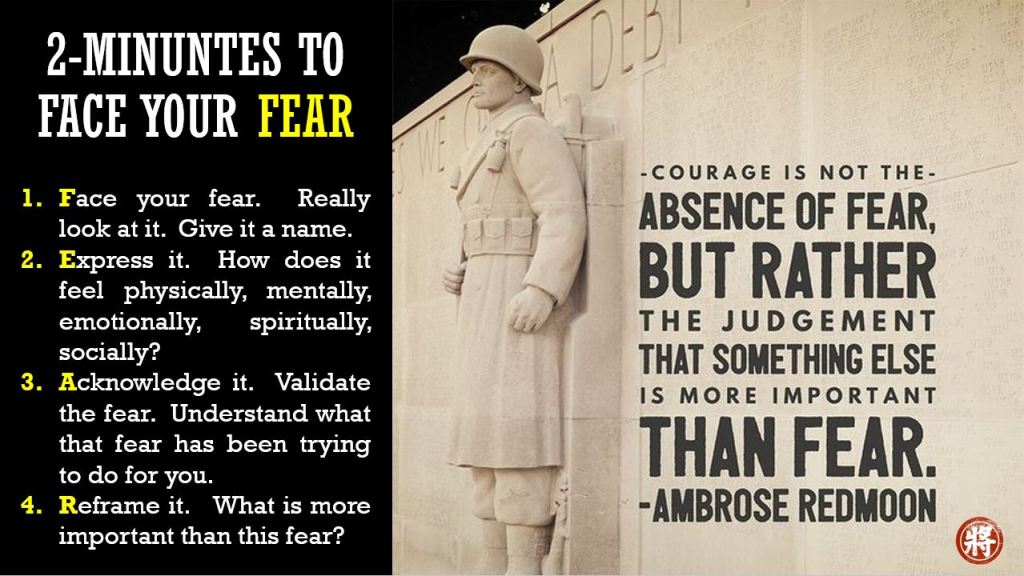
So I developed this two-minute “Face Your FEAR” exercise. It has four simple steps that form the acronym fear, they are:
#1 Face your Fear.
Really look at it and give it a name. Once we can label something and name it, we can manage it. If we just let it roam around in our minds and our hearts and we’re not really sure what it is, and we don’t really want to look at it because we don’t want to engage with it? Or maybe we’re afraid of it, and we may not feel powerful enough to deal with it, or we may not feel knowledgeable enough to address it.
It’s like this amorphous blob rattling around in our brain. So we have to take a good look at it. We have to face it and identify what it is. You are low self esteem. You are lack of self-confidence. You are entitlement. You are pride. You are … whatever it is in that moment, fear of judgment. You are fear of abandonment. You are fear of insufficiency, your fear of failure. That’s what you are and we label it because problem is if we don’t label it, we end up subconsciously labeling ourselves and absorbing it as an innate part of us — but it’s not! It’s just a challenge! It’s just a feeling! It’s just a set of beliefs that we inherited from our childhood, from society, from somewhere else that maybe we’ve never been critical of that we’ve never really examined and now it’s time to take a look at it.
Is this set of beliefs and thoughts and feelings and behaviors around this challenge or obstacle or topic or situation, is it serving me? Is it how I want to show up in this world? And if not, we can change it.
So Step #1: face the thing we’re afraid of. I mentioned in last week’s episode that success is on the other side of one more try, so it doesn’t matter how many times we have failed and it doesn’t matter if we’re afraid of failing again or falling. What matters is we get back up! Because success and everything that we want is on the other side of that fear, so that reconnects us back to getting in touch with what is important to us.
What is more important to us than this fear? So, we need to face it. We need to really take a good, hard look at it and give it a name, give it multiple names because it could be a combination of several things.
#2: Express.
This is the E. How does this fear, this feeling, this doubt, this combination of thoughts, beliefs, and behaviors, the whole package — how does it feel physically, mentally, emotionally, spiritually, socially, how does it impact us? How does it show up? Where does it show up in our bodies, in our thinking, and in our decision making?
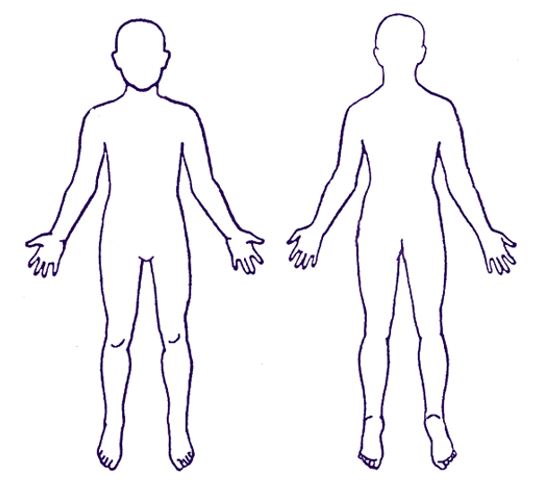
This is an exercise that I have my students do and emotional intelligence all the time is to actually give them a simple drawing of the body, and I have them think about where different emotions show up in their bodies. We do fear, we do anger, we do excitement, we do loneliness, we do a bunch of these different exercises and they start mapping on their body.
Oh, when I feel lonely, my eyebrows droop, or when I feel a lack of confidence my shoulders slump; when I feel angry, my jaw clenches and they start to get an idea, a map of how emotion shows up and it becomes a very useful self diagnostic tool.
In this case, we want to know how this fear is showing up physically. We also want to know what are the thoughts that I have when I am in this space, when I’m trying to avoid this or not engage with this, or when I’m letting it kind of dominate my mood without even realizing it, perhaps, to the thoughts that come with it. What are those deliverables that come into our lives? What are the emotions that I feel around this? For example, I have abandonment issues that brings with it a whole lot of anxiety and panic, and I feel it in my throat and a weight, a heaviness and the thoughts that I have that, you know, that come with that are related to all these doomsday scenarios, right? And so really digging in mentally, emotionally, and spiritually.
How does this affect my ability to believe in myself and then those around me and in the world and in any higher power that I might believe in? And how does that affect my social decisions?So really dig into the mess that this fear has created and express it, acknowledge it.
That’s step #3: Acknowledge it — validate the fear. What that fear has been trying to do for you? Because it is trying to do something, it’s trying to keep us safe. It’s trying to prevent us from feeling disappointment or hurt. When other people project their fears on us, they’re usually in a well-meaning manner, trying to do the same thing. They don’t want us to be disappointed like they’ve been disappointed. They don’t want us to be hurt like they’ve been hurt. When people project their fears on other people, it’s because usually that they haven’t healed from those hurts. They haven’t addressed the those fears of their own, and so they, you know, with good intentions project it onto others as others reality when it’s really just their own.
So give it a space to exist within us. Allow that fear to exist for a moment. Validate it. Like, ‘OK, I understand why I’m afraid of being alone, or why I’m afraid of failure or why I’m afraid that I’m not enough because there are so many people who are relying on me …’ Or whatever the case may be really acknowledge. that and validate it.
It doesn’t mean that we have to let it dominate our lives. We can give it a space, instead of what we usually do, or at least what I usually do, which is I invalidate it and I suppress it and I try and lock it in a closet with all the other skeletons and not deal with it.
So really trying, again with grace and space, without blame, shame and judgment to get curious and to acknowledge, ‘You know, I see as an 11 year old boy that this fear came up because I was trying to do this and I’ve just been trying to cope with it ever since and not knowing how to address it or how to resolve it or how to fix it or how to make it right, or even just how to live with it that. I was doing the best that I could.’
See, I believe that everyone is doing the best they can with the tools and the knowledge and the resources that they have available to them and sometimes we’re using outdated tools. Right? Or we’re using the wrong tools.
The computing analogy is if we picked up a set of beliefs as a kid and a set of fears. And we carry that into adulthood. We are dealing with 10-20 year old programming and it could be bad programming! Now we can do better than that. We don’t have to continue to let that operate in our lives.
On the military side, imagine going into combat with tech that is 20, 30, 40, 50 years old and outdated and never been updated and never even been maintained in most cases! That’s not how to win!
So we face our fear. We express it, we acknowledge it, and then #4, we reframe it, we get in touch with what it was trying to do with how it’s showing up in our lives. And we make a decision. We discover what is more important to us than this fear than this doubt than this whole mess that is created and we create a vision of what is more important of what we really want instead. We reframe it and then we embrace that and we beware of the “yes buts” that I talked about in Episode 17: “Three Principles for Achieving the Ultimate (Personal) Victory in Life!” “Yeah, I want that, but …” Because if we have a “yes, but” then we’re basically giving command back over to that fear to that mess to that doubt, to those limiting beliefs, those belittling beliefs, those limiting labels, those debilitating doubts and those festering fears. So, no “yes buts!”
So that’s the two-minute Face Your Fear exercise. Face your fear. Express it. Acknowledge it, and then Reframe it. Come up with something better because we need something better! We need to have something that is more important than that fear, than that doubt, than that MESS that we can then focus on and practice courage in! It takes courage to embrace a new set of beliefs about ourselves, about each other, about the world! To give ourselves a clean slate, a second chance; To turn over a new leaf, to do something differently, to change the outcome!
#5. Discipline, Determination, & Grit.
The last one. Yan2 严 is the Chinese term for discipline but also determination and grit — it means all of these. It can mean being strict with ourselves or severe but it also means self-respect and respecting others. This one encapsulates everything that we do in the military to maintain good order and discipline, as my friend and mentor Brig. General Paul Pirog mentioned in his Episode 12: Warrior Mindset Unplugged.
Going back to how we apply this in our own lives, why do we want good order and discipline? This comes down to a set of beliefs about ourselves, one we need it but we also deserve it. We are worthy of it. We are deserving of that investment in ourselves and all the benefits that it brings.
So I love this etymology of the Chinese word yan2, which does mean, disciplined and determined and strict. Being strict with ourselves in certain contexts is a good and necessary thing. I love this etymology, it’s got this overhanging cliff and as a rock climber I love that sense of these overhanging cliffs of challenge and there’s these two mouths at the top.
I always think of those as, as the critics, internal and external, who are going to say: “You’re not going to make it, bro,” “There’s no way,” “Just give up,” “You’re just gonna embarrass yourself,” or “this is gonna hurt like heck” and yet regardless of that climbing and clawing and scraping our way with whatever tools we have at our disposal — we’re going to figure it out. We’re going to make it work and we’re going to get to the top and we are going to kneel in victory at the top of the summit rather than kneel in defeat before the climb has even begun!
So I came up with a a great reflection as the last of our two-minute exercise about how we can develop more GRIT in our lives and this encompasses kind of everything in this character. How do we have the GRIT to practice discipline, daily discipline, determination in our lives?

I’m going to be the first one to say throughout a lot of my life, my discipline and determination was a roller coaster. I would be uber-disciplined and determined at times when things were going well and then I would have some setbacks and some frustrations and my mindset was such that I would give up on myself and then my self-care would go out the window and my discipline would break down and my determination would waiver. And then finally, I’d get so sick of that, then I would start over and be like, ‘alright, this time we’re going to go and we’re going to push even harder and we’re going to grind even more!’ And that was the cycle over and over and over again.
So this reflection is something that I developed that really is helping me to get off that roller coaster, that roller coaster of relative self-worth and performance-based worth and toxic perfectionism and have a little more balance, be a little more grounded. Because as we’re climbing and we’re facing those cliffs of challenge, we always need to make sure that we have multiple points of contact — grounding points so that we don’t slip and fall — and so this kind of came out of that.
So the GRIT reflection and the whole concept of grit got to give a shout out to Angela Duckworth. She really nailed this. So if you want to learn more about GRIT, look up Angela Duckworth. She’s got some great resources on her website. So the GRIT reflection again has four steps. You can do this in just two minutes or longer, but the four steps form the acronym GRIT.

I love acronyms, they help me organize my thinking. So the acronym GRIT stands for:
1. G: Get Clear on Growth and Goals: What do I want to do and achieve in my life right now? What do I want to be and become? How do I want to show up? What do I want in my life, out of my life, and for my life? So get clear on the growth that we want to experience and the goals that we want to have and pursue in our lives. We need that clarity first. Because that is our foundation. That’s our anchor.
2. R: Resolve any Resistance and Resiliently Act: So I’ve talked about this multiple times on the podcast when we get clear on our “Big Deal” we might have that vision but we rarely have the beliefs and the mindset to actually achieve it in the beginning. That’s where the work comes in and so as soon as we come up with what our growth and goals are, there are probably going to be some “yes buts” in there.
So we need to make a decision to act with discipline and determination and resolve any resistance and commit to seeing it through — no second guessing! If we’re going to do this, let’s do it and see it through! That’s going to mean resolving our internal resistance. If there’s a “yes, but” we’ve got to work it out, we’ve got to figure it out. We’ve got to figure out and face whatever that fear or that doubt is.
So we go back to that “Face your FEAR” exercise above and work it out. We give ourselves permission to resiliently act when we start off and we do something new. We’re going to stumble and we’re going to fail and we’re going to make mistakes and it’s not going to be perfect and in many cases, going back to what Marie Forleo said, we have to recognize that we’re going to suck. So we’re making a decision that throw ourselves out there in the beginning and learn from it and get better at it.
Nobody picks up any sport or any new language or any new instrument or any new activity, and just totally rocks it in the beginning. Even if you’re talented, even if it’s in our wheelhouse, it’s going to be a challenge. There’s going to be some setbacks, so giving ourselves permission. Expecting setbacks, expecting to stumble, expecting some failures and some missteps along the way, and giving ourselves permission to get back up and try again. To resiliently act. That is a key component of grit, resilience and that resilience.
Giving ourselves permission to be resilient means oh or Too often, we get in this mindset of: “Ugh, I can’t do this!” “See, this proves that I’m not good enough!” “I suck at this!” “I’m never going to get it down!” and we buy into that “Futility Farce,” that “Limiting Lie” that we talked about in Episode 6: “Six Traps of Self-Deception and How to Avoid Them.” So we need to make a resolution. We need to resolve that we’re going to stick with it! If we’re going to do a 90-day challenge, we are going to do all 90 days! We’re not going to quit at day 45 or day 5! We’re going to see it all the way through just for no other reason than to say I did a 90-day challenge and through that process I discovered it wasn’t really what I wanted to do with the rest of my life, but I did it for 90 days and now I’m going to take some of those skills and apply it in other areas of my life. So that’s the R.
3. I: Initiate and Ignore the Urge to Quit: So just because we’ve made a resolution and we’ve resolved any resistance to starting doesn’t mean that we’re not going to have the urge to quit later on. So we get clear on what we want, we make a resolution, a decision to pursue it, and then we actually get going on it. So what is the one thing that I can do right now or that I am willing to do right now to accomplish my goal or to grow in this area?
What one step can I take right now, where I am, as I am, with everything going on in my life that will get me closer towards who I want to be and how I want to show up in my life and get me closer to that goal? What one thing am I willing to do? Then do it and don’t wait! Don’t be like ‘I’ll start tomorrow.’ Start right now! Get it going!
Get the ball rolling, get things moving, and then ignore the urge to quit as it comes — and when I say ignore, I mean ignore that temptation. Meaning, don’t do it, but really, dig into why? Why is this showing up now? What’s going on? Get really curious about how and when does that urge to quit speak into my thoughts? What’s going on in my life? Is there something external that’s impacting me that’s wanting me to give up or give in? Or is there something going on within? Have I hit a wall, a plateau, where maybe I don’t feel like I’m good enough or maybe I feel like I’ve done enough and I’m ready to sit back and not work so hard and rest on my laurels. Whatever it is. Get curious about it. Figure it out.
Go back through that “Face Your FEAR” process that we just did. where we’re going to face it, express it, and we’re going to acknowledge it, and we’re going to reframe it. So that’s the “I” — initiate and ignore the urge to quit.
4. T: Tenaciously Try and Try Again! This is the key. The key to grit is vision. What is the vision that motivates me to get back up when I fall, dust myself off and try again? We want to get a little proactive here and we want to figure it out. Acknowledging that when I stumble and when I fall, when life knocks me down or even knocks me out, what am I going to cling to? What is going to get me back on my knees and try again rather than just take the 10-count? What is it that I refuse to let go of? What is my “Why?”
We’ve talked about this before in Episode 3: ”Sunzi’s Five Strategic Success Factors.“ Our why is our way forward. Our why is what allows us to tenaciously try and try again and get back up, over and over again until we get the outcome that we want. That is the heart of GRIT! Our why is our way forward!
So for this reflection, get clear on the growth and the goals that you want. Resolve any resistance to resiliently acting. Initiate and ignore the urge to quit and then tenaciously try and try again. OK?
Conclusion
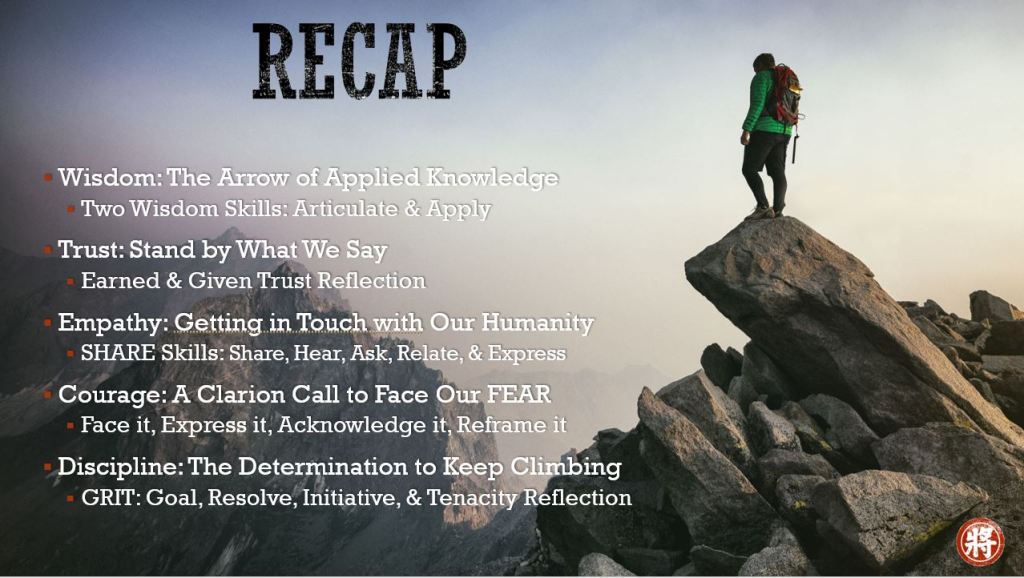
So today we’ve talked about five 2-minute exercises that you can do to level up your life to level up our leadership. Even if it’s just being a leader of ourselves, we talked about wisdom — the arrow of applied knowledge and I gave you the two, 2-minute wisdom skills to articulate what we know, so that it can help other people, and to apply what other people know in our own lives and our own situations and our own circumstances.
Then we did the trust reflection to stand by what we say and how we can both earn that trust and give that trust. How can we invest in ourselves and our own integrity and also give others the opportunity and invest in them? And what gets in the way of that? Right? Where are the breakdowns in our own self-trust? To really reflect on that.
We talked about empathy. Getting in touch with our own humanity and that SHARE skills exercise: Share, Hear, Ask, Relate, and Express. We talked about courage — the clarion call to face our fears and I gave you the “Face your FEAR” exercise: Face it, Express it, Acknowledge it, and Reframe it.
Then we talked about discipline — the determination to keep on climbing — and I gave you a GRIT reflection exercise: Get clear on your growth and goals. Resolve any Resistance and Resiliently Act. Initiate and Ignore the Urge to Quit, and Tenaciously Try and Try Again!
Imagine what life would be like if we took one of these attributes and we leveled it up and then we did another one. Imagine what our organizations, our units, our circle of influence would be like if we created this sort of culture where everybody was leveling up their lives in whatever ways they felt like they needed! This is the sort of culture that we can create because when we embrace this, when we start engaging in this sort of personal development and leadership, we give everyone else permission to do it as well.
What would happen in your life if you had a quiver full of knowledge and you knew exactly how to hit the bullseye? Whatever life threw at you, you’re like, ‘OK, I’ve got an answer to this, boom! Here we go. Not a problem.’ Imagine what it would be like if, whenever you encountered somebody else, that you heard them from empathy, their struggles and their story, and then you could give them an arrow, and say: “Hey, this really helped me when I was in a similar situation. Maybe it’ll work for you.” Imagine the sorts of relationships that we would have if we had more empathy and more trust! If we trusted ourselves and we trusted others more than we do now. Imagine what kind of society and organization we could create! Imagine what we could accomplish with more trust and more empathy! Imagine what would happen in our lives if we courageously faced that fear that’s holding us back and we gave everyone else around us permission to face their own fears and resolve those things that were holding them back! And to act with determination and discipline and grit to keep climbing beyond those fears!
These are five game-changing attributes for our lives, so if we’re not where we want to be right now, pick one and start working on it right now! And then do another and another, and see what happens.
I hope this has been helpful for you and if you want more information you would like me to come and give a presentation on this, I’d be happy to do that. If you would like some worksheets, I’ve got some one pagers on these to walk you through the process and if you are a visual learner, please check out the written blog version of this at www.artofwarforlife.com.
You are awesome! You are amazing! And you are absolutely essential in this world! You have great gifts to give the world! So go get ’em.
Thanks so much for listening everybody. If you found this podcast impactful, please, like and subscribe and join us for new episodes every “Warrior Wednesday.” For more information, tools, and resources to help you in your daily battles for questions or to work with me, shoot me an e-mail at artofwarforlife@gmail.com.
Most importantly: Always remember the power to win resides within! There is always a way!

 Warrior: The Art of War for Life - A Podcast on Winning
4 Comments