
Podcast Introduction
Welcome to “Warrior: The Art of War for Life,” a podcast for those who want to win! Leadership lessons, motivational mindsets, empowering principles, success strategies, and transformational tactics from the Sunzi, the Master of Victory. I’m your guide on the side, David Boyd, award-winning educator, transformational speaker and certified life coach. It’s time to start winning at life!
Episode Introduction
Hey, hey, hey. Welcome, everyone. Thanks for joining us. I’m really glad you’re all here listening. I know that there’s a lot of other places you could be and a lot of other things you could be listening to. So I appreciate that you tune in and I hope that you can learn something that will help you and. Your daily battles. Today I’m really excited about this week’s podcast episode. Which is the seven deadly sins of self sabotage. So let’s go!
If you’re a visual learner like me, check out the blog version of this podcast at http://www.artofwar. Forlife.com. Which includes all the Chinese characters I discussed, along with additional images. Don’t forget to join the Art of War for Life Facebook page. And follow us on Instagram @artofwarforlife. For any questions, comments or to work with me, shoot me an e-mail at artofwarforlife@gmail.com.
Oh, and as a reminder, the views expressed in this podcast are my own and do not necessarily reflect the official policy or position of the United States Air Force Academy, the Air Force, or the Department of Defense. Thank you. Thank you very much.
Self-sabotage has been a major problem in my life and as a result I’ve done a lot of research on it over the last decade. Or so trying to understand my own patterns and tendencies and really trying to get to the bottom of the why and how. So, I’m really looking forward to exploring and sharing this. Topic with you all.
As innovative coaching consultant, Lauren Mackler has stated: “A critical key to achieving success lies in our ability to activate our potential to create the results that we seek. Start by being aware of our self sabotaging patterns.”
Self-sabotage then thrives in ignorance and lack of awareness. When we don’t understand what’s going on inside of us when we don’t understand the underlying beliefs that are creating these patterns in our lives. They’re going to continue to rear their ugly heads.
Today, we’re going to talk about seven patterns of self-sabotage, seven traps, seven pit falls. I use the word “sin” very loosely here just because it rhymes with the seven deadly sins. Self-sabotage isn’t necessarily a sin but it is destructive.
In Chapter 3.4 of Sunzi’s Art of War, we read:
“Now the general is the backbone supporting the state when the general support is comprehensive, then the state will surely be strengthened when the general support is fractured. Then the state will surely be weakened. Therefore, there are three ways the ruler brings calamity to the military. First, not understanding when the three armies cannot advance an ordering in advance any. Or not understanding when the three armies must not retreat and ordering a retreat anyway. This is called entangling the army.
Second, not understanding the affairs of the three armies and governing the three armies the same as the civilian government this causes. Confusion among the military service members. Third, not understanding of the three army’s balance of military power, the chain of command, and undertaking the duties of military command just the same as the civilian government. This causes doubts among the military service members.
When the three armies are confused and doubtful, then the likelihood of the feudal Lords making trouble arises. This is what is referred to as ‘a disordered army is the drawn bow of victory for another.’”
夫將者,國之輔也, 輔周則國必強, 輔隙則國必弱。故軍之所以患于君者三: 不知三軍之不可以進, 而謂之進; 不知三軍之不可以退, 而謂之退; 是謂縻軍。不知三軍之事, 而同三軍之政, 則軍士惑矣。不知三軍之權, 而同三軍之任, 則軍士疑矣。三軍既惑且疑, 則諸侯之難至矣, 是謂亂軍引勝。
This passage describes seven ways rulers sabotage their military endeavors through their own ignorance or lack of awareness. First, by selecting spineless generals or engaging in back breaking micromanaging. Second, pushing a military agenda too far at all costs, consequences be damned. Third, by giving up too soon when they were right on the verge of victory. Both of these actions, pushing too far and giving up too soon, entangle the military.
The fourth form of ignorance that sabotages the military is not understanding military affairs and trying to run the army like a civilian government administration. This causes confusion among the ranks. Still another form of ignorance, or lack of awareness, pertains to not understanding the military balance of power or the chain of command and trying to adopt an egalitarian approach to military duties and responsibilities. This causes doubts, misgivings, and loss of confidence among the ranks. These sorts of ignorant sabotage sow seeds of confusion and doubt and leave the state and military vulnerable to meddling by the feudal Lords who were the states constituents in ancient China and result in chaos in the ranks, which makes the military and the state an easy target.
From this passage I’ve extracted seven deadly “sins” of self-sabotage:
1. Spineless Leadership: Not taking charge, not showing a little backbone, or being the general of our own state of being and our own lives,
2. Ignorantly pushing an agenda too far and not knowing when to quit, let go, and move on.
3. Ignorantly giving up too soon and abandonment.
4. Mishandling matters and indulging in constant confusion.
5. Bad boundaries and debilitating doubts.
6. Mistrust and the imbalance of personal power.
7. The internal conflict of conflicting and competing priorities.
1. Spineless leadership
We are the general, the backbone of our own state, of being. The Chinese character that Sunzi uses here is fu3 輔 and means to support, a frame, framework, and asset, backbone, or hub. It is comprised of a chariot 車 beside the character for beginning, which is a depiction of a sprout 屮 in a field 田. It’s literally depiction of a chariot frame in ancient China and conveys the sense that it all begins with the supporting frame. There were two long spars on either side that formed the frame of the chariot that went from the chariot itself and extended forward to the horse. The entire chariot was built around these two long frames. If those two beams were bad. The entire chariot would fall apart.
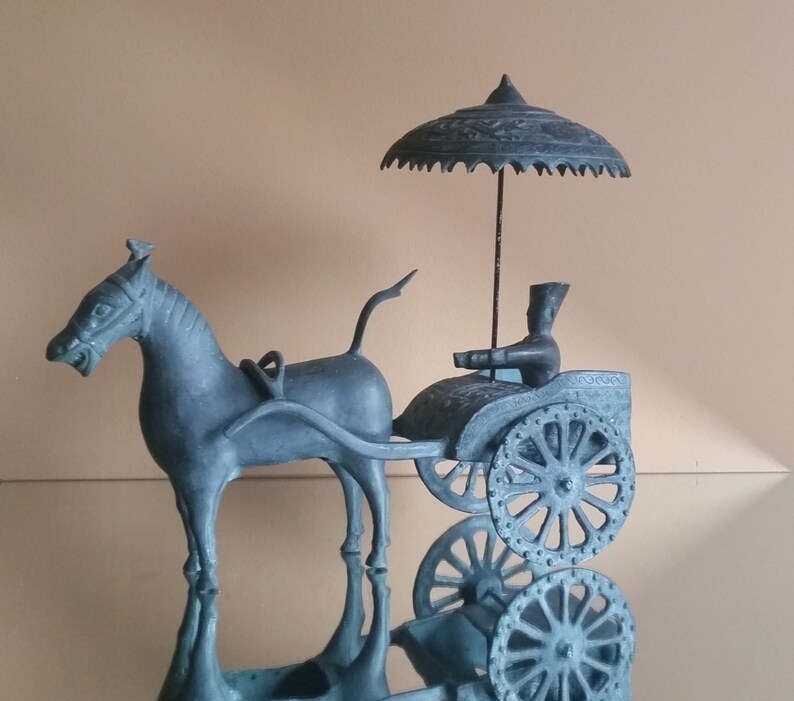
Likewise, in our own lives, we are literally the backbone, the supporting frame of our own lives. And if we’re not? We’re sabotaging ourselves. It all starts with us. We are in command of what we do with everything that comes into our lives and everything we send out into the world. We don’t get to choose what comes in, but we always get to choose what we’re going to do with it. We always have the ability to make lemonade out of the proverbial lemons.
When we externalize our happiness, self-worth, or personal power and peace, we are setting ourselves up for self-sabotage. When we let someone else rule over us or something govern our actions, we’re sabotaging ourselves. When we give someone or something else control of our state of being, we’re sabotaging ourselves. When we let other people become the center of our universe, or we let other things become the center of our universe and our entire lives revolve around them, we’re prone to self-sabotage.
Conversely, when we try to become the center of someone else’s universe, we’re also setting ourselves up for self-sabotage. Both of these are forms of self-sabotage. We live in a culture that constantly gives away its power to others and doesn’t even realize it. Every time we say, “oh, so and so made me so mad” or “so and so made me this or this made me that” or “if so and so does this, I’m gonna lose it!” we’re giving away our power to that person or that thing when the reality is nobody and nothing can make us feel anything that we don’t want to feel. We’ve just chosen, we’ve created a set of beliefs and a set of circumstances that become self-fulfilling prophecies where under these circumstances, I’m justified or forced in feeling and behaving this way – whether I want to or not – and we don’t even realize it! It’s all just programming! Anytime we let anything external dictate our happiness, our peace or our success, we’re setting ourselves up for self-sabotage because those externals do not have our best interests in mind. And yet, we subconsciously, unconsciously, unwittingly, unaware, ignorantly are choosing! That because it’s the culture that we’ve been raised in, we’ve grown up in. And we’re just not aware! But that’s actually what’s going on with self-sabotage!
Sunzi states that our self-leadership needs to be comprehensive and not fragmentary, so we cannot display a strong commitment to leadership in one area of our lives and not in others. For example, if we are uber-committed to our fitness regime, but not to our relationships. We’re sabotaging ourselves or vice versa. Take your pick. If we are super committed to work and excellence in our profession, but not in our home life, we’re sabotaging ourselves. All the money in the world is not going to heal a broken relationship, and even the best relationships are not going to create financial abundance. We need to eliminate those areas in our lives while we’re self-sabotaging and I’m speaking from experience. I’m a master of self-sabotage. I have been there. I still struggle with it, so what’s the solution? A good question to ask ourselves is: In what areas of our lives do we need to show a little more backbone and maybe not be so spineless? Are there some areas where we can show a little more backbone? Where can we create a little more structure? Where can we plan and get clear on what we want instead of failing to plan and therefore planning to fail? To really dig into this, I invite you all to go back to Episode 2: “Look in the Mirror – You are in Charge!” and Episode 15: “Six Butt-kicking Battlefield Beatitudes for Becoming the Master of our own Destiny.”
#2: Ignorantly Pushing Too Far
The second of Sunzi’s Seven “Sins,” for lack of a better word, of self-deception is ignorantly pushing an agenda too far. In other words, not being aware of and not knowing when we’re pushing things too far. We go too far sometimes. We don’t know when to quit, when to back down, or when to let things go and we force bad situations. Sometimes we push ahead, heedless of the cost. It can become an obsession, consequences be damned.
The etymology of the term that Sunzi uses here is advance or jin4 進 in Chinese. The ancient form of the character was comprised of a foot 止 beneath a bird 隹 beside a road 辶. It is literally a depiction of chasing after a bird on the road on foot. It brings with it a sense of being out of control or futility. If you imagine chasing after some bird running all over the place trying to catch this bird, it seems crazy. And yet, how often do we do something similar?

The etymology reminds me of a quote by Stephen King, of all people who said: “Some birds are not meant to be caged. That’s all. Their feathers are too bright. Their songs too sweet and wild. So you let them go. Or when you open the cage to feed them, they somehow fly out past you and the part of you that knows it was wrong to imprison them in the first place rejoices, but still. The place where you live is that much more drab and empty for their departure.” How many times in our lives when the bird has flown the proverbial coup, do we go chasing after it? Desperate to control it, to put it back in its cage. How many times when someone or something in life has given us the proverbial bird do go chasing after it to prove it wrong or seek revenge instead of just letting it go?
In the words of the classic Kenny Rogers song, “The Gambler:” ”You got no one to hold ‘em, know when to fold ‘em, know when to walk away, and know when to run.”
Herman Hess noted that: “Some of us think holding on makes us strong, but sometimes it is letting go that is actually strength.” Similarly, Eckhart Tolle stated: “Sometimes letting things go is an act of far greater personal power than hanging on.”
Sometimes it’s better to live to fight another day than to force a bad situation. We don’t always have to go down with the sinking ship. There are other opportunities that are awaiting us. So what’s the solution? Start by getting clear on what we really want and decide how we want to show up in any given situation, and then determine can this situation or this person or these conditions really give me what I want and if not, give yourself permission to let go and hold on to the belief that just because we couldn’t find it in this situation or this circumstance doesn’t mean that we can’t find it somewhere else; just because we failed in a business does not mean that there’s not a successful business endeavor out there for us somewhere else; just because we’ve been heartbroken in a relationship doesn’t mean that there isn’t a better relationship out there waiting for us; just because we’ve failed to achieve our fitness goals or our health goals or our financial goals or anything else that we want in this world in the past, doesn’t mean that we can’t get there in the future. It just means that something was missing from the equation this time.
So we go back to the drawing board and we need to believe that in order to let go, so that we don’t feel so desperate that this is my only chance at happiness! This is my only chance for success! This is my only chance for companionship! That’s why we stay in bad situations.
#3. Ignorantly Giving up Too Soon & Abandonment
The third of Sunzi’s seven deadly sins of self-sabotage is not being aware of or ignorance of when not to quit. This is essentially the opposite of #2. Far too often we give up, we give in, and we settle too easily. Instead of hanging on, hanging in, and pushing through just a little bit longer, staying out there in the fight, weathering the storm, we quit too quickly, concede defeat too easily, and run instead of fighting for what we really want. We abandon our goals, our dreams, and ourselves.
The character that Sunzi uses here is tui4 退, which means to retreat, to go inside, to withdraw, to slow, to waiver, or to abandon.
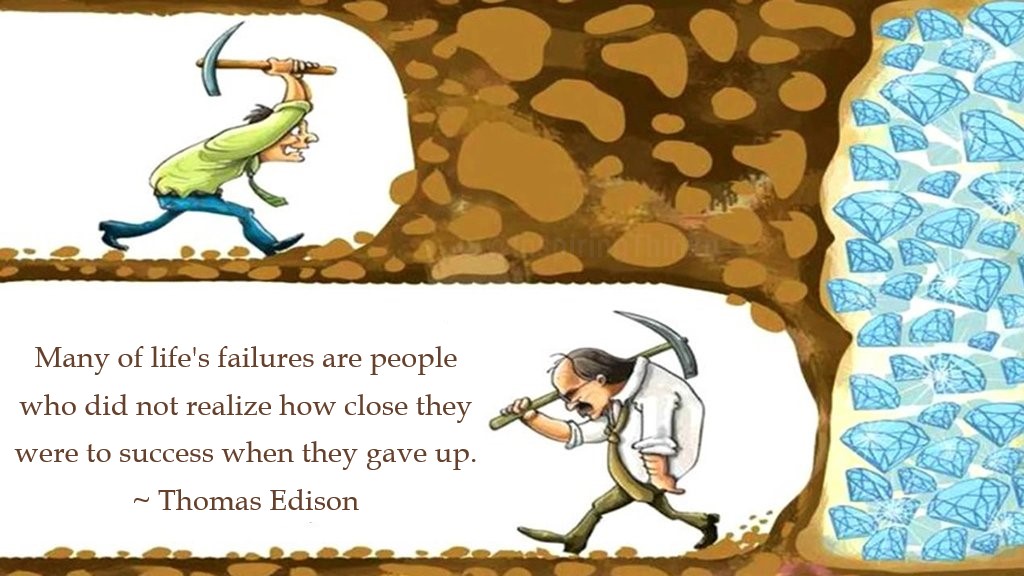
Thomas Edison once said: “Many of life’s failures are people who didn’t realize how close they were to success when they gave up.” I see this pattern in my own life a lot. I too often give up too easily in the pursuit of what I want and find myself stepping back into that comfortable role of the selfless servant without acknowledging or fighting for my own wants and needs, usually because I’ve also fallen into that first sin of self-sabotage – I’ve externalized my sources of happiness, of affirmation, of peace, and of success – and so I’m people pleasing or I’m trying not to rock the boat.
In Episode 23, I mentioned that I have abandonment issues from my childhood. Interestingly, as psychotherapist and founder of abandonment recovery, Susan Anderson has observed: “Self-abandonment is the emotional root of self-sabotage.” That fits me. When I abandon my dreams, I’m basically giving up on myself and my ability to create the life that I want – my worthiness or my deservedness to have the life that I want. This is a big one for me! So what’s the solution instead of pulling out, giving up or backing down too soon?
Again, decide on what is really important to you. What is the most important thing in a situation or circumstance or opportunity or relationship, and give yourself permission to hang in a little longer, even if it’s uncomfortable, even if there’s a risk, even if the possibility of failure looms over us like a shadow. Hang in! Hang on! Keep fighting a little longer! Even if it doesn’t work out, the act of hanging in there, staying in that fight a little longer gives us strength and peace.
I can’t remember if I’ve talked about this on the podcast. I did my Ph.D. work at the University of Indiana in East Asian Studies and minored in Religious Studies, and I completed all my coursework. I passed my qualifying exams. And the situation in the department had changed and people had left who had worked with the department had kind of imploded and they came back and told me they weren’t going to have any funding for me. And thankfully, my wife found this job at the US Air Force Academy, and so I took it and I started working on my Doctoral Dissertation away from IU, which was very challenging. My committee members were scattered. Communication tended to breakdown. I got distracted by other things. They would get distracted by other things. It was hard to maintain communication to get feedback in a timely manner, and I ended up with a whole lot of translations. My dissertation was on concepts of immortality, longevity, and deathlessness in ancient China – I like to say that my dissertation took forever! My first draft had all this translation. I had all this material. I had all this data. I didn’t have any questions. And it was terrible. And they tore it apart, and rightfully so. After that, I remember feeling like ‘I’m done. I’m never coming back to this!’ and so I literally set it on the shelf for a couple of years and I quit. I gave up. At that point I didn’t continue to push or fight hard. And that was right about 2010, 2011, and it was right about the time I was hitting my midlife crisis and just starting to really work on and become aware of a lot of my own issues and. so I just left it for a while and as I began to work on kind of my own personal recovery and my own growth and identify some of my issues, several people encouraged me to go back to it and I kind of shrugged it off, saying, “You know, it’s done. It’s over. I got nothing.”
After a couple of years, I realized that I did have something and I started to think, ‘You know, maybe there is something there and I and I should go back to this.’ So towards the end 2013, I passed my qualifying exams in 2008 and I had seven years of eligibility and so in late 2013, it started to come back to me and in 2014 I was reengaging, and so I wrote this dissertation in 2014 and I started sending in draft chapters and I started doing all this work. And I completed it just under the wire of my eligibility and the university came back and said we don’t have anybody who can guide you through a proper defense, and therefore we can’t give you a PhD. And I appealed. I went to the Dean. Again. I felt like this time I had that urge to just surrender, but I didn’t. I went to the Dean of the College. I went to the Dean of the University. I reached out to everybody I could think of. I went to the Board of Higher Education and in the end I still didn’t get my PhD, but I hung in that fight longer and I pushed myself harder and farther to not quit. And I have a certain amount of peace about it that I didn’t even though I didn’t get my Ph.D. I showed up in the end, and even though I lost on the technicality, so to speak, I fought harder than I would have previously for myself, and for my degree, and so I have a certain peace that I finished it anyway. Kind of like the runner who falls in a race and gets back up and finishes the race even though they finished dead last – even if they limp across the finish line – there’s value in that effort.
#4. Mishandling Matters and Indulging in Constant Confusion
The 4th of Sunzi’s “Seven Deadly sins of Self-Sabotage” is mishandling matters and indulging in constant confusion. This results from not knowing what we want out of a situation, or how to get it, or maybe we’re not giving ourselves permission to achieve it, which brings us back to “raising the BAR on our beliefs,” which I discussed in Episode 9. We have to believe before we can achieve and receive. The result of mishandling matters like this is constant confusion.
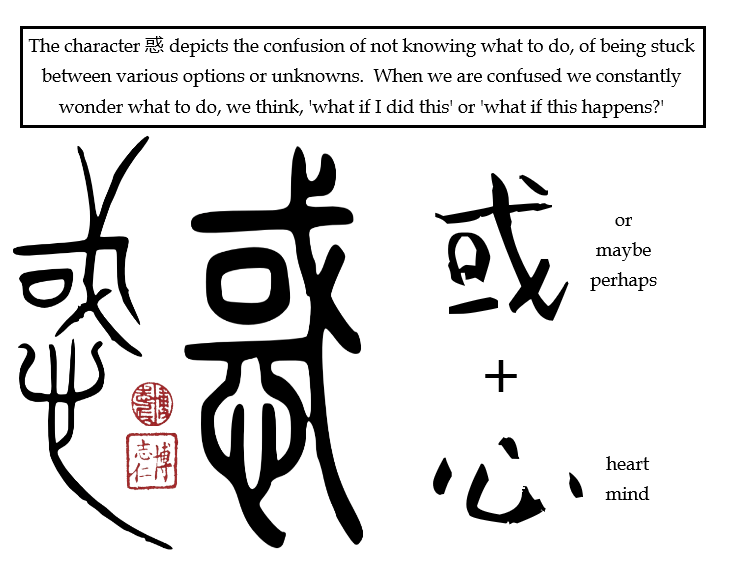
The character Sunzi uses here is huo4 惑, which means confused, perplexed, or bewildered. Its etymology is interesting. It’s comprised of a state 或 (also the phonetic) above a heart 心. The character for ‘state’ is comprised of that Chinese dagger-axe 戈 over a mouth 口 and the character for one 一. Just as we need to be willing to raise our voices and raise up our arms as one in defense of our state, our nation, or our country, what emotional and mental states are we willing to fight for? Conversely, a lack of clarity, a lack of unity, in this regard indicates that we’re confused and don’t know what we’re fighting for or why.
I’m reminded of the classic Genesis song, “Land of Confusion.” We are in charge of our own state of being mentally, emotionally, spiritually and socially. When we don’t know just what state we want to be in and that it’s our right to choose our state of being and to not let others dictate our state of being, that results in constant confusion and mishandling matters in our lives!
The Shuowen jiezi 説文解字, China’s earliest etymological dictionary, defines huo4 as chaos or turmoil. In this case, inner turmoil of the heart and mind. Life Coach Brooke Castillo has observed that confusion is a form of self-indulgence that separates us from our own wisdom – those arrows of applied knowledge that Sunzi talked about, when she stated: “We have so much more wisdom in ourselves, within ourselves, and access to so much more wisdom than we allow ourselves to know because we’re constantly indulging in confusion… Don’t live in the place of confusion. Don’t live in the place of ‘I don’t know.’ Don’t let yourself stay in that space, because when you do, you block all your progress. You block all of your opportunity to go into the unknown and you block all of your wisdom.”
When we indulge in confusion, we prevent ourselves from taking our shot and applying what we know. Again, this all comes back to certain belittling beliefs that we hold about ourselves. We don’t trust ourselves. We believe that we don’t have the answers. We don’t have the skills. We don’t have the experience or the expertise. We don’t have the knowledge, either because somebody told us or we just had an experience earlier in our in our lives where maybe we tried something and it didn’t work out.
I really like Brooke Castillo’s solution to confusion, which is this: Every time we find ourselves getting stuck in, ‘I don’t know,’ ‘I don’t know what to do,’ ‘I don’t know how to fix it,’ ‘I don’t know how to make it right,’ ‘I don’t know how to get where I want to be,’ or ‘I don’t know how to get what I want,’ anytime we find ourselves trapped in the “I don’t knows,” she always asks the question: “Well, if you did know, what would you do?”
This gives us permission to slow down, get out of that panic and get in tune with some possibilities and some options and some opportunities and some potential. So give yourself permission. You carry everything you need inside of you! And if you don’t know the answer, you may know how to find it, and you may know someone who does. So give yourself permission to find a solution to get out of that confusion and take a shot! Even if it doesn’t work the first time; even if it doesn’t work the first ten times, or the first 100 times! If it’s something we really want, give ourselves permission to figure it out and not just settle for, “I don’t know …”
We don’t have to live in a state of confusion! I think this happens because of certain belittling beliefs that we hold about ourselves. We don’t trust ourselves, which is one of Sunzi’s “Five Essential Leadership Attributes” that I talked about in Episode 4 and again just recently in Episode 23. I know for me, I didn’t trust myself. I learned to not trust myself, my intuition, my feelings, and therefore, I cut myself off from my own sources of internal wisdom. So trust yourself! You know you better than anybody else in this world! At the same time we’re capable of far more than we give ourselves credit for! So raise the bar.
#5. Bad Boundaries and Debilitating Doubts
The fifth of Sunzi’s “Seven Deadly Sins of Self-Sabotage” is the practice of bad boundaries and the indulgence in debilitating with doubts, which can lead to people pleasing, micromanaging and controlling others. In Episode 7: “Eight Tactics to Transform Your Life,” I discussed the importance of establishing good boundaries, which was the 6th of his eight tactics. There are a lot of great quotes there on good boundaries, so check it out!
Here I wanted to discuss the flip side: when we don’t establish good boundaries and either practice bad boundaries with others or allow others to practice bad boundaries with us. We’re sabotaging ourselves, the result, and perhaps even the cause of bad boundaries, is doubts, debilitating doubts!
The character that Sunzi uses here is yi2 疑, which means doubt or uncertainty. It depicts an old man with a cane and an open mouth conveying the sense of “uh …” or uncertainty. As Canadian American motivational speaker and self-development author Brian Tracy has said: “Self-doubt does more to sabotage individual potential than all external limitations put together.”
When we doubt ourselves and others, it’s usually because we don’t trust. We don’t trust ourselves or we don’t trust others. When we don’t trust ourselves, we often practice bad boundaries with others because we’re trying to people-please or seek external affirmation to offset our own lack of self-confidence. We’re spineless and are not being the general of our own lives.
When we don’t trust others, we often practice bad boundaries with them, such as manipulation, control, and micromanagement. When we do this, we cause others to doubt us and themselves, and when others do this with us, when we allow others to do this with us, practice bad boundaries, we’re creating doubt in our own lives and we’re reinforcing that doubt that they may have about us because we’re being spineless and not standing up for ourselves or being our authentic, true selves. The solution to defeating the debilitating doubts that cause us to practice bad boundaries, then, is to develop more trust in ourselves, more self-trust. So go back to that two-minute trust reflection I shared in Episode 23, “Warrior Mindset Unscripted.”
#6: Mistrust and the Imbalance of Personal Power
The sixth of Sunzi’s “Seven Deadly Sins of Self-Sabotage” is mistrust and the imbalance of personal power. What we’re talking about here is a lack of awareness, not understanding, or ignorance of when to take charge and when to trust others, when to lead out and when to delegate. This is all about chain of command. We can’t do everything! And we need to balance that out.

The character that Sunzi uses here is quan2 權, which means power or authority, and also a certain amount of balance to that power. The character is super interesting! The character quan2 is comprised of a tree 木next to a heron 雚. It is the ancient name for the yellow Birch wood tree, and it conveys the symbolism of unusual, uncommon, or extraordinary – the grace, balance, and power of the heron. A heron is a powerful hunter because it has great balance – even with those scrawny twig-like legs. If you’ve ever watched a heron fish, it just stands there waiting out in the water, waiting for its opportunity to strike.
As Thomas Paine put it: “The balance of power is the scale of peace.” As leaders, if we don’t trust the people around us or trust ourselves and therefore have the balance of power tipped too far in one direction or another, maybe we don’t trust ourselves so we delegate way too many things to other people or we delegate everything that we don’t feel confident doing or don’t want to do to others, resulting in those around us feeling like we never do any work. Or conversely, we hoard all the power ourselves and don’t give anyone else meaningful opportunities to lead and grow. When we do that, when that balance of power is tipped too far, in one direction or another, we’ll have no peace in our lives! We will feel that turmoil, that inner turmoil, that chaos! Will feel the need to control, manipulate and micromanage everything and everyone else around us! Everything everybody else does to try and ensure that we get what we want – but it is the ultimate form of self-sabotage! It’s no way to lead! It’s no way to live!
So how do we start entrusting others? Again, we get clear on what we want in our lives, out of our lives, and for our lives. And what kind of people can support and contribute to that. Then we attract and surround ourselves with those types of people by showing up in that way in our own lives. Sending that out into the world and modeling that for others, and then we trust them to do their jobs, play their parts, and fill their roles.

The best sports teams are not always the ones. With the biggest superstars. But the ones who can surround those stars with. Great role players. And the ones where those superstars can trust their role players. It takes a certain type of superstar athlete to make everyone around them better. Michael Jordan was a great example of this. He understood both the need to and the how to balance his own personal power on court with when to empower those around him. MJ took a lot of game-winning shots and he also set up a lot of other people on his team to take and make game-winning shots because he trusted them when the game was on the line, when the outcome was to be decided. So trust yourself and trust others a little more. Go back to that trust reflection exercise.
#7: Conflicting and Competing Desires
The last of Sunzi’s “Seven Deadly Sins of Self-Sabotage” is conflicting and competing desires. When difficulties arise, we feel inner turmoil. That’s what this describes. When we have conflicting and competing desires, especially when things get hard, we may feel pulled — we want to go one direction and yet we feel pulled in another – or we feel chained to another — like we’re tethered. We lack clarity and conviction, but allow ourselves to remain in a place of confusion and doubt. We create constant conflict, turmoil and chaos for ourselves and become subject and suspect to conflicting desires, competing priorities and other people’s agendas.
In Episode 21: “Overcoming the Anger of Frustration, Impatience, and Rash Action,” I discussed the concept of a divided heart. A divided heart often results in self-sabotage. Our self-sabotaging beliefs are like those bungee obstacles, where you’re strapped to a bungee cord with an anchor, like those inflatables, and you run and pull to see how far you can stretch out. It’s great strength training exercise! And in the beginning we can run and we can stretch it a little bit and then maybe we can crawl and we can climb and we can drag and we can stretch it a little bit further from that anchor point. But the further we push those limits, the further we push ourselves out from those limiting beliefs, the greater the internal resistance, and as soon as things get difficult, we usually get snapped back into our old familiar self-defeating habits, patterns, and behaviors.
As long as we’re tethered to our old ways of thinking and beliefs about ourselves, about each other, and about the world, we’ll never be able to get past our internal opposition, and what we want will forever remain just out of our reach. So, what can we do? What must we do? We need to get clear on our objective. What our “Big Deal” is, which we talked about way back in Episode 1. As I mentioned then and in several episodes since, when we get clear on our “Big Deal,” we may have the vision to achieve something new, but we may lack the beliefs to support it. That’s the work that we need to do to avoid self-sabotage. We must sever the tether. Cut the cord that controls us, break the bands that bind us, and cut ties with whatever it is that is holding us back, holding us down, and snapping us back into past patterns that will only allow us to progress so far. We need to level up our beliefs about what is possible and about our own potential. We need to set ourselves free.
Conclusion
In conclusion. Today we’ve talked about seven deadly sins of self-sabotage. They are:
1. Spineless leadership: not taking charge, showing up in our lives with little backbone, or not being the general of our own state of being, our own lives, livelihood, and well-being.
2. Ignorantly pushing an agenda too far. Not having the awareness of knowing when to quit, let go, and move on.
3. Ignorantly giving up too soon and abandonment – both self-abandonment and abandonment of our goals.
4. Mishandling matters and indulging in constant confusion.
5. Practicing bad boundaries and debilitating doubts.
6. Mistrust and the imbalance of personal power and
7. The internal conflict of competing priorities.
We’ve covered a lot of ground today, and I hope that this has been eye-opening and helpful for you. As someone who has struggled with self-sabotage throughout most of my life, I would encourage all of you go back to that “Face Your Fear” exercise in Episode 23 and determine what is more important than our fears and doubts and practice a little more courage. Be the general of your own state of being! Of your own life! And start to become aware of when maybe we’re pushing something a little too hard, a little too far, and when we need to step back, sit down, let go, move on; when to cut bait and when to cut our losses; and conversely, when we maybe need to hang in the fight a little more, and push a little harder; try one more time! Reach out again and not give up too soon, not give in, not settle! Never abandon our dreams, and never abandon ourselves!
We are powerful beings with a profound purpose on this planet! Don’t give up too quick on that! We have great gifts to give the world! Give ourselves permission to do so. Maybe step back and identify the areas where we tend to mishandle things or the circumstances. What are the triggers? What are the stresses that often result in us mishandling a situation? Give ourselves permission to get in touch with our own inner wisdom and take a shot! Try it, do something, don’t just sit there like a deer in the headlights of confusion. Stop doubting ourselves and start believing! Set some good boundaries, start to trust, and balance out our own personal power – when to take charge and when to delegate to others. And lastly, get clear on our priorities. Prioritize our time, our energy, and our lives!
The last thing I want to say is, if you struggle with self-sabotage like I have, believe that it doesn’t have to be that way. Dig into the beliefs that are fueling that self-sabotage because you deserve better. We can achieve more! We can have everything that you want in life – but we have to believe it first! We have to believe in order to achieve and receive. So regardless of whether it’s a better relationship or better job situation, better finances, better health, more peace, more happiness, greater abundance, whatever it is that you want that you’ve told yourself that you just can’t have, you can change it! It all comes back to beliefs.
When we change our beliefs, we end self-sabotage. You are worthy of all the best things the universe has to offer. Take a hard look at what’s underneath the surface of your self-sabotage and choose to believe something different. Then rise up! Show a little backbone! Don’t push things too far. Learn to let go of bad situations, believing that there will be better situations to come. Then fight for what you want. Don’t quit! Don’t give in! Don’t settle! Hang on! Hang in! Stay out there in the battlefield just a little longer.
Don’t indulge in constant confusion. Make a choice. Trust yourself. Don’t doubt. Just believe in yourself. Believe in those around you. Believe that the world will provide everything that you need to build the future that you want! Trust yourself to find your own way forward, because there is always a way to get from where we are to where we want to be in any area of our lives! Trust yourself that you’ll find it! Get clear on what you want and surround yourself with people who can help you to get there and put yourself in situations that can help you to create that.
In the words of Anthon St. Maarten: “No more excuses, no more self-sabotage, no more self-pity, no more comparing yourself to others. It’s time to step up. Take action right now and start living your life with purpose and on purpose.” It doesn’t matter how many times we’ve struggled with self-sabotage before. That’s gone! We can stop the self-sabotaging today. You can do it! You got this!
Thanks so much for listening everybody! If you found this podcast impactful, please, like and subscribe and join us for new episodes every warrior Wednesday. For more information, tools, and resources to help you in your daily battles, for questions or work with me, shoot me an e-mail at: artofwarforlife@gmail.com. Most importantly, always remember the power to win resides within! There is always a way!

 Warrior: The Art of War for Life - A Podcast on Winning
4 Comments