Episode 5: Four Keys to Tip the Scales of Life & Shift the Balance of Power in Our Favor

Introduction

Hey!  Hey! Hey!  Welcome everyone!  Thanks for joining us!  I am so glad you are here listening! I want to take a moment to personally invite you connect with me.  If you are listening to this episode, I want to hear from you!  It’s been a month since we launched and I would love to get some feedback on what you like about the podcast, what is working and what isn’t, what you want to hear more about, and what I can do better to help you start winning your daily battles.  I’d also love to hear what challenges you are looking to overcome, what you are looking to create, and what your “Big Deals” are.  So please shoot me an email at artofwarforlife@gmail.com or send me a DM on Instagram @artofwarforlife, and join the Art of War for Life Facebook page.  When you do, I will send you a free copy of the Sunzi Battle Planner I developed, which is a great resource to walk you through getting clear on your “Big Deal,” getting in touch with your why, working through Sunzi’s Five Strategic Success Factors, and how to level up our leadership with Sunzi’s Five Essential Attributes of great leaders.

Last week, we talked about Sunzi’s Five Essential Attributes for General Leadership and how to level them up!  As I mentioned a few weeks ago, next week, we are going to talk about Sunzi’s Six Traps of (Self)-Deception.  Today, we are going to discuss Sunzi’s “Four Keys to tip the scales of life and shift the balance of power in our favor.”

So let’s go!

Sunzi’s 4 Keys to Tip the Scales of Life and Shift the Balance of Power in Our Favor

Have you ever had an inspiring win?  Or the feeling of just totally crushing it in life?  Have you ever felt so on top of your game that you were filled with absolute confidence and just knew that everything was going to work out great?!  Like you were so “on” or in the zone that you just couldn’t miss?  That’s an amazing feeling!  On the flip side, have you ever just felt “off,” like things were just misaligned – that you just couldn’t get into a groove?  That no matter how hard or what you tried, that something was missing?  Or worse, that the deck was stacked against you, that you were destined to just take the “L” and that the odds are never in your favor?  I have been there so many times!  Wouldn’t it be life-changing if we could tip the scales and shift the balance of power in all areas our lives so that could have more of the former feelings and less of the latter? 

In Chapter 1, verse 5 of Sunzi’s Art of War, we read:

“The benefits of strategic planning come from listening, then turning what you hear into tactical advantages that can assist you out in the field. Tactical advantages are utilizing potential benefits to control the balance of power.”

From this passage, I’ve derived four key actions for dominating our daily battles, which form the acronym LISTEN, which stands for Listen (& Learn), Strategize, Transform into Tactics, and Engage. 

If you haven’t realized it by now, I love acronyms because they are easy to remember and help to focus my thinking.  That, and in the military, we love our acronyms, so it is kind of ingrained in me now. 

So how do we gain those benefits of strategic planning?

Key #1: LISTEN

2,500 hundred years ago, Sunzi identified the art of listening as the first key action for unlocking the benefits of strategic planning.  In Chinese, the character to listen or hear 聼 (Simplified: 听), which is pronounced ting1 in Mandarin, is literally regarded as the virtue of the ears.  The oldest form of the character found in the Oracle Bones, which date back over 3,000 years, depicts an ear beside one or two mouths – or the ability to hear what others are saying. 
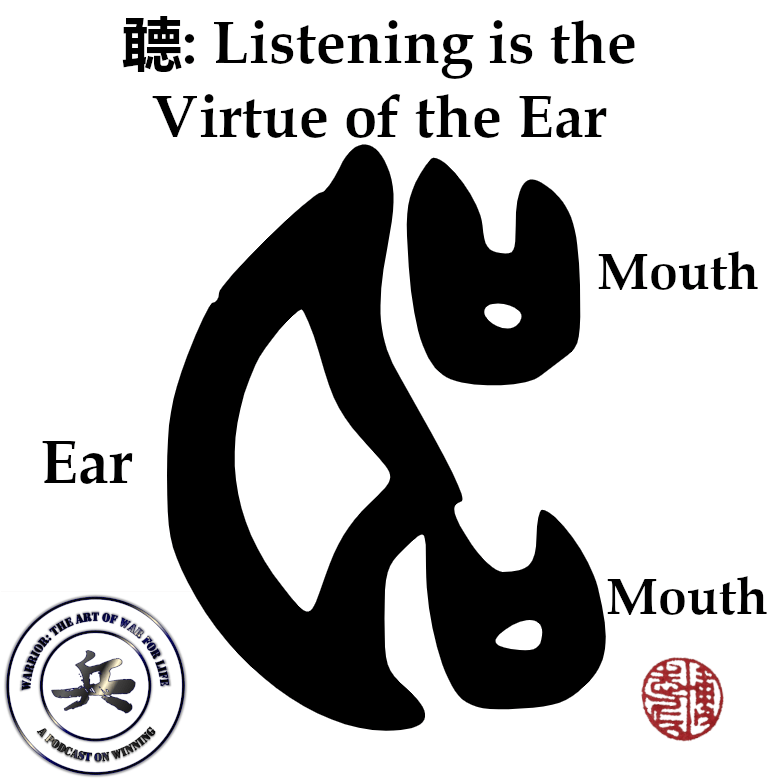
Someone once said: “Listening is a great way of receiving gifts of wisdom, intelligence, and inspiration, [if] we but only hear.”  Last week we discussed what our lives would look like with a little more wisdom, one of the five essential leadership attributes that Sunzi lists.  The art of listening is essential to leveling up our wisdom and yet far too often we let ourselves get distracted and our own inner voice of wisdom gets covered up in the cacophony of culture.

In today’s “digital age” we are constantly bombarded with information.  At the end of 2020, the digital world was composed of 44 zettabytes, which is 44 trillion gigabytes of information – and that astounding number is growing exponentially!  It is estimated that by 2025, there will be over 200 zettabytes of information in the cloud!  We now carry more information in our pockets than entire ancient civilizations had at their disposal – but are we any better for it?

According to the Harvard Business Review, “the surging volume of available information—and its interruption of people’s work – can adversely affect not only personal well-being but also decision making, innovation, and productivity.”[1] 

If knowledge is the arrow, as we discussed last week, with so much information at our disposal, who should we listen to?

Our Hearts

In order to re-center our lives from the constant pull of information overload and recover our inner voice of wisdom so that we can hit the targets in our lives with the arrows of applied knowledge, we need to first listen to our hearts and get back in touch with ourselves.  As Carly Fiorina, the first female CEO of a Fortune 20 company, now turned politician, has said: “You have to master not only the art of listening to your head, you must also master listening to your heart and listening to your gut.”

What do our hearts tell us?  This brings us back to our soul yearnings and to our “Big Deal.”  What is it that we really want?  What is the most important thing to us in our lives right now?  And, as we discussed last week, why.  Because our Why is our Way forward!

Letting go of all the negative names, all the limiting labels, all the belittling beliefs, all of the parasitic practices, and embracing the infinite possibilities available to us in this moment, what is it that we want to believe about ourselves, about each other, and about the world?  What do we want to believe is possible?  Start there.

Inner Circle

Next, listen to our people.  Once, we have spent some time really getting in touch with ourselves, then we go to our inner circle, our support network, our trusted cohort – those who have our backs, love us unconditionally, and want to see us succeed and thrive in our lives and listen to what they have to say, and we share with them what we have learned in listening to our hearts. 

American Psychiatrist Karl A. Menninger (1893-1990) said: “Listening is a magnetic and strange thing, a creative force.  The friends who listen to us are the ones we move toward.  When we are listened to, it creates us, makes us unfold, and expand.”

If we are stuck in the process, it is a great idea is to go these people first and ask them, “Hey what makes me unique?  What would you say my strengths are? What are my talents?”  Because sometimes, we are so boxed in that we can’t even see those things in ourselves, and we are blinded to the talents and abilities that we are already using and just don’t realize.

Outer Circle

Then, we go listen to those in our outer circle, to those we know, and sphere of influence and we ask them.  What is your biggest challenge right now?  What help do you need? What would you like to see happen?  What would help?

Lastly, we listen to what is going on in the world around us.  What are the trends and patterns.  What do people need right now?  What are they looking for?  Who has achieved the outcomes and results I want in my life?  What plans, strategies, and tactics did they use to get there?  This is all about getting curious and collecting information.  The better we listen, the more our strategic plans will benefit.

No matter how long it has been since we have listened to our hearts, we can begin, once again, to do so now and as we do, we will recover the voice of our inner wisdom.

Key #2: Strategize 計

The second key action that will tip the scales of life and shift the balance of power is to strategize.  Interestingly, the Chinese character for strategic plans or planning 計 (Simplified: 计), pronounced ji4, is comprised of speech 言 and the number ten 十, which is a symbolic number implying completeness and perfection.  This indicates the importance of hearing what a lot of people have to say. Once we have done that, it’s time to strategize – to develop some strategic plans.

When I was a little kid, I had a lot of plans for my life.  I wanted to be an explorer, an archaeologist like Indiana Jones.  I wanted to recover things that were lost in the sands of time, uncover things that were buried beneath the surface, and discover things that could change the world. I also wanted to be a Ninja.  Go figure.

Somewhere along the way amidst the heartbreaks, setbacks, and disappointments, I stopped believing in myself, in my potential and in the infinite possibilities that lay ahead.  As I did, I began to shelve those dreams and plans for my life, and to settle for less and less.  It wasn’t so much a singular act, but rather a slow death of a thousand cuts.  Like a favorite childhood book I once read multiple times each day that I took off the shelf and looked at less and less as I got older, my dreams and plans were largely pushed aside and crowded out by “reality” and relegated to the margins of memory, only to be recalled occasionally, to be reminisced of fondly, to be longed and pined for desperately, but rarely to actually be reached for, and acted upon.

There is an old adage, “If you fail to plan, you plan to fail.”  For a long time, I didn’t have much of a strategic plan and I didn’t realize that I was setting myself up for failure by not having one. 

I thought I had a plan but it was more like 12% of a plan, which according to the Guardians of the Galaxy is NOT a plan, and barely a concept.

Business strategist Ellie Pidot provides us with a great definition of strategy: “Strategy is a fancy word for coming up with a long-term plan and putting it into action.”  That is the heart of strategic planning. 

I don’t remember who said it but: “First we observe and then we serve.”  We take all that information we recovered through listening to our hearts and gained by listening to our inner and outer circles, to those who have achieved what we want to create in our lives, to what is happening in the world, and then uncover the plans and identify strategic opportunities to set ourselves up for success in pursuing our “Big Deal,” serve others, solve problems, and provide solutions.  We are purposeful beings on this planet with great gifts to give the world.  How do we do that?  By getting tactical!

Key #3. : Get Tactical

The third key action for tipping the scales and shifting the balance of power in our favor on the battlefield of life is to get tactical.  Once we have synthesized a general strategic plan of how to accomplish our “Big Deal” from everything we have learned through listening, it is time to get tactical, to transform those strategic observations and opportunities into tactical advantages that can help us out there in the real world.

There is a funny story I heard.  “Two men formed a partnership. They built a small shed beside a busy road. They obtained a truck and drove it to a farmer’s field, where they purchased a truckload of melons for a dollar a melon.  Then they drove the loaded truck to their shed by the road, where they sold their melons for a dollar a melon. They drove back to the farmer’s field and bought another truckload of melons for a dollar a melon.  Transporting them to the roadside, they again sold them for a dollar a melon. As they drove back toward the farmer’s field to get another load, one partner said to the other, “We’re not making much money on this business, are we?” “No, we’re not,” his partner replied. “Do you think we need a bigger truck?”

While their strategy of selling melons along a busy roadside was sound, their tactics were ineffective.  They did NOT need a bigger truck.  A lot of times, the answer to our problems is NOT just to work harder, work longer hours, or do more of the same, but to find a transformational tactic that can tip the scales and shift the balance of power in our favor, thereby increasing our chances for success.

The Chinese word for tactical advantages 勢 (Simplified: 势) is pronounced shi4 in Mandarin.  It can also mean power, potential, force, tendency.  The character has a rich two-fold etymology, both stemming from agriculture.  The character for shi4, or tactical advantages, is built upon the character 力 li4, meaning might or strength, at its base.  It is a depiction of a plough beneath a person kneeling and holding a seedling or a crop start (埶).

The invention of the plough radically revolutionized agriculture in China, as it did throughout the world.  The plough allowed ancient farmers who had previously been limited to digging and sowing seeds by hand, to harness a strength far greater than their own – that of horses, oxen, or other domesticated livestock.  This in turn, gave farmers the potential to plant more fields in less time, which led to greater harvests, supporting larger populations.  This was a total game-changer for humanity!  One that changed the trajectory of civilization.  Any farmer who had a plough was at a dramatic advantage over those who prepared fields through manual labor.  Communities, cultures, and civilizations who developed the plough earlier than others likewise possessed a decided advantage over those that didn’t.

The top half of the character 埶 is a depiction of a person kneeling down, holding a seedling or crop start for planting, with all of the potential it contains within it to grow and provide an abundant harvest for years to come.  See, a single plant carries within it more than enough seeds to repopulate.  A stalk of rice grown from single grain of rice will produce about fifty additional grains of rice.  A single sunflower can produce between 80 to 200 seeds, an average oak tree can produce about 10,000 acorns a season, and a single orchid plant will produce an estimated 4 million seeds a year!  That is potential!

Just as the plough revolutionized agriculture, there are tactical advantages that allow us to harness a strength greater than our own, to increase our potential and efficiency, waiting to be discovered in every area of our lives.  I call these advantages transformational tactics because these are game-changers.  They open up new possibilities and opportunities.  In economics, these would be a whole new market, a disruptive technology, or a groundbreaking approach that gives us access to things that were previously inaccessible.  These bring new fields or endeavor into cultivation for us and allow us to serve and support more people in a greater capacity.   These are broadening perspective changes and paradigm shifts that allow us to see what was previously invisible.  Far from “miracle cures”, these are tactical tools we use to help tip the scales and the balance of power in our favor, so that we can work smarter and not just harder, which leads us to the last key action.

Key #4. : Engage – Get Out There

The fourth key action that Sunzi identifies is to engage, or literally to get out there!  There is a recurring theme in Star Trek called the “Ready Room” scenario, where the Captain and the command officers get together and discuss the problem or difficulty they are facing.  After listening to all of the information and perspectives available, they then decide on the best strategy for resolving the issue and the most effective tactics for making it happen, then it is time to move, to act.  It was Captain Jean-Luc Picard, who popularized the command “Engage” whenever they set out to their far-off destinations with a strategic plan and tactical advantages in place.    

The Chinese word here (外 wai4) refers to just that; to “getting out there” and implementing in the field.  This is where all the listening and learning and all the general strategizing become boots on the ground, butt-kicking tactics that tip the balance of power in our favor and enable us take control out on the battlefields of life.  Or, more peacefully, to sow the seeds and reap the harvest of the abundant life we are looking to create. 

Conclusion

Whenever, we listen, listen to our hearts, and get in touch with what is really important to us, and to our why, listen to those who unconditionally love and support us, and who truly have our best interests in mind, we increase our wisdom, or our ability to achieve our goals and hit the bullseyes we are aiming for in our lives.  As we take all that we have learned in that process and look for openings and opportunities to apply it, we will develop and synthesize strategic plans and transform them into tactics that tip the scale and shift the balance of power in our lives, opening up new possibilities and potential for growth and abundance.  We don’t need a bigger truck!  We only need to recover our inner voice of wisdom, uncover the plans and purpose of our lives that we have let get buried under the dirt and detritus of disappointment and distraction, and discover the transformational tactics that will change everything for us, that will tip the scales and shift the balance of power so that we can start winning in life again and more abundantly!   So listen to our hearts this week!  Then get out there and share!   It’s time to engage!


[1] https://hbr.org/2009/09/death-by-information-overload

Episode 4: Level Up Your Life! Sunzi’s Five Attributes of Great Leaders & How to Develop Them

Listen to the full episode on Spotify, Apple, Google, Amazon, or wherever you get your podcasts.

Hey!  Hey! Hey!  Welcome everyone!  Thanks for joining us!  I am so glad you are here listening! 

Last week, we talked about Sunzi’s Five Strategic Success Factors, the fourth of which was general leadership.  Today, we are going to focus on these five essential leadership attributes and a couple of simple actions to help us develop them.

So let’s go!

The Five Essential Attributes for General Leadership

In last week’s episode, we talked about how the Way, or Dao, is the Way of leadership.  It is the vision a leader has at the crossroads of choice to take action.  Sunzi lists five essential attributes for generals.  They are: wisdom, trust, empathy, courage, and disciplined determination.  These are equally applicable as general leadership attributes outside of a military context. 

Wisdom

The first essential general leadership attribute that Sunzi lists is wisdom.  Dan Millman said: “Wisdom is the use of knowledge.”  Interestingly, there is a similarly close connection in Chinese between wisdom and knowledge.  The etymology of the Chinese character for knowledge comes out of the archery tradition.  It depicts an arrow next to a mouth.  In ancient China, archery was used both for hunting and warfare.  It was an essential skill to protect and provide and is a difficult art to master, requiring a lot of practice and instruction. 

I can imagine the novice archer shooting volley after volley at the target with some success but not satisfied with their results and then the master archer coming over and whispering something in the novice’s ear with their arrow nocked ready to release and then suddenly in a flash of understanding it clicks and the archer can now hit the bullseye more consistently.  See, knowledge, applied knowledge is power.    

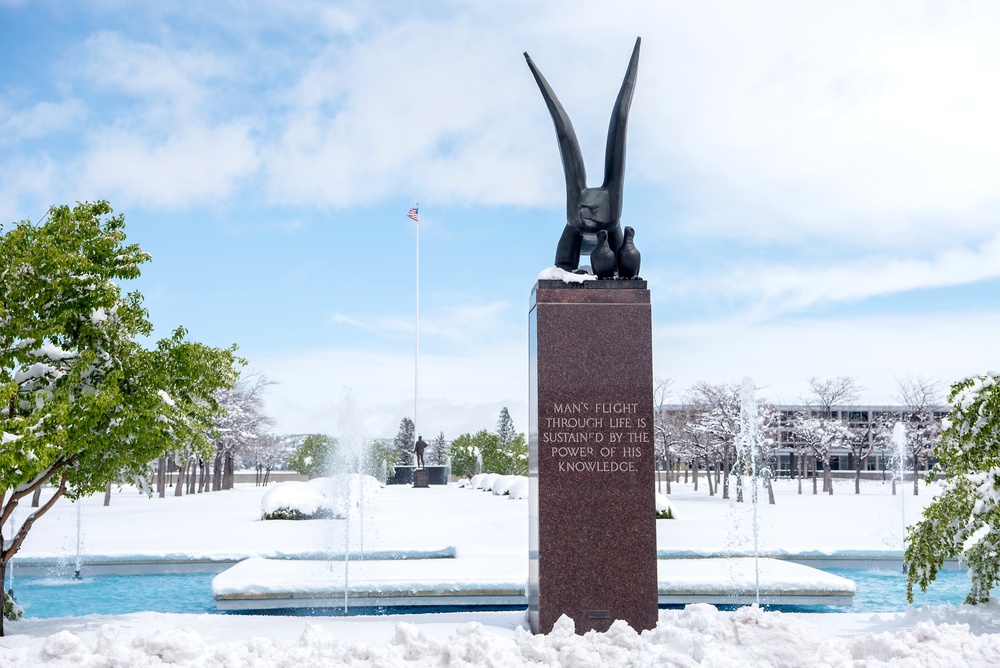
I’ve mentioned in previous episodes that I’ve taught at the U.S. Air Force Academy for 15 years now.  The heart of the Cadet Area is the Terrazzo, which was designed by landscape architect Dan Kiley. The name comes from the walkway’s terrazzo tiles that are set among a checkerboard of geometric marble strips forming a square around the grassy knoll known as “Spirit Hill,” with a historic plane standing as a sentinel in each corner.  On the east side of the Terrazzo lies the Air Gardens, boasting two reflecting pools and fountains.  On the south side of the Air Gardens is the famous Eagle and Fledgling Statue.  I passed by it just this morning.  The inscription by Lt. Col. Austin “Dusty” Miller, USAF (1914-2006) reads: “Man’s flight through life is sustained by the power of his knowledge.”  Each of us, man or woman, is sustained by the power of our knowledge – and more specifically by the knowledge we master and learn to apply in our flight through life.     

Interestingly, the Chinese character for wisdom contains the character for knowledge within it and adds to it noteworthy speech and a set of calipers for measuring.  If knowledge is the arrow of the mouth, or the ability to utilize what we know to protect and provide, wisdom, is both the ability to articulate what we know and share necessary information with others in a timely, learning-focused manner and the ability to internalize and act on the information being shared by others – what others know – and apply in our own lives.  Wisdom is the ability to apply knowledge to gauge where we are in relation to our target, our goal, or our desired outcome.

The general doesn’t have to be the smartest person in the room and neither do we.  In fact, if we are, we may want to find a better room.  No, just need to be able to share what we know in accessible ways and apply what others know.  In other words, while it is true that all of us no more than we apply – increasing wisdom is closing that gap. 

All this talk of wisdom, knowledge, and arrows has got me thinking of the Avenger Hawkeye.  I have always related to him because he has no superpowers and yet, he has an arrow for every occasion and can make the shot.  As we increase our wisdom, we load our quiver with knowledge we can apply in any situation.

So how do we increase our wisdom?  We can start by reflecting on these questions to determine where we are and where we can improve.  How well do I articulate what I know so that others clearly understand?  How well do I apply and help others apply knowledge?  How well do I let others share what they know?  How well do I apply others’ knowledge as a tool to help myself and others?

Wisdom has two skills then.  The ability to share what we know and make it accessible, applicable, and actionable for others.  The better we do that, the more we empower others.  The second skill is the ability to leverage the landscape, the intellectual landscape in this case, to apply what other people know, the knowledge that they have to our own lives, so that we can stand on the shoulders of giants and don’t have to reinvent the wheel.

Here are two simple actions to try this week to increase our wisdom.  First, when sharing what we know, focus on what people are hearing instead of on what we are saying or teaching.  What are people picking up?  Are they getting the right message?  Do they understand what I am offering?  Second, on the flip side, create an environment that encourages people to share what they know.  Get curious about people’s passions and expertise.  Ask lots of questions.  Then find ways to apply their knowledge and insights.  As we do, we will find that our quivers will be fully loaded with the arrows of applied knowledge.

Trust

The second essential attribute of general leadership listed by Sunzi is trust or trustworthiness.  It’s etymology in Chinese is simple and straightforward.  Trust 信 is composed of a standing person 亻 next to speech 言 or literally, to stand 立 (inverted) by the words of our mouths 口.  Trust, then is the integrity to have our actions reliably match our words in transparency and honesty.

Some people say that trust is earned.  Others hold that trust is given.  I’m going to be honest here and admit that I have not always been the most trusting or trustworthy person.  This one is one of the hardest ones for me.  See, I grew up as a people pleaser, so I would say a lot of things in the moment to appease people that I did not follow through on.  I made promises, I didn’t keep.  I offered things, I couldn’t give.  This hurt my integrity.  As I dug deeper into this issue, I discovered that at the heart of it all was a lack of self-trust. 

I thought that I did not trust myself because I had made and broken so many personal promises over the years.  As I peeled back the layers and got to the pith of the problem, I discovered that 

As German poet, playwright, novelist, scientist, and statesman Johann Wolfgang von Goethe (1749-1832) has stated: “As soon as you trust yourself, you will know how to live.” Because I didn’t trust myself, I didn’t know how to live and I had a hard time trusting others.  I couldn’t give something to others that I wasn’t giving to myself.  So, in the words of Nepalese poet Santosh Kalwar: “Trust yourself, you will start to trust others.”

What can we do to increase our trustworthiness and be more trusting?  We can begin by reflecting on where we are, then work to improve, and reveal and resolve issues that come up that affect our trustworthiness and our ability or willingness to trust others.  How well do my actions reflect my words?  Do I do what I say I will?  Is my word my bond?  Do I stand by what I say?  Do I say what I mean?  Some say trust is earned, others say that it a gift.  How can I both earn and give the gift of trust to others?

Lewis Cass (1782-1866) said: “People may doubt what you say, but they will believe what you do.”  So stand by what we say.  Our word is our bond.  People believe behavior.  Be honest with ourselves and others.  Give others the gift of trust and the opportunity to stand by what they say.  Most importantly, begin with leveling up our self-trust.  As Ralph Waldo Emerson (1803-1882) wrote: “Self-trust is the essence of heroism.”  So “Trust thyself, for every heart vibrates to that iron string.” Forgive ourselves for our past mistakes.  Give ourselves a second chance, a clean slate, a fresh start – because each of us is worthy of our own trust.  Each of us deserves to stand by ourselves – to be our own greatest advocate, not just our greatest critic.

Empathy

The third essential characteristic for general leadership mentioned by Sunzi is what I call empathy.  It is also more regularly translated as benevolence, humaneness, or co-humanity.  The character for empathy 仁 is composed of a standing person 亻 next to the number two 二.  Empathy, then, is the ability to relate to the experiences and emotions of those around us through our shared humanity.  It is the cornerstone of interpersonal emotional intelligence.

Brene Brown has stated: “Empathy doesn’t require that we have the exact same experiences as the person sharing their story with us…Empathy is connecting with the emotion that someone is experiencing, not the event or the circumstance.” When I see someone struggling do I get in touch with the times in my own life that I have struggled with similar feelings and thoughts?  Do I look upon others as people with passions and pain, dreams and doubts?  Returning to Brene Brown: “Empathy has no script. There is no right way or wrong way to do it. It’s simply listening, holding space, withholding judgment, emotionally connecting, and communicating that incredibly healing message of ‘you’re not alone.’” Leaders who do that connect with and gain the fierce loyalty and devotion of those they serve.

How do we develop empathy?  Start by looking at others as whole beings with strengths and weaknesses, struggles and successes.  When others are struggling, we can choose to get in touch with our own humanity to connect with them through the power of empathy. As Oprah Winfrey aptly put it: “Leadership is about empathy. It is about having the ability to relate to and connect with people for the purpose of inspiring and empowering their lives.” 

Courage

The fourth of Sunzi’s five essential attributes for general leadership is courage or bravery.  Courage is the ability to act boldly and bravely in pursuit of what we want and inspire others to join us in the fight.  In Chinese, courage 勇 is the strength 力 to get to work, to find or make a way, plough a field, haul buckets, or build a pipeline for ourselves and others.  Courage reverberates and resonates like the clarion call of a bell 甬.

For much of my life, I was a coward – paralyzed by my internal fears and doubts.  Fears and doubts, that as I mentioned in Episode 0, pretended to useful and helpful – protecting me – but they weren’t.  They did not serve me at all.  See, as rapper, actor, and motivational speaker Wil Smith has said: “Fear is not real. The only place that fear can exist is in our thoughts of the future. It is a product of our imagination, causing us to fear things that do not at present and may not ever exist. That is near insanity.”  That was my inner life.

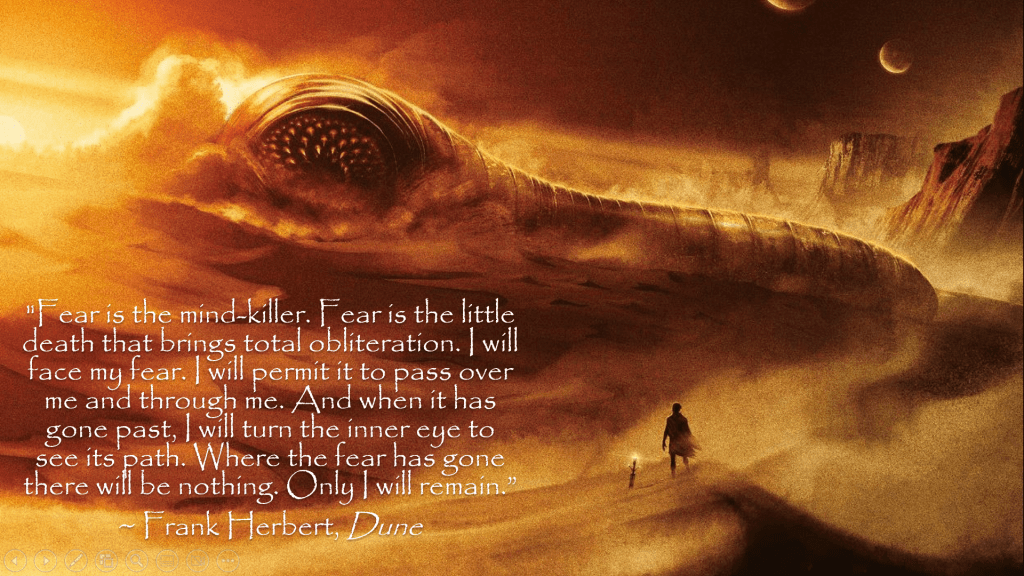
What do I use my might and strength for?  Does it serve only myself or does it extend to others?  This returns us to our soul yearning, our “Big Deal,” our “Grand Endeavor.”  What am I willing to fight for, to work for?  Without courage, fear takes over in our lives.  My favorite quote on fear comes from Frank Herbert’s (1920-1986) epic novel Dune: “Fear is the mind-killer. Fear is the little-death that brings total obliteration. I will face my fear. I will permit it to pass over me and through me. And when it has gone past I will turn the inner eye to see its path. Where the fear has gone there will be nothing. Only I will remain.”

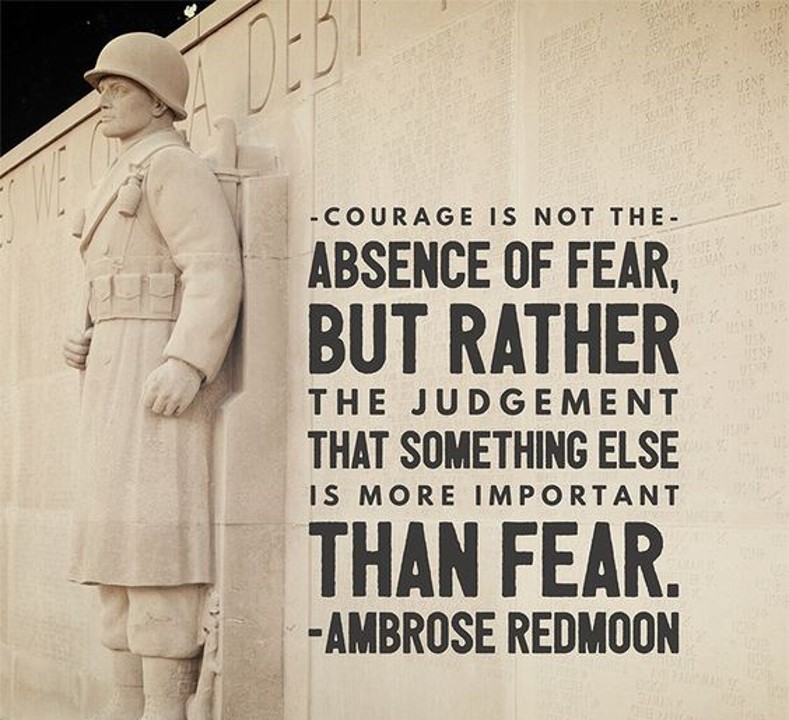
How do we develop courage?  We can use our strengths to bravely find or make a way forward for ourselves and others.  Let our courage to face our fears and get out there and work inspire others to action.  Do something we have been afraid to do. As we face our fears with courage, we give others permission to do likewise.  See, in the words of Ambrose Redmoon (1933-1996): “Courage is not the absence of fear, but rather the judgment that something else is more important than fear.”  So, what is more important to us than our fears?  What is it that emboldens and empowers us to face our fears? 

Disciplined Determination

The last of Sunzi’s five essential characteristics for general leadership is what I call disciplined determination.  Abraham Lincoln (1809-1865) said: “Discipline is choosing between what you want now and what you want most.”  The Chinese word here means strict, severe, serious, and disciplined.  It also means respect.  The character is comprised of two mouths above dangerous cliffs overhanging the character for boldness or daring.   determination, perseverance, grit.  It is the ability to persevere and the grit to not give up in the face of criticisms and setbacks.

When things get serious, severe, & hard, when we are facing overhanging cliffs of challenge 厂 and people are mocking and doubting 吅, saying we aren’t going to make it, discipline is the daring determination 敢, the grit to claw and climb and work our way up with any tools 攵 we have for as long as it takes to reach the top.

The greatest example of this to me comes from American rock climber Chris Sharma. He’s arguably the greatest rock climber the world has ever known. One of the most outrageous and amazing rock climbs ever filmed was when he climbed up the underside of this freestanding limestone arch known as Es Pontas, off the coast of Mallorca. Es Pontas, known as “The Bridge,” is considered to be one of the hardest climbs in the world. If you fall, you plummet straight into the water forty feet below. Climbing ropeless above the Mediterranean Sea, Sharma spent months attempting to make this climb, but he kept getting stuck at this 7-foot dyno. He splashed down at least fifty times, dropping into the ocean below. He had to swim back to shore, dry himself off, swap out his gear, and try again. Finally, after falling fifty times, he stuck it! But that wasn’t the end. Climbing further up, he fell many more times than that, at the even harder lip of the arch. After over a hundred falls plummeting into the ocean, he finally made the first ascent in September of 2006. That is grit. That is disciplined determination!

I love Angela Duckworth’s concept of grit, which she defines as the power of passion and perseverance.  She challenges us with this great series of questions: “How often do people start down a path and then give up on it entirely? How many treadmills, exercise bikes, and weight sets are at this very moment gathering dust in basements across the country? How many kids go out for a sport and then quit even before the season is over? How many of us vow to knit sweaters for all of our friends but only manage half a sleeve before putting down the needles? Ditto for home vegetable gardens, compost bins, and diets. How many of us start something new, full of excitement and good intentions, and then give up—permanently—when we encounter the first real obstacle, the first long plateau in progress?  Many of us, it seems, quit what we start far too early and far too often. Even more than the effort a gritty person puts in on a single day, what matters is that they wake up the next day, and the next, ready to get on that treadmill and keep going.”

In what areas of my life can I practice more daring determination instead of shrinking before the voices of my (inner) critics?  This brings us back to last week’s idea of attacking those antagonistic voices inside ourselves and adopting an atmosphere of awesome accomplishment and achievement where we expect to do whatever it takes to win and will adjust our approach to ensure that instead of allowing an atmosphere of anxiety and apathy determine the results that are available to us.  Each of us can choose an area of our lives to practice more disciplined determination in.  As we do so, it will get easier.

Stop for a moment and think what our lives would look like if we leveled up our leadership in these five areas.  What problems would we be able to solve and solutions would we be able to provide with our quivers full of the wisdom of more applied knowledge?  What would our relationships look like with greater trust and empathy for each other?  If we stood by our words and engaged with those around us from the place of our own humanity?  What seeds could we sow, what risks could we take in our lives and how could we better inspire others out there with the clarion call of greater courage to stare down the illusion of our fears and push through them to the other side?  What mountains could we climb if we had greater disciplined determination to ignore and not be dissuaded by the absurd objections of naysayers and doubters that would see us crushed against the cliffs of criticism? 

Questions or comments? Feel free to shoot me an email at: artofwarforlife@gmail.com.

Episode soundtrack by Sentius

Episode 3: Sunzi’s Five Strategic Success Factors

“If you fail to plan, you plan to fail.”

Summary

In Episode 3, we discuss Sunzi’s Five Strategic Success Factors that we need to Manage, Improve, Reveal & Resolve, Observe, and Repeat (The actions from last week’s episode on the MIRROR).  They are: 

1. Your Why is Your Way

2. Create a Climate of Conquest & Overcoming Challenges/Adopt an Atmosphere of Awesome Accomplishment

3. Leverage the Landscape & Enjoy the Journey

4. Level Up Your Leadership!

5. Systematize Success

This episode features an experimental underscore by Sentius

Transcription

Hey!  Hey! Hey!  Welcome everyone!  Thanks for joining us!  I am so glad you are here listening!

These first few weeks of the podcast have been amazing!  So many friends and former students have reached out with just a massive outpouring of encouragement!  I really appreciate that because I’ve never done anything like this before and at times the learning curve has felt a little overwhelming but then I think about all of you.  I’ve had people from all over the U.S., Canada, the U.K., Australia, and even Bangladesh tune in and listen.  It’s both humbling and energizing, so thank you for your support!

I am so excited about this week’s podcast!  This is one of the topics that really got me started.  Last week we talked about the concept of the MIRROR, 6 critical actions for achieving victory once we have gotten clear on what our “Big Deal” is.  The first of those actions is to manage, to start where we are, take charge of our lives, and start pulling our own strings.  Sunzi specifically stated that there are five things that we need to manage our daily battles and start winning.  Today, we are going to focus on these five strategic success factors.

So let’s go!

5. 法: Systematize Success

Checking in at #5 is the concept of systematizing success.  What specific tactics can I employ, approaches can I take, and solutions can I come up with to achieve my goal?  What systems, processes, and strategies have others used to create similar outcomes?  How can I turn obstacles into opportunities?  What steps can I take now to move forward?  What habits and routines can I install in my life to support the pursuit of my “Big Deal?”

The Chinese character here is the same one used in the title of the book translated as “Art.”  It has a rich set of meanings and a fascinating etymology.  As a noun, it refers to methods, laws, rules, standards, and regulations.  As a verb, it means to model and emulate, to embody and to exemplify.  How are these two meanings related?

The etymology of the word is fascinating.  It literally refers to crossing a river. The Chinese landscape is dominated by two giant rivers running west to east – the Yellow River and the Yangtze River.  These are, at times, very dangerous.  Before bridges, people had to find their own way to ford or cross safely without losing their footing and being swept downstream. 

The most ancient form of the character adds a large stag on top.  According to legend, the stag would appear to good people to show them where to ford the river, thereby providing a standard that they could follow.  They would then mark the crossing with stones for those who came later.   De-mythologizing for a moment, it is not too far of a stretch to see how an ancient people desperately looking to find a ford across a dangerous river would have regarded the sudden appearance of a stag crossing somewhere up or downstream as a sign or good omen that could easily grow into a standard for others to follow and emulate.

– Inherent then, in this “Art” is the idea of habits, of systems and structures, routines and rituals that will govern our actions and ensure reliable and reproduceable results as we pursue our “Big Deal.”  In our lives, we don’t just want to be that lucky blind squirrel who sometimes finds a nut, a one-hit wonder, or a flash in the pan.  No, we want to be able to replicate our success over and over again – for ourselves and others.

In sports, we don’t just want to be able to make the winning play once, we want to have trained it so many times that it is embedded in our bodies as muscle memory so that it becomes automatic.  That is how we systematize success to create consistent outcomes in our lives and reproduceable results for anyone else looking to do likewise. 

Once we have figured out how to get what we want in our lives, we want to be able to replicate it.  It is not enough for us to just survive in our lives, we want to thrive.  And once we learn how to cross the RIVERs in our life, we want to mark it to help our friends, families, and fellow human beings on this planet to thrive as well.  To do that we need to systematize success. 

4. 將: Level Up Your Leadership!

The fourth strategic success factor that Sunzi talks about is general leadership.  In war, the general is the leader that all the troops look to for direction.  Specifically, Sunzi identifies five essential characteristics for general leadership, which are equally applicable in our lives.  They are: Wisdom, Trustworthiness, Empathy, Courage, and Disciplined Determination.  There is so much to talk about here that I’m going to dedicate next week’s podcast to how to begin leveling up our leadership through these five essential characteristics.  So stay tuned.

Leadership expert John C. Maxwell has taught that our leadership skills determine the level of our success and the success of those who live and work around us.

It’s been said that if we do what we’ve always done, then we’ll get what we’ve always got.  In order to go somewhere we have never been or achieve something we have never done in our lives, we will need to not just choose new actions and new behaviors aligned with our “Big Deal,” but we will also need to upgrade our mindset – to think new thoughts, believe new ideals, and become more than we have been. 

So, in order to win, we need to level up our leadership individually and surround ourselves with a competent leadership team, a support network – trusted advisors and confidants that will hold us accountable, show us our blind spots, and have our backs.  Great leaders find their way across the RIVER and show other RAFTers how to do likewise.

3. 地: Leverage the Landscape & Enjoy the Journey!

The third strategic success factor that Sunzi lists is the land.  It is learning to navigate the nuances, transcend the topography, and masterfully maneuver through the landscape from where we are right now to where we want to be to achieve victory in our lives. 

It is asking ourselves: How do I get from where I am to where I want to be?  What is the landscape like?  What terrain do I have move through to be successful?  What potential chokepoints are there?  How can I use the landscape to my advantage?  How can I transform the landscape into an asset rather than a liability?

See, we are embarking on a journey.

To get from where we are to where we want to be, we are going to have to move through not only a physical landscape but also a mental, emotional, spiritual, and social landscape that we have probably never maneuvered through in quite the same way before.  Sure, we have probably been part way before, we may be familiar with the terrain but we have our limits.  Sure, we can and should learn from those who have gone before us.  We can stand on the shoulders of giants and draw upon those who have paved the way and that will get us so far. 

I love land navigation, hiking, backpacking, and navigation.  In order to get from where we are to where want to be, we need a map and a compass.  We need to map out where we are going, plot our course, identify the landmarks and waypoints along the way, and set out on our journey.  Move.  Take a step.  Of course, there will always be unknowns. 

We have been talking a lot about the RIVER of life and this reminds me of what the Greek philosopher Heraclitus (ca. 535-475 BCE) said: No one ever steps into the same river twice, for it is not the same river and we are not the same people.  Even if I have been somewhere before, there is always the possibility that things can and will be different.

There is a telling moment in the beginning of the Lord of the Rings saga, where Sam and Frodo have fled the comforts and familiarities of the Shire and set out towards the town of Brie to meet the wizard Gandalf.  At one point in the film version, Samwise Gamgee, played by Sean Aston, stops suddenly in the middle of a field and says: “This is it.  If I take one more step, it will be the farthest away from home I’ve ever been.”

Like Sam, we are going to reach the limits of our understanding, the edges of our comfort zone, the familiar boundaries that we have set in place for our lives and we are going to have to move beyond and push past them as we set out along the “road less traveled.”  As we move towards what we want, as we take steps, sooner or later, what started out as a well-worn and familiar path has gotten smaller and smaller and become a game trail, and sometimes we find ourselves bushwhacking and pathfinding – blazing a trail not just for us to get where we want to be in our lives but also for those who WILL follow in our footsteps and come after us.

When we open up new avenues of possibility, others will follow.  People will come into our lives.  So we need to leverage the landscape and transform the topography of our thinking from obstacles to opportunities, from impasse to pathways, from problems to potential. 

Equally important is enjoying the journey.  As we pursue our “Big Deal” we are embarking on and amazing journey of discovery, creation, and opportunity.  We cannot be so focused on the destination that we fail to stop and smell the roses.  The journey has value.  Let it empower, inspire, and transform us to become a better version of ourselves.  Even as we keep one eye on our destination, move forward, and keep the other eye on the wonder that surrounds us and to possibilities that we maybe haven’t thought of yet.

When I went to Taiwan in 1994, I thought I wanted to be in sports medicine.  I had no idea how that single decision was going to totally transform the trajectory of my life.  I had no idea that I would one day be where I am now but I am infinitely grateful for the unbelievable experiences and opportunities I have had because of it. 

We have no idea of the awesome things that are waiting up ahead for us.  We have no idea the amazing people we are going to meet, or the unimaginable experiences and opportunities that we are going to have.  So embrace that infinite possibility with an open mind – even if it leads us to someplace we never thought we’d go or even knew existed.  That is where we find joy and satisfaction.

Shortly after I arrived in Taiwan, I had a profound experience that changed my life.  I was running late for an important appointment and was riding my bike as fast as I could through the busy streets in a constant game of Frogger.  I remember passing by a mother with her daughter.  The little girl was pushing a stroller with a baby doll in it but the wheel was askew and wobbling badly making it difficult for her to go fast.  For some reason, I instantly knew I could fix it but I also knew I was already late and in a hurry and there was a momentary back and forth in my mind.  Ultimately, my humanitarian goals won out and I slammed on my bike brakes rushed over and pointed to the stroller because at the time, I could barely speak any Chinese, and knelt down and popped the wheel back into place.  Then I smiled, waved, got back on my back, and rode away.  As I did, I looked back to see that little with the biggest smile on her face.  It was precious and priceless.  I don’t remember what the appointment that seemed so important was – but I will always remember with gratitude stopping to help that little girl.

Whatever we encounter out there on our proverbial journey, we want to take full advantage of whatever the landscape has to offer us with gratitude and openness.  That is what leveraging the landscape really means – to find the best ways to get where we want to be in our lives while being open to whatever the landscape puts in our paths – whatever opportunities the RIVER brings to our RAFT.

2. 天: Create a Climate for Conquest and Overcoming!  Adopt an Atmosphere for Accomplishing & Achieving

The second strategic success factor is what Sunzi simply calls “the heavens.”  The character refers to the sky above, to the seasons, to time, to climate, atmosphere, and weather.  These are intangible factors that are critical for success.

What is the social, cultural and even political climate, political atmosphere like?  Are they conducive to pursuing my goal?

What is my mental mindset and emotional climate and atmospheric condition?  What is the energy like?  If we were to give ourselves a weather-style forecast for accomplishing our “Big Deal” what would be?  Clear and sunny or partly cloudy with a chance of showers?

3C’s of Climate Control: Cut the Complaining, Create a Climate Conducive to Conquering Challenges, & Contingencies to Compensate for the MESS beyond our control

1. Cut the complaining.  We live in a culture where negativity is rampant.  I mentioned last week that I unknowingly suffered from a victim mindset for much of my life.  Sometimes, it still rears its ugly little head in my thinking and beliefs.  Often in the form of complaining. 

I love this quote by Japanese philosopher and peacebuilder Daisaku Ikeda: “Sometimes we complain without thinking much of it, but the frightening thing about complaining is that every time we do, a cloud descends over our heart, and our hope, appreciation, and joy gradually wane.”

2. Create a mental emotional, spiritual, and social climate conducive to conquering and overcoming challenges.  We get to do that.  That is 100% on us!  Because it stems from our beliefs – and our beliefs shape our thinking, our thinking generates our emotions, our emotions drive our actions, and our actions largely determine our results.

3. Create Contingencies to Compensate for the cultural climate and the MESS beyond our control.  Last week, I introduced the concept of the MESS beyond our control by using the analogy of the RAFT and the RIVER.  This concept was first inspired by Rock Thomas.  We don’t get to decide what the RIVER of life will bring, how the currents of challenge and the eddies of opportunity will swirl around us and we cannot control what other RAFTers are doing.  We are only in control of our own RAFT not anyone else’s.  However, we ALWAYS get to decide how we will respond to the RIVER and other RAFTers. 

Simply put, if we know we are going into a climate where it rains a lot, pack an umbrella, bring some rain gear.  If we are going into the desert, bring sunscreen and extra water.  The same goes for operating in a corporate or cultural climate.  We can take care of and prepare ourselves for the storms of life.

The Triple “A” Approach to Achieving Awesome Atmosphere: Attack, Adopt, & Adjust

Author Hugh Reginald Haweis wrote: “Emotion is the atmosphere in which thought is steeped, that which lends to thought its tone or temperature, that to which thought is often indebted for half its power.” 

See, not only do our beliefs shape our thinking, which creates our feelings, which drive our actions, which determine largely determine our results – it works both ways.  Our results also drive our actions, which generate greater emotion, which direct our thinking, which reinforce our beliefs as well.

1. Attack our own antagonistic attitudes.  We don’t have to just sit passively by and let “stinking thinking” run rampant in our minds, fuming and festering.  We don’t need to let our bad attitudes “get away with” sucking the life out of our own party.  We can call ourselves on our garbage and then take out the trash!

2. Adopt an atmosphere of accomplishing and achieving.  Atmosphere defines environment.  So adopt an atmosphere where anything is possible and where we expect to accomplish and achieve our goals.  Because, as Dr. Ed Cole stated, “Expectancy is the atmosphere for miracles” and our “attitude determines [our] altitude in life.” 

3. Adjust our approach based on the atmosphere around us.  When I walk into a classroom, one of the first things I do is get a feel for the atmosphere of those in the room.  Then I adjust my approach accordingly.  If the energy is low, I may introduce some fun, humor, or engagement to elevate it.  If it is a little too rowdy, I may introduce a focused discussion question and break everyone into smaller groups.  The key is to adjust our approach so that we can most effectively achieve our objectives within that atmosphere rather than letting the atmosphere dictate what results are available to us.

Balancing Season & Timing for Success

There is a paradox here between what I talked about last week in starting where we are and just getting out there and doing things and biding our time and waiting for the opportune moment.  Taken to extremes, both can hinder us as we pursue our “Big Deal” or “Grand Endeavor.” 

I tend to be someone who gets excited about an idea and wants to jump in and start doing.  I often find myself starting to drive away before I even know where I am going, which drives my wife crazy … 😛

The danger in this approach is that sometimes, I jump the gun, go off halfcocked, or don’t have everything I need.  In my zeal for getting to the beach, I may forget my towel, and so on. 

It’s been said that we never get a second chance to make a first impression and it’s true.  We want to make sure that we gather everything we need to maximize our opportunities and give us the best chance of success.

In a previous episode, I mentioned that I first had the idea of doing this podcast in December of 2021 and even entertained the possibility of launching in 2022.  I put together a launch schedule and everything and I wrestled with whether or not I could muscle through on pure adrenalin and enthusiasm.  Ultimately, I waited and spent last year learning, preparing, and focusing in on my content.  In this case, it was the right call.  I wouldn’t have had the same perspectives a year ago that I have now.

On the flip side, there is a danger of waiting too long, of becoming paralyzed by fear, doubt, and the need for perfection.  Between what don’t want to do right now and what we don’t feel ready to do yet, lies the danger that we will do nothing.  The reality is that there is no time like the present.  There may never be an ideal, magical moment where the stars will align and everything will be perfect and if there is, we may not be able to see it for what it is in moment but only be able to look back years later with the benefit of hindsight and recognize it for the turning point it actually was.

As a recovering toxic perfectionist, I tend to get obsessed with wanting everything to be “just right.”  One of my sons, who has mixed all of the amazing and inspiring music for this podcast, has reminded me repeatedly of a study on the best pottery.  In this study, participants were assigned to two groups.  One group was told to focus on quality and produce the best, most spectacular single piece of pottery they could.  The other group was told to do the opposite, to focus on quantity and just get their product out there.  Interestingly, the group that ended up producing the “best” pottery was the latter group, who improved their process and technique and honed their skills through the repetition of doing rather than obsessing over perfection.

I’m going to be honest.  As I approached my January 2023 launch, I did not feel entirely ready.  I didn’t have all the episodes I wanted recorded.  There were unexpected technology issues and delays.  I have recorded, edited, and put together episodes on five different computers so far.  There were discussions of postponing but this time, I knew I had to move forward, to pull the trigger, to take the plunge, to jump in and grab the bull with both hands and figure it out along the way – even knowing that it was and is not going to be perfect – but I am doing and learning.

As we walk the tightrope trying to balance waiting for the opportune moment and seizing the day, it is important to remember the words of English Evangelist Leonard Ravenhill who said: “The opportunity of a lifetime must be seized within the lifetime of the opportunity.”

So “Carpe Diem”

1. 道: Your Why is Your Way!

The first strategic success factor that Sunzi lists is the Dao or the Way.  The character 道 has a fascinating origin, which sheds invaluable insights into its meaning and implications for life.  The Chinese character for the Dao depicts the head of a buck with a large eye under a set of antlers standing in the middle of a crossroads.  For deer, elk, and similar animals, the big buck is the leader of a herd, just as the matriarch is the leader of a herd of elephants.  Their primary duties are to protect and provide.  They are constantly on the lookout, scanning the horizon for danger and opportunity while choosing a path to lead the herd to the most fertile and abundant areas.  It is no wonder ancient Chinese observers absorbed these characteristics into their concept of the Way.  Inherent in the Way, then is vision and leadership – whether we are leaders of many or simply leaders of ourselves. 

See, there is a difference between a road and a way.  A road is something that everyone uses but a “Way” specifically refers to the vision of opportunity that the leader has at the crossroads of choice to take definitive action and move in a certain direction.  Vision guides decision, decision determines direction, direction leads to destination. How we choose to see, the vision we have at the crossroads of decision and action is the hallmark of leadership.

Behind every way, there is a why.  Our “Why” is our way forward! 

In order to make our Way, we need to get in touch with our Why.  It is so important to get in touch with our Why!  It’s not so much what we are doing as why we are doing it?  Why do we want this?  Why is it such a “Big Deal” for us?  Why is it so important to us?  Why are we fighting for this?  What will our lives be like without this and what will life be like if we actually win?

See, our Why is the ember of action.  Our Why is the set of beliefs that we hold about the importance of what we are doing and its significance.  Our Why connects us to our longings deep down inside to that inspiring ember that can ignite action.  It is our Why that gets us up in the morning when we are tired and worn out.  It is our Why that sparks us to pick ourselves back up when we get knocked down, to get to our knees and then our feet, to dust ourselves and then try again when we fall!  It is our Why that fires us up.  It is our Why that warms our soul in the cold and lights our Way in the darkness.  If our Why is strong enough, we will make it happen.  If not, we will make an excuse.  It is our Why that drives us and propels us through the hard times. 

When things get hard and we want to give up and we want to stop and quit, and we wonder if it is still possible or even worth it and we begin to doubt if we are getting any closer, making any progress, or having any impact at all, it is our Why that gives us traction to get through the grind and keep on going, it is the vision to see the obstacles as opportunities, the problems as possibility.

It grounds us when we feel lost and keeps us moving forward to victory when we get bogged down.  It unites us and unifies us internally and with likeminded individuals to work toward common goals.  It anchors us in hard times and keeps us moving forward. 

Our Why informs our vision and keeps us focused on our “Big Deal.”  Without getting in touch with our Why, we will struggle to find our Way.  With a strong and compelling enough why, we can endure, overcome, and achieve anything! 

That is why Sunzi’s starts his list of five strategic success factors with it.

So to find our Way, we only need to get in touch with our Why and every time we feel we have lost our Way or our vision is blurred, obscured, or unclear, we only need to get back in tune with our Why.

We stand at the crossroads of choice every moment of our lives and we can choose at any time to move in a different direction or continue down the path we are on.    

It is my fundamental belief that THERE IS ALWAYS A WAY – a way forward, a way upward, and a way over; there is ALWAYS a way around, a way through, or a way out of any situation or circumstance.  The Way is a myriad network of trails and tracks, connections and crossings, potentials and possibilities.  It is a set of steps and solutions, an array of openings, options, and opportunities, from wherever we find ourselves to wherever we want to go, from wherever we are right now, to wherever we want to be in any area of our lives.  No matter what we have done, what has happened to us, or how we ended up where we are, there is no situation or circumstance in life that cannot be changed, improved, or overcome because we can ALWAYS change the way we look at, think about it, and respond to it.  By doing so, we change our experience in this world.  No matter how stuck we feel, no matter how deep the rut, no matter how dark the hole, THERE IS ALWAYS A WAY! Nothing is impossible.  No obstacle is impassible. We only need the vision to see that at any moment we stand at the crossroads of choice and the determination to act upon our Why and move toward what we really want.  It is our opportunity and our privilege as long as we draw breath to find a way, to become a wayfinder, a problem solver, a solution creator, a trailblazer, a guide on the path of life, not just for ourselves, but for our families, for our friends, and for all within our sphere of influence – that is the Way.

Episode 1: What’s Your Big Deal? What Are You Fighting For?

Summary

In this episode we discuss the importance of getting clear on what we are fighting for in our lives and what our “big deal” is. We also introduce a Warrior’s Mindset, the battleground of the mind, the etymology of Warrior in Chinese, and a 3-step YES approach to discovering our dreams, recovering our passions, and uncovering our purpose.

Transcription

Hey, hey, hey!  Welcome everyone!  Thanks for joining us!  I am so glad you are here listening!

Today we are going to talk about the importance of getting clear on what we are fighting for in our lives and what our “big deal” is.  We’re also going to introduce a Warrior’s Mindset, the battleground of the mind, the etymology of Warrior in Chinese, and a 3-step YES approach to discovering our dreams, recovering our passions, and uncovering our purpose. 

So let’s get go!

Sunzi’s Art of War opens with the passage: “Warfare is a major affair of state, the point of life and death, the pathway to survival or extinction – it cannot be overlooked.”

The Art of War presupposes that we know what we want and what we are fighting for.  This clarity of purpose cannot be neglected or overlooked.

In Lewis Carroll’s (1832-1898) classic, Alice in Wonderland, there is a telling exchange with the Cheshire Cat:

“Alice: Would you tell me, please, which way I ought to go from here?

The Cheshire Cat: That depends a good deal on where you want to get to.

Alice: I don’t much care where.

The Cheshire Cat: Then it doesn’t much matter which way you go.

Alice: … So long as I get somewhere.

The Cheshire Cat: Oh, you’re sure to do that, if only you walk long enough.”

Like Alice, for too many of us, the only goal we seem to have is just to “walk long enough” to “get somewhere” in our lives.

Recent surveys have shown that 80% of Americans don’t have any goals whatsoever.  That means only 20% of us have any clue where we are going in our lives or what we are fighting and working for!  Talk about a not-so “Great Resignation!”

If we don’t know what we are fighting for or working towards, then how will we even know if we are winning?  Without clear goals, how will we know when we have achieved victory? 

The same survey reported that only 30% of those who actually set goals achieve them.  In other words, only 6% of Americans are setting and succeeding in their goals. 

Interestingly, a recent study by Bloomberg reveals that the top 20% of the U.S. population holds 70% of all the wealth in the U.S.  Is there a link between lack of goals or not knowing what we want and prosperity? 

The other 94% of Americans either don’t know what they want out of life or don’t know how to accomplish it.

That was totally me.

In the last episode, I shared how not too long ago my wife lovingly confronted me with the hard truth that I had no idea what I wanted or how to get it. 

Because I didn’t know what I wanted and had convinced myself deep down inside that I couldn’t get it, have it, or keep it anyway, there were things in my life that I didn’t want.  I just accepted them as my lot.

World renowned Jazz musician, turned U.S. politician, turned motivational speaker Les Brown said: “Life is a fight for territory and once you stop fighting for what you want, what you don’t want will automatically take over.”

That was totally me.  For decades, I just kind of went with the flow.  Taking what I could get, accepting whatever life threw at me.

I had learned in life through my failures and by well-meaning people who were trying to protect me to not to dream too big, not set my sights too high, and not set myself up for disappointment.  Just play it safe.

But deep down inside I hated it.  I knew something was missing.  I wanted something more.  But as my wife said, I had no idea what that looked like or how to get it.  I didn’t have a clear vision of what I wanted and often the glimpses I had seemed to conflict each other.

When I did have a “Big Idea” it usually got suffocated by my doubts and fears that masqueraded in my mind as “rational” and “realistic” thoughts trying to help me – but they weren’t.

I had some small things that I wanted and occasionally, when I could convince myself that there was actually a chance of getting them, I would even work for the things I wanted.  But I kept hitting a wall. 

I had become so risk averse and so afraid of failing, rejection, and putting myself out there that my comfort zone just kept getting smaller and smaller.  I had put myself into a tiny, little box.

Why?  Because of my thoughts and beliefs.

Thankfully, my wife is a dreamer.  When she had a great idea, I usually went along with it even though I had few dreams of my own. 

Her dreaming eventually created a small space for me to begin dreaming, to believe in my dreams, and push back against the limiting beliefs that were keeping me “safe” inside my little box of life. 

A Warrior’s Mindset

See, to chase our dreams, to fight for what we really want in life, and get clear on our “big deals” we need to adopt a warrior’s mindset and that starts with examining our beliefs.

I am huge proponent of Dr. Carol Dweck’s work on Growth Mindset.

As a child, I loved playing Nintendo’s game The Legend of Zelda.  For those of you who are unfamiliar with it, it’s a quest game, that chronicles what mythologist Joseph Campbell has called “the hero’s journey” – in this case, Link’s journey to defeat Ganon and save Princess Zelda.  At the beginning of the game, Link starts out with 3 hearts and a wooden sword.  It’s not much but it’s enough to get started.  As you quest, he grows stronger, accumulates better weapons, shields, tools, and resources.  He gains more hearts, which allow him to survive the rigors of life in Hyrule with its enemies and traps.  To do so, you are also required to learn various strategies and tactics to help him defeat various monsters.  While basic Link could never hope to defeat the all-powerful Ganon at the beginning of the game, by the end, with the right combination of skill and preparation, victory is attainable.

So it is with life.

A warrior’s mindset is a Growth Mindset.  Far from a woo-woo, feel good, naïve optimism that everything is going to magically work out fine in the end, a growth mindset – a warrior’s mindset – holds that we may not be able to do everything we want to right now, we may not have all the tools, resources, and allies that we need to accomplish our “Big Deal” at the moment but, like Link with his three hearts and wooden sword, we have enough to start – we can take a step – there is something we can do right now, and we’ll figure out the rest along the way. 

Growth Mindset, a Warrior’s Mindset, holds that we are enough right now, as we are, where we are, with what we have at our disposal to get started doing great things.  Sure, it may be hard, and we may stumble and fall along the way – but we can do hard things.  We’ve done hard things before.

I believe that.  I believe every single person on this planet has at some point in their lives done hard things, has overcome challenges and difficulties, has stared down fear and doubt, and has pushed passed pain and heartache, to get to the victory on the other side at least once in our lives. 

A Warrior’s Mindset is the confidence that we’ll do it again and again.  As many times as we have to, to get what we want.

So yeah, I am a huge proponent of mindset work because I had such a fixed mindset in so many areas of my life for so long.

Battleground of the Mind

It’s been said that we can only receive those things in life that we believe we deserve.

If we believe, then we can achieve, and we will receive.

When we really believe that we can do something or have something in our lives, when we actually believe that we can accomplish something or create something, then no power on earth can stop us from making it happen.

Conversely, when we don’t believe, then no force in the universe, not God or Karma or Fate, can drag us up to victory.  

See, our beliefs shape our thinking, our thinking creates our feelings, our feelings drive our actions, and to a large extent, our actions determine our results.

This is why battling for our minds and hearts matters.  It’s a big deal.  Our hearts and our minds are the battleground – the place where we live or die inside.  Failing to fight for our minds is the pathway to personal defeat.  Our minds and hearts cannot be left unexamined or uninspected.  This duty, this right, this opportunity cannot be overlooked, it cannot be neglected, and it cannot be left to others. 

If we don’t decide what we are going to believe, if we don’t determine what we are going to think, how we are going to feel, and what we are going to do, then someone or something else will do it for us – and they probably won’t have our best interests in mind.

If we aren’t working to accomplish our own goals, then, in the end, we will work to accomplish other people’s goals.

As newly appointed Anjali Chaturvedi has said: “In the end, it’s you fighting against you, for yourself.”

The Etymology of Warrior

The etymology of the word warrior in Chinese, the origin and root meaning of the actual character in the title of Sunzi’s Art of War, depicts two hands holding a battle axe overhead preparing to strike. 

In the same way, it falls to each of us to raise our proverbial battleaxes above our heads with both hands and fell the overgrown forests of false beliefs, fetid thoughts, and feral feelings that are choking out our minds and have a stranglehold on our souls. 

An axe is both a weapon and a tool.  As a tool, it can be used to chop trees down to provide the raw materials to build something useful and needed.

So it is with us.  At any moment, we have the opportunity to chop down the limiting lumber that clogs our minds and hearts or the lumbering limits that block our way forward.  At any time, we can take the raw materials of our past and our present and turn those obstacles into opportunities, into the building blocks of a better future.

This is the Warrior’s mindset: To boldly examine our beliefs, our thinking, our feelings, our behaviors, and our results against what we really want and cut down anything that is obstructing us or standing in our way.  It is the choice to reframe our experience to empower and serve us moving forward rather than to limit and enslave us to a past that is no more.

This is the way to not just survive but to thrive, to reclaim our lives, and embrace our place as powerful, profound, and purposeful beings on this planet. 

Key to a warrior’s mindset, then, is belief.  The belief that what we do matters.  The belief that we have the power to build and create what we want and that we can overcome anything that stands in our way.  The belief that we can win!  Do you believe that?

The Kobayashi Maru: The No-Win Scenario

I grew up watching Star Trek and in it there is a test called the Kobayashi Maru, a no-win scenario designed to test how people face death.  Captain James T. Kirk, the only Star Fleet officer to ever pass the test, did so by reprogramming the simulation and changing the rules of the game, making it possible to win.  He refused to accept defeat.  In his words, “I don’t believe in a no-win scenario.” 

For a long time, I just accepted the “no-win scenarios” of my life.  For most of my life, I believed deep down inside that I was a failure and that my best was never going to be good enough no matter what I did.    So I didn’t try.  I settled.  I quit.  I gave up.  I gave in – and I hated it.  I hated myself for it.

But not anymore.  So I say again: there is ALWAYS a Way to get from where we are to where we want to be in any area of our lives.  There is ALWAYS a Way forward, a way upward, and a way onward.  There is ALWAYS a way through, a way around, or a way out of any situation or circumstance that we may face.  There is ALWAYS a Way to see things, do things, and respond to things differently.

I recently had the great pleasure of listening to George Takei, Sulu from the original Star Trek, talk about the racist and illegal internment of Japanese Americans during World War II.  They had almost everything taken from them.  They were forcibly relocated.  They lost jobs, homes, and businesses. 

Yet, through it all, there were those who chose to embody the noblest of virtues and the highest ideals of America, even when those in power had succumbed to the basest forms of fear-based prejudice

In the words of Marie Forleo, “everything is figure-out-able.”

That is the warrior’s mindset.

All we need to know is what we want.

Strategy #1 – Y-E-SSS!: 3 Steps to (Re)Discovering Your Dreams, Recovering Your Passions, and Uncovering Your Purpose

Now, let’s get into the first of over 80 leadership lessons, motivational mindsets, empowering principles, success strategies, and transformation tactics from Sunzi’s Art of War

I developed a simple 3-step process from this opening passage to help you discover or rediscover your dreams, recover your passions, and uncover your purpose.

So, I am giving you some questions to ponder this week and I invite you reflect on the answers and flesh them out through this three-step process, using the acronym YES, which stands for Yearnings – Endgame – Strive, Struggle, & Sacrifice. Y-E-SSS!

I have a great worksheet on this to help walk you through the process.  If you are interested, shoot me an email: artofwarforlife@gmail.com

Step 1: Say Yes to Your Yearnings

Think about what you want.  What do you want in your life, what do you want out of your life, and what do you want for your life.  Think about that for a moment and any suspend disbelief.  In an ideal world, if anything were possible for you – and it is – if time, money, and energy were no longer obstacles, if you could do anything, what would you do?  Think about what you want and brainstorm a list.  Don’t worry about whether it’s realistic or possible.  Don’t judge it.  Just write or type :P. 

Give yourself permission to dream big even if you need to start small and work your way up.

There is a yearning deep down inside of all of us.  Something profoundly personal and unique.

Call it potential, call it purpose, call it mission, call it destiny.  I call it a gift waiting to be opened.

What is your “Big Deal?”  What is that thing deep down inside that feels like life or death for you?  What is that thing that you cannot imagine living your life without?

Maybe it’s a Big, Hairy, Audacious, Goal you want to accomplish in your life?  Maybe it’s a group of people you want to help?  A problem in this world that you see and want to solve?  A solution you want to provide?  A better way of doing something. 

What is it that brings you to life?  What excites you?  Gets you fired up?  Or even angers you to take a stand and do something?  What is your call to arms?

What have you always wanted to do?  What does your soul long to say yes to?  Take some time on this.

From this list, I want you to pick three that seem the most important to you.

Feel free to pause this podcast and come back to it when you are done. 

Step 2: Endgame

Okay, once you have done that.  Look at your list and think about why.  Why do you want these things in your life, out of your life, and for your life?  What is your end goal in achieving or creating them?  What end result are you looking to create?  What problem are you looking to solve?  Solution you are looking to provide?  People you are looking to help & serve?  How is the world going to be changed for the better by creating this?

Coming at it from another direction.  When you die, what legacy do you want to leave behind?  What impact do you want to have had on others?  Are there other ways of creating this endgame result than what you have thought of? 

Because our feelings drive our behaviors, it is sometimes helpful to think about what feeling you are chasing.  What feelings are you looking to create by doing these great things? 

These could be feelings both in yourself and/or others.  For example, if you feel passionate and driven to provide clean drinking water to villages in Africa, it is helpful to dig into those feelings.  I love the thirst-quenching sensation of cool water on a hot day and the idea of people not having that moves me.  The joy on the faces of the children as they drink their first cup of clean water inspires me, etc.

Step 3: Strive, Struggle, & Sacrifice

I’m not going to lie, to pursue our dreams and achieve our “Big Deal” requires effort.  It requires hard work, overcoming hardship, and even making some sacrifices.

What are you willing to strive and struggle for?  What are you willing to work to create?  What are you willing to fight for, dedicate your life to, or even die for? 

How much time, energy, and/or money are you willing to invest in pursuing your “Big Deal?”  It doesn’t necessarily have to be much, and it can and will change later.  The important thing is to start taking steps toward what we want in how we invest our time, our energy, and, as needed, our finances.  Then we will start gaining momentum and we will find that as we take a step and then another and another that opportunities, insights, and resources will begin to align to allow us to keep going, just like Link on his quest to save Princess Zelda.

I first had the idea of launching this podcast in December of 2021, so I started dedicating consistent time over the next year to prepare for a January 2023 launch.  It didn’t cost me much in terms of money less than $100 total throughout the year but I invested a lot of time and energy and sacrificed some sleep and TV and movie watching.  Most importantly, I poured my heart and soul and very being into making this happen.

What are you willing to sacrifice to pursue your “Big Deal?”  What are you willing to pour your heart and soul into?

Invitation

In next week’s episode I’ll be inviting each of you to take a look in the MIRROR – Five Critical Actions for Achieving Success.

Until then, your homework assignment is to spend some time answering and reflecting on these prompts. 

Give yourself permission to dream big, to get back in touch with some of your deepest desires, your soul longings.  You are a powerful being with profound purpose on this planet.  You have great gifts to give the world.  Someone out there in this vast world desperately needs what only you can provide, someone is searching for the very thing that only you can create, and they are just waiting for you to show up in their lives as the best version of yourself.  So go discover your dreams, recover your passions, and uncover your purpose.

Intro & Outro soundtracks by Sentius

Episode 2: Look in the MIRROR – You Are in Charge!

Summary

In Episode 2, I introduce the concept of taking a look in the MIRROR, which stands for Manage, Improve, Reveal, Resolve, Observe, & Repeat, 6 critical actions to take charge of our lives and start achieving victory!  I also introduce the practice LEAD, which stands for Learn, Emulate, Assess, and Decide.

Transcription

Last week, we started with the opening passage from Sunzi’s Art of War, which reads:

“Warfare is a major affair of state, the point of life and death, the pathway to survival or extinction – it cannot be overlooked.”

This week we continue on with passage 1.2, which reads:

“Therefore, manage warfare through the Five Factors, improve combat effectiveness through strategic planning, and reveal & resolve its underlying conditions.”

I have extracted 6 critical actions for achieving victory from this passage.  They form the acronym: MIRROR = Manage, Improve, Reveal & Resolve, Observe, and Repeat.

1. Manage: Start Where You Are

In order to win, we need to take a good, hard look in the MIRROR. In the Art of War, Sunzi states that we need to manage our Daily Battles with Five Strategic Success Factors, I am going to talk about those specifically in next week’s episode, so for today, let’s focus on the imagery and implications of these critical actions, beginning with managing.

The Chinese character Sunzi uses here comes from the ancient Chinese textile industry.  It means to both interweave and to support, to manage and to take charge, to experience and to pass through.  It is a depiction of silk strands 糹 and a weaving loom 巠.

It conveys the idea of “pulling the strings” or managing the warp and woof, the main and cross threads of an interwoven textile or tapestry.  The loom provides the frame that supports and structures the interweaving of all the strands of the tapestry.

So it is with a leader.  Good leaders – even leaders of one – get a clear vision of what they want, as we discussed in last week’s episode, and that clarity provides a structure that supports and directs all of the interwoven elements into a cohesive whole.

How?  After getting clear on what we want to create in our lives, the next step is to choose to be proactive and intentional.

At any moment we have the option and opportunity to take charge of our lives!  Regardless of how long we may have given control over to other people or things.  We are actually still in command! 

Take charge/control of what we want.  How?  It starts by taking ownership and accountability of where we are right now. By embracing the empowering truth that each of us is the one weaving the threads in the tapestry of our own lives.

Too many of us are giving control and relinquishing responsibility for our lives to someone or something else. We want other people to solve our problems, we want the government to provide, and we want institutions to take care of us.

The victim mindset is rampant in America right now.  I know, I suffered from it for decades of my life. The problem was it didn’t help me, it just kept me stuck.

Please understand that I am NOT saying that there aren’t horrible and unfortunate things that happen to people every day, because there are.  There will always be elements, situations, and circumstances over which we have no control.

Life is like a RIVER and we are like a RAFT, we don’t get to control the currents of what comes into our lives or what other rafters are doing but we ALWAYS have the ability and power to choose how we are going to navigate our raft through the rapids and currents of life.

We get to decide.  We don’t have to go with the flow and let the river of life dash our hopes and dreams on the jagged rocks of reality or just hold on and hope the river eventually takes us somewhere better or easier downstream. We can always do something to improve and empower ourselves and take a step towards what we really want.

To switch to a sailing analogy, we can’t control the winds but we can adjust our sails so that the winds propel us toward our destination instead of blowing us off course in our lives.

It is time to take back our Personal Power & Control!

How do we do that?  By managing our MESS!

Manage Our MESS

If you are anything like me, the instant we start to pursue something we want, life can get kind of messy – mentally, emotionally, spiritually, and socially.  There is inevitably going to be some resistance inside.

To plot a course to where we want to go and get what we want in our lives, out of our lives, and for our lives, we need to know where we are – we need a starting point for our hero’s journey.

Managing our lives is about identifying our starting position, our resources and our liabilities and making a commitment to start taking action today in how we spend our time, energy, and money to move toward more autonomy and freedom – we can at any moment begin to manage our MESS. 

The acronym MESS stands for Mental – Emotional – Spiritual – Social

In thinking about where we are in relation to our “Big Deal,” it’s helpful to think through and write out responses to the following questions.  What is the MESS I am going into?  What MESS am I bringing into this?

Mental: What is my mental mindset going into this?  Is it supporting what I want to achieve?  Or is my thinking like a big bag of cats, hissing and thrashing about!

Emotional: What emotional energy am I bringing into this?  Bold, timid?  How do I feel about achieving this?  Confident, insecure?

Spiritual: What (limiting) beliefs, doubts, or fears are coming up for me as I think about this?

Social: Who am I going to encounter or interact with in pursuing this?  What could their MESS be?

As we reflect on these, it is absolutely critical to do so with without blame, shame, or judgment.

Remember, we can only control our own MESS and we are not responsible for other peoples’ MESS or external factors & circumstances beyond our control.  However, we can ALWAYS compensate for and control how we respond to those external factors – the MESS beyond our control.

It doesn’t matter how we got where we are or whose fault it was – our own or someone else’s.  It doesn’t matter how long we’ve been stuck in a rut or felt trapped in our lives.  It doesn’t matter how many times we may have tried and failed in the past.  None of that matters.  It’s not helpful in moving forward.  So let go of the would have, could have, should haves and the regrets of yesterday. 

Instead, focus on what we can do right now.  For what we choose to do next is infinitely more important than what we have done in the past. 

If the goal is to become a better athlete, get out on the court and start playing.  If the goal is to learn to play an instrument, get one and start making some noise, give ear plugs to anyone around … 😀

If the goal is to get a date, then get cleaned up, get out there and meet people.  Just start!  Don’t wait for some perfect magical moment before beginning.

Don’t listen to the voices in our heads that are going to try to dissuade us from pursuing our dreams and goals. 

Voices that say stuff like, “I don’t know how to …,” “I’m not very good at …,” “I don’t have enough …,” “What if people …,” or “nobody’s going to …”

All those messy thoughts and feelings, those fears and doubts, those limiting beliefs, are dream killers and goal crushers!  We don’t have to listen to them.  We can literally tell them to sit down, shut up, do something helpful, or get out! 

Our opportunity is right here, right now with whatever we have at our disposal – and we can begin to transform our lives with it in this very moment!  We can begin to pull the strings of our own lives and weave what we want from the fabric of the universe.

So start where we are.  Take a step.

2. Improve

The second critical action for achieving victory is to improve and enhance efficiency & effectiveness through strategic planning & tactics.

Now that we have made a commitment to ourselves to actively manage our lives and not give in to our internal resistance, those messy mental, emotional, spiritual, and social limiting beliefs about ourselves and the world, we want to start working smarter not just harder!

We want to improve our odds and give ourselves the best chances of success and develop strategic plans to enhance efficiency, effectiveness, and capabilities.

The imagery Sunzi uses here is that of a drill.  Like many other cultures, the ancient Chinese fire drill was comprised of a bowstring wrapped around a stick.  Simple tools like these were used to start fires and drill holes and were way more effective than doing it by hand. 

This character is part of a word family meaning to emulate, assess, enhance, and improve efficiency.  It is also the term for field grade military officers and thus by extension also refers to leading, to command, and to take charge.

Sunzi intentionally used this word for all of its various connotations and associations at once.

Good leaders make things better.  They take charge of situations and improve efficiency.  So can we.  We can lead out in our lives, even if we are only a leader of one – ourselves.

So, I have another acronym to help with this: LEAD, which stands for Learn, Emulate, Assess, & Decide.

LEARN: Now that I’ve started, what can I learn to do better?  What do I need to learn to improve in my life and my pursuit of my “Big Deal”?  How can I improve what I’m doing?  And what can I learn from the process?

EMULATE: Who is doing what I want to do and getting the results I want?  Who has mastered what I want to learn?  How did they get where I want to be?  Who are the examples? What can I learn from them?  Because they may have had different approaches to the same goal, the more examples we can learn from the better as each one will help us triangulate our own personal approach.

ASSESS: What areas can I do better in right now with the skills and awareness I have at this moment?  Which areas can I deploy my newly acquired knowledge and skills to the greatest effect?  Is this helping or working for me?  Everyone’s path is different, just because something worked for someone else does not guarantee that it will work for us and just because something didn’t work for us, doesn’t mean there isn’t another way for us to get what we want.  There is ALWAYS a Way.  There is ALWAYS another option.

DECIDE: We can’t do everything we need to all at once in the beginning.  Trying that approach almost always guarantees burnout.  But we can do something, and we can decide to do the most important and impactful things first and be determined to see them through.

Start doing it, see what works for us and what doesn’t.  Determine how we can adapt and refine our new skills and knowledge.

3. Reveal

The third critical action for achieving victory that Sunzi identifies is “getting to the bottom of things.”

The imagery of this verb means to seek out, discover, or uncover.  It depicts a rope made of silk strands 糹, threads, or vines 𣎵.  It conveys the idea of revealing, exposing, and unraveling the various strands and exposing the pith or heart of the matter – the core issue.

As we begin to take manage our lives and work to improve, issues are going to arise, obstacles are going to appear, and resistance is going to emerge – internally and externally.

Externally, we may be using underdeveloped skills, ineffective tactics, or inefficient approaches to get what we want.  We might not have good systems in place for success. 

As we begin to manage our lives and start to improve our results, we need to reveal and get to the bottom of our obstacles.  This is usually pretty easy when it comes to external things.

When I was 11, I grew six inches in one year and sprouted up to my current height of 5’10”.  I was playing power forward on the basketball team and my skills were focused on rebounding, positioning, and shots down low around the basket. 

Over the next couple of years, my teammates continued to grow and I didn’t, so I moved from power forward to small forward and had to increase my shooting range and interior passing.  When I moved to shooting guard, I had to improve my off-ball movement and spot-up shooting.  I remember the day my coach told me that if I wanted to continue to play basketball at the high school level that I was going to have to improve my ball handling and dribbling skills.

Far more difficult are the internal obstacles that come up as we pursue our “Big Deals” – they are more difficult to see and often times we don’t want to see them.  We are going to hit personal walls and reach the edges of our own comfort zones.

When I was a teenager, I went on a backpacking trip through Zion’s Narrows.  It was amazing!  However, on the first day, I cut my finger open badly while attempting to spearfish with my knife.  I was so embarrassed that I didn’t tell anyone but just bandaged up my finger and continued the trek.

Three days later, when I returned home, my parents discovered my wound and promptly took me to the doctor.  He took one look at it and stated that he was going to have to open it up to clean it out due to exposure to bacteria in the river water I had been slogging through for three days.

Due to a traumatic broken leg I had earlier in my life, I was morbidly afraid of both pain and doctors. I was almost hysterical and tried to convince him that the injury had already begun closing up and healing and that I would be fine.  He patiently helped me understand that if I didn’t get all the germs and bacteria out of the wound that they would be trapped inside and fester until I could lose my finger to infection.

Then he quickly opened up the wound and taught me how to scrub it with a micro-brush, which I had to do for three days before he could stitch it closed. 

The greatest obstacle to my healing was not actually the wound but my fears and my beliefs.  Once those were revealed and resolved, I was able to move forward with the painful but manageable task of cleaning my wound and it healed and I was able to move on.

More often than not it is our internal obstacles that keep us stuck.  Limiting Labels, Belittling Beliefs, Unexpressed Expectations, & Self-Deception.  I actually have a podcast planned on this topic next month so stay tuned.

Remember, our beliefs inform our thinking, which generates our feelings, which drive our actions, which create our results. 

Last week, I mentioned the idea that if we believe, then can we achieve, and only then will we receive.  This is at the heart of the Law of Attraction & The Law of the Harvest

The challenge is that when we expand our goals – when we get in touch with that yearning deep down inside – that “Big Deal” that we can’t imagine life without, we often don’t have the beliefs and thinking to support achieving it yet.  There is a disconnect.

Often that is revealed in our self-talk. So in order to achieve something new in our lives, we need to not only choose actions aligned with our dreams and passions and that move us toward our “Big Deal” we also need to identify the feelings that will motivate and drive those behaviors, the thoughts that will create those feelings, and the underlying beliefs that will support success.

That may require some digging in.  It may require peeling back the layers to get at the heart or the pith of the underlying beliefs about ourselves, the world, or the situation.

If left unexposed or unrevealed, these limiting beliefs will continually fester, subtly and secretly undermine our efforts, and cause us personal pain and discomfort.

4. Resolve

Like my cut finger, what is concealed, must be revealed, in order to be healed. Once we have revealed or exposed the problem, we have the opportunity to resolve it, to reprogram our thinking by choosing more empowering beliefs, and reframe our entire experience – even the past. 

You might ask: How can I change the past?  Simply by telling a new narrative about it.

See life is only about 10% what happens to us and 90% the stories that we tell about the things that have happened. 

Holocaust survivor Viktor Fankl (1905-1997), who became one of the most influential thinkers of his age taught: “There is a space between stimulus and response, and in that space is a choice, and in that choice is freedom.”

This is NOT to say that horrible things don’t happen to us through no fault of our own because they do.

And yet, even in those horrible things, we have the choice to decide whether we will let those things devastate us or whether we will rise above them!

We are the ones who get to decide what things mean in our lives and for our lives.  We get to make what happens to us mean something.  If we don’t make it mean something tragic and don’t cling to that meaning by repeating, retelling, and reinforcing the story, then it’s gone and forgotten – meaning nothing for our lives in this moment.  If we decide that we are going to use the horrible things that have happened to us as fuel to advocate for change and for a cause.

That doesn’t mean that what happened to us was right or justified in any sense.  What it means is that, we are taking our power back and transmuting that suffering into something that will serve and empower ourselves and others. 

We don’t always or even often get to control what flows into our lives from the RIVER of life but we ALWAYS get to decide how we are going to navigate even the roughest rapids and challenging currents. 

Once we have revealed the thought patterns and beliefs that are holding us back and sabotaging our efforts to move forward, we can change them.

The limiting lumber and lumbering limits inside must be chopped down with the battle axe of bravery.

Chop down anything in our thinking, our feelings, or our behavior that gets in the way or holds us back from what we really want or that we believe disqualifies us from deserving what we really want.

Things like: “This is too hard!  This sucks!  I’m no good at this. Everybody else is …”

Expose the underlying limiting beliefs and replace and resolve them with something that is encouraging and empowering. 

When we say: This is too hard!  What we might really believe is “I’m not good enough” or “I was expecting quicker results” … those are beliefs that we can change if we want to into something like “I’ve done lots of hard things in my life, I’ve got this” or “I’m going to stick to this as long as it takes.”

5. Observe

Take a step back and observe — see what happens when we change our thinking and our beliefs about something.

We may be surprised how fast things can turn around.  Doors can open quickly when we find the key.  Progress can happen rapidly, once we find our bearings.  Chains can be removed once the right combination is obtained.  A large movement can begin as soon as we find the perfect blend or special sauce.

USAFA stairs story …

Make some observations and then continue to adjust.

See we knowingly or unknowingly accept our beliefs about something and then we experience them. What were the results of our initial attempt?  Did we get where you wanted to be?  Create what we were hoping for?  Is there still more work to be done to achieve our “Big Deal?” Have my objectives changed?

In a sporting event, let’s say football.  Both teams come out with a game plan based on their best preparation and scouting of their opponents.  As they execute, they adjust based on what is working and what is not.  During the contest things come up, like injuries or obstacles.  While coaches do their best to adjust real-time, at the quarter or during halftime breaks, film sessions between games, matches, and competitions provide more time to observe what is happening and make more substantive adjustments.

So it is with our lives. 

6. Repeat

Taking charge of our lives and fighting for what we really want – our “Big Deals” – is not a one-and-done event but an ongoing process.

Don’t give up if you don’t succeed the first time.  Keep going.  Keep trying.  Go back to the drawing board.  Dig deeper.  Hit it again.  Progress is a process.  Learn from our mistakes and keep moving forward.

If at first you don’t succeed, try, try again. Thomas Edison light bulb story.

Taking charge of our lives, starting where we are, constantly improving and enhancing our efficiency and effectiveness, revealing, exposing, and getting to the heart of issues and obstacles that are undermining and standing in our way, then resolving, observing – seeing where we are at, what’s working, and making adjustments, and repeating the process   The key is to “re-solve” them – to solve again and again – as many times as it takes to get what we want.

Conclusion

In conclusion, take a look in the MIRROR this week.  Start Managing your life in the areas that are critical to achieving your “Big Deal.”  You get to weave the tapestry of your life!  So start managing your MESS!

Then take steps to Improve: Learn, Emulate, Assess, and Decide.  Find ways to get better.

As issues and obstacles arise Reveal and Resolve them.  Get to the heart of the matter.  Replace anything that stands in the way of getting what you really want out of life.

Observe how things are progressing.  Get some feedback and then Repeat the process as many times as needed.

Here is an example of how to put all this together: If your goal is to learn to play a sport, start playing.  Get the needed gear and start playing around.  Find groups who are playing and join them. Then start learning the skills to play the game.  Watch videos online, practice with people, get some coaching.  There are lots of resources and people willing to help.

For a long time, I didn’t like looking in the mirror, I didn’t make eye contact with myself because I didn’t like what I saw there and I was afraid of what I might see.  My beliefs about myself had created a self-loathing that was unimaginable.  I was self-abusive.  I said things to myself that I would never have said to another living being – and those beliefs – that I was a failure, that my best was NEVER good enough, that I was fundamentally flawed and broken – affected everything and everyone around me and prevented me from creating the life I wanted and pursuing my dreams. 

And yet I had the power within me to change all of it.  I remember one day several years ago I was driving in my car and while checking my rearview mirror I unintentionally made eye contact with myself and a voice popped into my head – it was my own voice and it said: “You don’t have to beat yourself up anymore!” 

All of a sudden, I was bawling my eyes out.  See, earlier in my life I didn’t realize that I had a choice about what I believed.  I beat myself and condemned myself because I believed I deserved it, and all my failures and shortcomings were proof that I was nothing.  But in that moment it became crystal clear.

So with lots of help, I turned the painful experience of looking at myself in the mirror into an empowering one and so can you!

If you have believed things about yourselves that limited or denigrated you in any way, you can stop.  You can choose to believe something different about yourself and the world. 

As I mentioned in last week’s episode, you are a powerful being with a profound purpose on this planet.  You have great gifts to give the world.  You are awesome!  You are amazing!  And you are absolutely essential in this world!  Someone out there in this vast world desperately needs what only you can provide, someone is searching for the very thing that only you can create, and they are just waiting for you to show up in their lives as the best version of yourself.  Do you believe it?  Will you believe it?  If so, then your life can and will begin to change just as mine has.

So go discover your destiny, recover your self-worth, and uncover your uniqueness.

Intro & Outro soundtracks by Sentius

Photo by Andrea Piacquadio:

https://www.pexels.com/photo/photo-of-woman-looking-at-the-mirror-774866/

Episode 0: Introduction to Warrior: The Art of War for Life

Summary

An introduction to the text of Sunzi’s Art of War, Warrior: The Art of War for Life podcast, and me, Prof. David Boyd, Assistant Professor of Chinese Language & Culture at the United States Air Force Academy, award-winning educator, transformational speaker, and certified life coach.  Leadership lessons, motivational mindsets, empowering principles, success strategies, and transformational tactics from Sunzi’s (Sun Tzu) Art of War.

Transcription

Hey, hey, hey! Welcome everyone!  Thanks for joining us!  I am so glad you are here listening!

Today, I am going to give you a brief introduction to myself, to Sunzi’s Art of War, and to the Warrior podcast.

So let’s get go!

A question I get asked a lot is how did I get into all this stuff?  Well …

My interest in Asia began with the smell of incense. 

I can still smell the intense fragrance of sandalwood wafting through the streets of Chinatown in San Francisco. I was probably 8 or 9 years old and my Mom and Grandma had brought me to meet my Dad for lunch. 

As I watched the incense ascend into the heavens from the censers in front of the Tin How Temple and the small shopfront shrines, my gaze rested upon the Chinese characters on the store front placards – the calligraphy drew me in like mystic runes containing untold treasures of wisdom and knowledge.  From that moment on, I was hooked!  I wanted to unlock their secrets and mysteries.

As I walked, I was intrigued peering into the acupuncture shop with its skeleton poked full of needles and jars of herbs and natural remedies lining the walls.  I still remember the soft, cool feel of the elegant silks between my fingers in the fabric shop, and the exquisiteness of the ornate porcelains in the ceramics shop.  I was amazed by the masterful motions that I witnessed through the window of the Kung Fu studio by people of all ages wearing different colored sashes.  Then there was the serene peace of groups doing Tai Chi in unison at Portsmouth Square.

Of course, there was the amazing food, which patiently encouraged my awkward bumbling and fumbling of chopsticks with a plethora of flavors that dazzled my young taste buds.

These experiences opened my eyes to a whole new world that has been a part of my life ever since.

As a teenager, I began studying martial arts, Asian philosophy, and Japanese.  After high school, and a failed beach volleyball career, I lived in Taiwan for two years as a missionary doing humanitarian work, where I learned Chinese.

Afterward, I began my formal education, earning my Bachelor’s in Asian Studies at Cornell University in 2001.  In 2005 I earned two Master’s Degrees at the University of Colorado, Boulder in East Asian Languages & Civilizations and Religious Studies.  I completed my Doctoral coursework and passed my Candidacy exams at Indiana University, Bloomington in 2008.

Since then, I have had the great privilege of training cadets at the United States Air Force Academy to become leaders of character and cross-cultural competency.  They are now all over the world doing amazing things in countless fields of endeavor.

Through it all, I struggled with depression, toxic perfectionism, self-sabotaging behaviors, co-dependency, people pleasing, limiting beliefs, and devastating self-talk. 

One day my wife told me point blank that I had no idea what I wanted in my life or how to get it!  She was absolutely right.  I was lost.  I felt disempowered, disenchanted, and disconnected.

Of all the things she has said to me over our more than 25 years of marriage, of all ways she has inspired and encouraged me, even at times pushed, pulled, and dragged me to become a better version of myself – that was the most profound and impactful thing she has said to me (so far).

In 2012, the trajectory of my life began to change.  I became involved in personal development and began to identify issues that were holding me back from the life I wanted.  It was not a clean or linear progression, full of ups and downs, successes and setbacks, but slowly things began to improve.  As I discovered empowering tools and insights, I became involved in character and leadership development, wanting to share what I had learned.

As I grew into this exciting new venture, I began to see parallels with the ancient Chinese texts I had studied for so long. 

Ultimately, this led me back to Sun Tzu’s Art of War.  So let’s talk about this text.

Sunzi’s Art of War is traditionally attributed to the ancient general and military strategist Sun Wu.  The text was compiled in the 5th century BCE during a time of unprecedented civil war known as the Warring States period of Chinese history. 

Over the next thousand years it became the keystone of Chinese military strategy.

The First Emperor used it on an unprecedented scale to unify China in 221 BCE and it was deployed in a constant game of cat and mouse four centuries later by renowned strategist and statesman Cao Cao during the Three Kingdoms period.

By the 8th century its influence had spread beyond China throughout Asia.

In Japan, samurai and shoguns memorized its passages and applied its principles.

After the Jesuits translated it into French in 1782, Napoleon Bonapart became the first Western military leader to consult it in his campaigns.

It was first translated into English in 1905 by Lionel Giles.

American General Douglas MacArthur employed it against the Nazis during World War II.

Chinese Communist leader Mao Zedong likewise attributed his victory over Chiang Kai-shek’s Nationalist forces in the Chinese Civil War to it.

Ho Chi Minh and his generals used it effectively against the United States during the Vietnam War.

Generals Norman Schwarzkopf and Colin Powell applied it in the Gulf War.

Current Chinese President Xi Jinping has utilized it extensively in his rollout of the Belt Road Initiative and South China Sea expansions.

It remains required reading for Chinese officers to this day and recommended reading for members of the U.S. military and intelligence community!

Its principles have been effectively extended to the business world, sports, and even dating! 

In America, The Art of War has experienced renewed interest thanks to prominent pop culture endorsements by characters such as Michael Douglas’ Gordon Gekko in the Hollywood blockbuster Wall Street films, American TV mobster Tony Soprano, James Bond “007,” Star Trek’s Captain Jean-Luc Picard, and the 2000 action film by the same name starring Wesley Snipes.

Today, the Art of War is an oft’ quoted or misquoted source of hilarious and sometimes thought-provoking memes.

But seriously, why has the Art of War garnered so much attention in the public imagination? 

Because it works, it delivers tried and true results, which is why I refer to Sunzi as the “Master of Victory.”

I have spent over a quarter century studying the ancient language, cultural context, and historical background of Sunzi’s Art of War.

I first studied the text in graduate school and was very interested in its relationship to philosophical Daoism.

When I first came to USAFA in 2008, I had the idea of teaching Sunzi’s Art of War as a course on military strategic studies. 

In Fall of 2022, that idea finally came to fruition.  I offered a capstone course to an elite group of some of the best, brightest, and hardest working cadets in the Air Force.  We read the text in its original language. 

In preparation for this class, I retranslated the entire text from its original classical Chinese language, returning to and exploring the profound original root meanings and rich imagery that Sunzi employed, along with the intentional multiple layers of meaning he created that has allowed the text to speak poignantly and poetically, powerfully and pragmatically for over two thousand years.

I fell in love with the text all over again.  As I re-examined the language of the text and taught it to my students, I discovered the leadership lessons, motivational mindsets, empowering principles, success strategies, and transformational tactics that I will share with you in this podcast.

Some may ask: Why?  Why a podcast on Sunzi’s Art of War for Life? 

Lou Allen said: “Some battles are fought with swords, some with words, but the hardest battles are those we fight in our own minds.”

Why Warrior?  Because I know what it feels like to lose.  I know the aching of soul and the frustration of feeling powerless, of not knowing what to do, of feeling constantly embattled and at war inside myself between what I want and what I believe I deserve.  I remember the pain of feeling enslaved to my fears and doubts, the indignation and resentment toward the belittling, constricting, and parasitic beliefs that sucked and squeezed the hope, life, and energy out of me.

I remember the joy of deliverance and the peace inside as I have made progress, changed, and gotten things right in my life.  I think back on everything that would have helped me when I was younger and everything that is transforming my life right now and I want to share it.  If this podcast empowers only one person out there in this wide world, if it makes only life better, and prevents one person from suffering the pain and anguish I have felt, then it is worth it.

So, for all of you who are tired and worn out, to all of you who feel defeated and demotivated, who have settled for less than or given up on your dreams, to all of you who have lost, have lost something of yourselves and feel broken by the battles of life, I say:

Don’t give up!  The battle is not over.  It’s not too late.  You are not too far gone.  Your best days are not forever behind you.  You are not doomed to fail.  As long as you still draw breath there is hope.  As long as you wake up this morning, there is an opportunity.  Today is a new day.  So start over.  Give yourself another chance.  A fresh start.  A clean slate. 

There is ALWAYS a Way!  There is ALWAYS a Way to get from where we are right now, to where we want to be in any area of our lives!  There is ALWAYS a Way forward, a Way upward, a Way onward!  There is ALWAYS a Way through, a Way around, or a Way out of any situation or circumstance we may find ourselves in.  There is ALWAYS a Way to see things, do things, and respond to things differently in our lives so that we can start getting what we actually want and start winning!  Nothing is impossible!  It doesn’t matter how we got where we are today or whose fault it is.  It doesn’t matter how long we’ve been stuck in a rut or felt trapped in our lives.  It doesn’t matter how many times we’ve tried and failed and over and over again in the past.  As long as there is today, there is ALWAYS a Way.

So Rise up!  Pick yourself up off the ground.  Dust yourself off and try again.  Take a step. Move toward what you really want.  Show up as who you really want to be – who you actually, already are deep down inside.  It’s time to start fighting for want you want no matter how many times or how much you may have lost in the past.  It’s time to start winning.  You can do it! 

Intro & Outro soundtracks by Sentius

Warrior: The Art of War for Life – A Podcast for Winning Trailer

Summary

This 90-second trailer introduces Warrior: The Art of War for Life – A Podcast for Winning.  Tune in with Prof. David Boyd, award-winning educator, transformational speaker, and Certified Life Coach, every “Warrior Wednesday” for a new episode on leadership lessons, motivational mindsets, empowering principles, success strategies, and transformational tactics from Sunzi’s Art of War.  

Premiering January 4th, 2023.

Soundtrack by Sentius